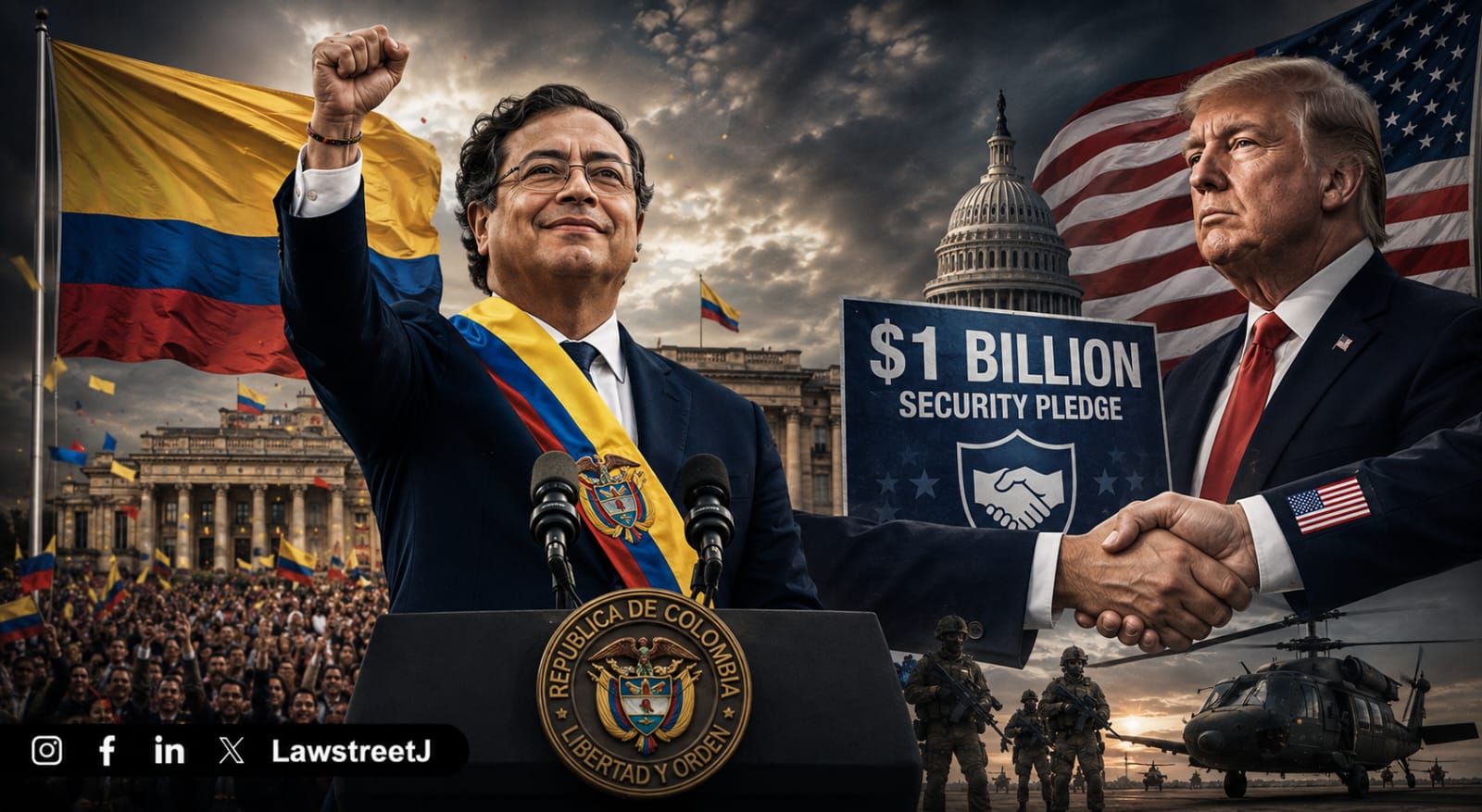
CALI, COLOMBIA — Within hours of Abelardo de la Espriella raising his right hand and taking the oath of office as Colombia's new president, the United States government announced that it intended to pledge one billion dollars in security assistance to his incoming administration, one of the fastest and most publicly declared expressions of American support for a foreign government in recent memory. The announcement, made by the US State Department on Friday evening, transformed de la Espriella's inauguration day into the opening act of a diplomatic realignment that reverses years of bitter acrimony between Bogotá and Washington with a single, billion-dollar handshake.
The US State Department said on Friday that it planned to announce a $1 billion security package for new Colombian President Abelardo de la Espriella's right-wing administration. In a press release, the office of the spokesperson for the department said the package aimed to help Washington and Bogotá achieve "our shared goals."
De la Espriella was sworn in as president on Friday in a ceremony attended by a US delegation that included Acting Attorney General Todd Blanche. "The delegation demonstrates US commitment to reinvigorating the US-Colombia relationship and deepening of our shared security and economic partnership," the State Department said.
Also attending the inauguration were US Representative Mario Díaz-Balart and DEA Administrator Terry Cole. "The Trump Administration welcomes Colombia joining the Shield of the Americas and stands ready to support the de la Espriella Administration's efforts to defeat the vicious narcoterrorist and criminal organizations that threaten US, Colombian, and hemispheric security and economic prosperity," the State Department said.
The Inauguration: A Soldier's Ceremony in an Unconventional City
De la Espriella chose not to be inaugurated in Bogotá, the conventional seat of Colombian presidential power. He held his swearing-in at a university in Cali, in Colombia's southwest, a city that has seen some of the country's most severe cartel and gang violence in recent years.
After the ceremony, de la Espriella flew by helicopter to address soldiers at Batallón Pichincha in Cali. The US-backed 48-year-old flew by helicopter to address soldiers in a military garrison after his inauguration in the southwestern city of Cali.
Calling himself "The Tiger," he vowed to "defeat narco-terrorists" in his first presidential speech at a military garrison in Cali.
The symbolism was impossible to miss. A new Colombian president, on his first day in office, choosing a military garrison over a government palace as the venue for his defining speech, delivering those remarks to hundreds of soldiers in uniform, adopting the military salute he had made a campaign trademark. This is what a policy break looks like when it has been made deliberately theatrical.
He pledged to "relentlessly defeat narco-terrorism," adding that "the option of dialogue is completely exhausted", a reference to the former administration's spluttering peace talks with guerrillas. "There will be no room for manoeuvres that undermine the stability of the nation," he told the soldiers.
What De la Espriella Has Promised: Mega-Prisons, Jungle Strikes, and US Troops
The policy programme de la Espriella outlined on inauguration day is a comprehensive reversal of the approach taken by his predecessor Gustavo Petro, who had pursued negotiated peace with armed groups. The incoming president's agenda is, by contrast, built around enforcement, military action, and deep alignment with Washington.
At his swearing-in, de la Espriella broke with Petro's negotiated-peace strategy toward armed groups, declaring that "the option of dialogue is completely exhausted" and pledging to "relentlessly defeat narco-terrorism." He also committed Colombia to joining the Shield of the Americas, the US-backed regional counter-cartel coalition that grew out of a March 2026 summit hosted by the Trump administration, and pledged to strengthen state-run Ecopetrol and pursue "responsible and sustainable fracking" to shore up the country's oil and gas reserves.
The new president has also proposed allowing US troops to operate from Colombian territory, bombing cocaine laboratories hidden in the jungle, constructing "mega-prisons" and reducing the size of government.
The proposal to allow US military forces to operate on Colombian soil is the most geopolitically significant element of the new president's platform. Colombia is a sovereign nation that has long been sensitive about foreign military presence on its territory, a sensitivity rooted in its history with both American intervention and the long shadow of its own internal armed conflicts. De la Espriella's willingness to offer the US a footprint inside Colombia reflects both the depth of his ideological alignment with the Trump administration and the severity of his assessment of what it will take to defeat the criminal organisations operating across the country.
The "mega-prisons" proposal echoes similar initiatives adopted in other Latin American countries, most notably El Salvador under President Nayib Bukele, who has become a regional model for the Trump administration's preferred approach to gang and cartel suppression. The plan to bomb cocaine laboratories in the jungle represents a kinetic escalation from the crop eradication programmes that have characterised US-Colombia counter-narcotics cooperation for decades.
The Shield of the Americas: A Regional Architecture Taking Shape
Colombia's announced accession to the Shield of the Americas on day one of de la Espriella's presidency is the most concrete institutional action he has taken so far and it places Colombia inside a regional security framework that the Trump administration has been actively constructing since a March 2026 summit.
The Shield of the Americas is a US-backed counter-cartel coalition aimed at coordinating regional governments in the fight against transnational narco-trafficking and criminal networks. Colombia's membership, given that it is the world's largest cocaine producer and the source of a significant proportion of the drugs entering the United States, transforms the Shield from a framework to a functioning operational alliance.
The US has become increasingly involved in Latin America during Trump's second term in the White House, carrying out strikes on alleged drug-trafficking boats coming from the region and launching an operation to capture former Venezuelan leader Nicolás Maduro. Maduro has since been held in custody in New York on charges including narco-terrorism and drug trafficking to which he has pleaded not guilty.
The trajectory from the strikes on drug-trafficking boats to the capture of Maduro to the $1 billion package for de la Espriella represents a coherent and escalating US strategy toward Latin America under Trump, one in which military and law enforcement tools are deployed in coordination with political alignment with right-wing governments across the hemisphere.
From Sanctions to a Billion Dollars: How Colombia Got Here
The $1 billion pledge is not merely a statement of policy. It is a dramatic reversal of a bilateral relationship that had, within the past year, hit one of its lowest points in decades.
Washington intends to provide $1 billion USD in security assistance to his new government, capping a stunning reversal in a bilateral relationship that a year earlier had produced sanctions against a sitting Colombian president, a revoked visa, and a call from the presidential palace for American soldiers to disobey their commander-in-chief.
Former President Gustavo Petro was Colombia's first leftist president, and his tenure produced a sustained and public deterioration in US-Colombia relations. The Trump administration placed Petro on the SDN, Specially Designated Nationals list, effectively imposing personal sanctions on a sitting head of state. His visa was revoked. From Bogotá, the presidential palace issued calls for American soldiers to disobey orders.
Petro remained on the SDN list, and was still lobbying for his own removal from it as late as early July 2026, when he asked Trump by phone to lift the designation on him.
That context makes the speed and scale of the US response to de la Espriella's inauguration all the more striking. One administration produces sanctions, a revoked visa, and a public breakdown. The next administration produces a billion-dollar security package within hours of taking office.
After four years of diplomatic spats with the US, Trump now has an eager ally in Bogotá. Colombia has been the United States' top ally in counternarcotics and one of its most important trade partners in the Western Hemisphere. However, that relationship took a sharp turn during former President Gustavo Petro's administration, the first leftist president in the country's history.
Who Is Abelardo de la Espriella?
The far-right lawyer Abelardo de la Espriella was sworn in as president of Colombia on Friday amid tight security. His mandate marks a sharp turn right for the Andean nation, with the 48-year-old keen to cozy up to Washington and come down hard on Colombia's patchwork of armed groups.
De la Espriella is a lawyer by training who became one of Colombia's most prominent right-wing voices in the years following the 2016 peace agreement with the FARC guerrilla group, an agreement he consistently opposed. He won the June 21, 2026 presidential election against leftist candidate Ivan Cepeda. During the campaign, he echoed many of Trump's domestic and foreign policy positions, praised the American president publicly, and positioned himself as the candidate who would restore Colombia's alliance with Washington.
He has adopted on the campaign trail a stiff military salute, a gesture he carried into his inaugural address. His campaign nickname, "The Tiger," signals the political persona he is consciously projecting: aggressive, confrontational, and unapologetic about his willingness to use force.
His proposal to allow US troops to operate from Colombian territory marks the beginning of what both he and the Trump administration clearly intend to be a close and mutually reinforcing security partnership with the $1 billion pledge as the first tangible expression of that intention.



.jpeg)