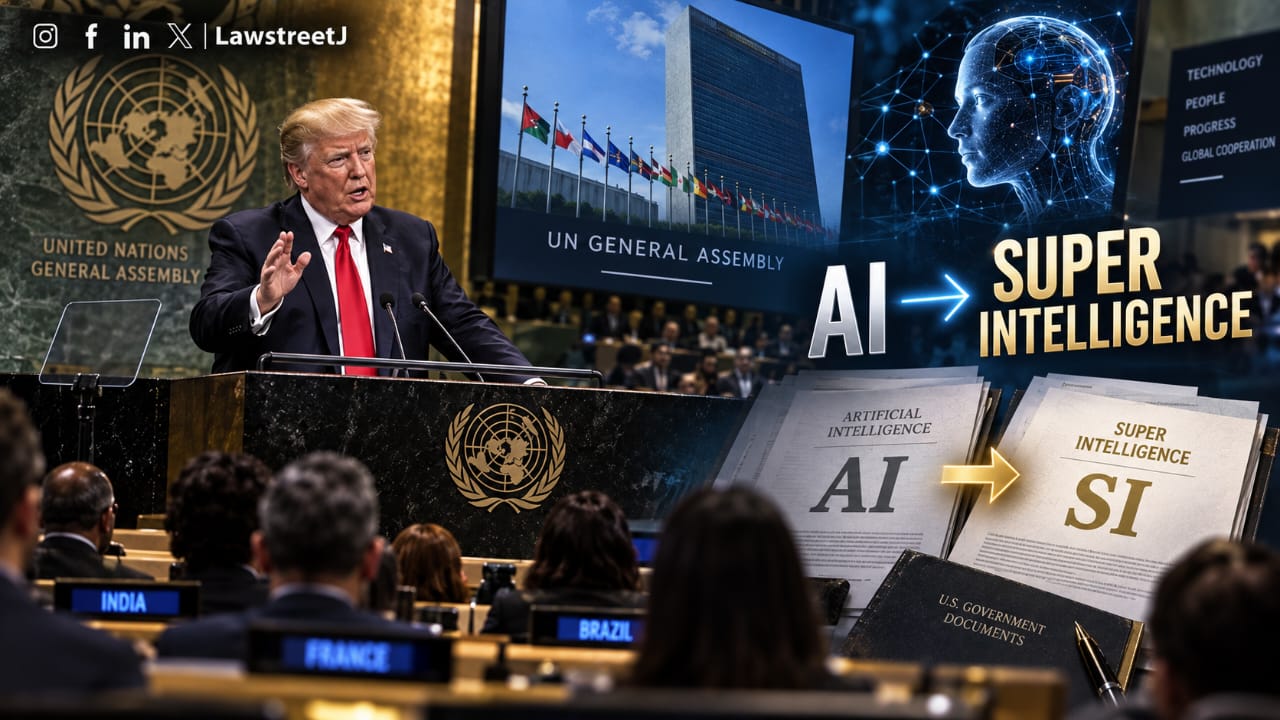
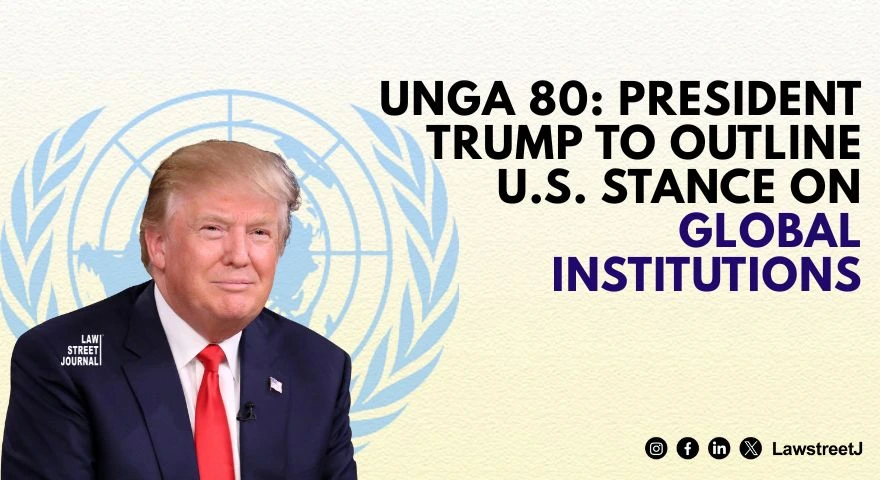
NEW YORK — Donald Trump stood at the United Nations podium on Tuesday, September 22, 2026, and announced he was changing the name of one of the most consequential technologies of the century, by presidential decree, more or less on the spot.
"From this point forward, all of United States documents and hopefully the world's will be changed to use the much more accurate term super as opposed to artificial," Trump told the General Assembly. "So it's super intelligence." He didn't stop at the announcement either. He explained his reasoning in the same breath, "The use of the word artificial makes intelligence sound fake. It is not fake. It's actually amazing." Then, almost as an afterthought, he added a line that undercut his own point a little: "But we have to be careful. In fact, it is exactly the opposite of what it purports."
A Rocky Start Before the Rebrand Even Landed
Before Trump got to the AI announcement, the speech had already gone somewhat off-script, literally. According to PBS and multiple other outlets covering the address, Trump opened by revealing his teleprompter wasn't working. "I don't mind making this speech without a teleprompter, because the teleprompter is not working," he told the assembly, adding that whoever was operating it was "in big trouble," a line that drew laughs from the hall. He also referenced a separate malfunction, an escalator that stalled midway up on his way into the UN building, joking that if First Lady Melania Trump "wasn't in great shape, she would've fallen," before noting the teleprompter came back online partway through his remarks.
Once the technical hiccups were out of the way, Trump moved through a wide-ranging address touching on the war with Iran, pressure on other nations to isolate Tehran economically, a deal expanding the US military presence in Greenland, and a warning to Cuba that "fundamental change" was coming following negotiations between Secretary of State Marco Rubio and Cuban officials. It was against that backdrop, roughly midway through, that Trump pivoted to what would become the speech's most widely quoted moment.
Here's where things get technically tangled. Superintelligence isn't a term Trump invented, it's already a well-established concept in AI research, referring specifically to a hypothetical form of artificial intelligence that surpasses human cognitive ability across virtually every domain. Philosopher Nick Bostrom wrote an entire book on the subject back in 2014, titled simply "Superintelligence: Paths, Dangers, Strategies," and it's widely considered one of the most influential texts in the field's safety literature. Bostrom's book, notably, isn't a celebration of the concept, it's a warning about it.
That existing meaning makes Trump's rebrand something of a definitional collision. He's not proposing a new name for AI broadly, he's taking the term researchers already use for the most advanced, most theoretically dangerous form of AI, and applying it to the technology category as a whole. As Axios put it plainly in its coverage, "Trump wants to drop the 'A' in AI." Whether federal agencies, let alone the rest of the world, actually adopt "SI" in place of "AI" going forward remains to be seen, and Trump himself seemed to anticipate some resistance, telling the assembly he was "not going to stifle growth of something that will be bigger than the industrial revolution."
Rejecting Global Oversight, and Timing That Raised Eyebrows
The name change wasn't really the point, if you read past the headline. Trump used the moment to make a considerably more consequential policy argument, that the United States would not accept international efforts to regulate or govern AI development. "The United States also totally rejects any attempt to construct a globalist scheme to control... artificial intelligence," he told delegates, before pivoting into the renaming announcement itself.
He was explicit about what that rejection meant in practice. "I'm not going to stifle growth of something that will be bigger than the industrial revolution," Trump said, adding, "we will only encourage super intelligence. We're going to encourage it, not rein it in." He framed the stakes in blunt competitive terms too, "Whoever wins super intelligence wins. That's the group that wins. And we're leading now over China by a lot and everyone else. And we're going to keep it that way."
The timing of that framing landed awkwardly against events unfolding elsewhere in Washington. Just days before Trump's speech, AI pioneer Geoffrey Hinton had told US senators that Congress has roughly a year to act on AI risk, and a former Anthropic researcher had separately warned that advanced AI could pose an existential threat to humanity, concerns that had been feeding an active debate in Washington over regulation.
Earlier the same month, Senator Bernie Sanders and Representative Greg Casar had introduced the Ban Artificial Superintelligence Act, legislation that would specifically outlaw the very category of system Trump's speech had just made the administration's official terminology for all of AI, a coincidence in vocabulary that several outlets covering the speech noted pointedly.
Dismissing the Warnings Directly
Trump didn't just reject regulation abstractly, he took a direct shot at the researchers and public figures raising safety concerns. According to PBS, he dismissed most warnings about AI's risks to humanity by comparing them to prior warnings about global warming, suggesting the same voices had cried wolf before and shouldn't be trusted now.
That framing put him at odds not just with domestic critics like Hinton, but with an active UN-affiliated effort already underway, the Independent International Scientific Panel on AI, which published a preliminary report in July as part of broader United Nations work toward international AI governance frameworks, work Trump's speech effectively declared the US wants no part of.
One more detail complicated how this speech actually got covered back home. According to PBS's Associated Press-sourced reporting, the White House press pool declined to cover Trump's remarks in protest of his recent ban on certain news outlets from the White House, a dispute that had been simmering since Trump's announcement earlier in September that he was barring CNN, MS NOW and Politico from the building over what he called "fake news" coverage. That standoff meant some of the usual pool reporting infrastructure covering a major presidential UN address wasn't functioning normally on the day of the speech itself, adding a layer of friction to an already eventful address.
As of this week, Trump's directive that US government documents adopt "super intelligence" in place of "artificial intelligence" remains, in practical terms, a stated intention rather than a codified policy with a clear implementation timeline.
Whether federal agencies formally shift their terminology, and whether any other country follows Washington's lead, as Trump expressed hope they might, is likely to become clearer only as officials work through what, if anything, actually changes on paper. For now, the moment has mostly registered as exactly what dominated headlines within hours of the speech: an American president renaming one of the world's most consequential emerging technologies from the floor of the United Nations, while explaining that the old name simply sounded too fake for something he considers very real.




.jpeg)