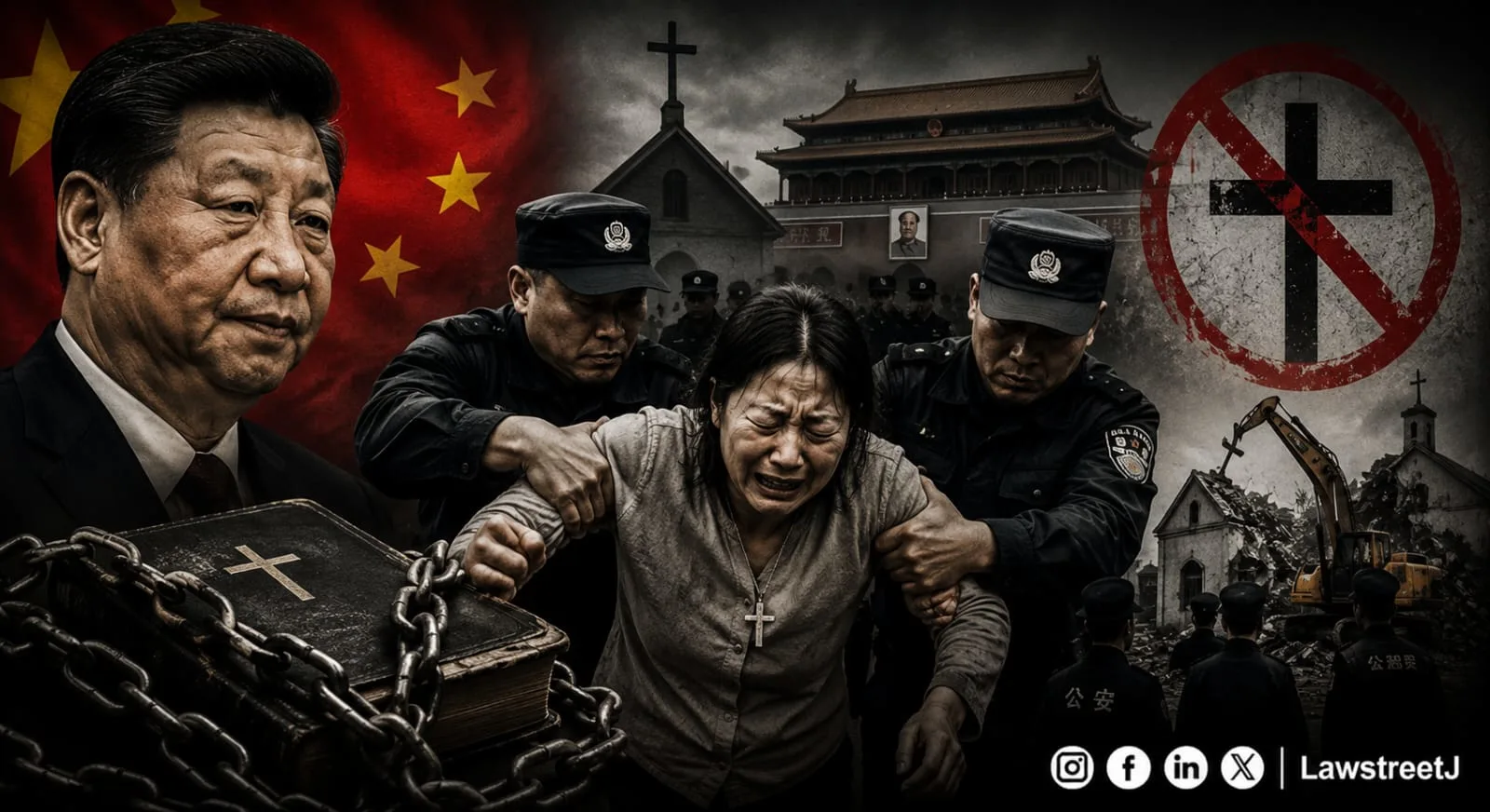
Beijing / Chengdu / Beihai | At 2 a.m. on October 11, 2025, Chinese police stormed homes across Beijing and several other cities simultaneously. They handcuffed pastors and seized Bibles in coordinated raids on the Zion Church network, one of the country's largest unregistered Protestant communities. Founder Pastor Jin Mingri, known as Ezra Jin, was taken into custody at his residence in Beihai, Guangxi Province. He joined nearly thirty other leaders detained on charges of illegally using information networks to disseminate religious content.
Seven months later, on May 21, 2026, eighteen of those leaders, including Pastor Jin, remain held in Beihai City No. 2 Detention Center. Chinese authorities have extended their pre-trial detention and increased pressure on the lawyers who represent them.
That October night was not an isolated incident. It was the opening move in what rights organisations, journalists, and legal scholars are now describing as China's most severe crackdown on Christianity in at least seven years, a campaign that has since expanded its targets to include children attending Sunday services, lawyers representing detained Christians, and worshippers accessing sermons online.
What Is Happening: The Documented Cases
The scale and coordination of the current enforcement campaign distinguish it sharply from the routine pressure that unregistered Christian communities in China have faced for decades. Over the past six months, Beijing has arrested hundreds of leaders and practitioners of Protestant "underground churches," including Early Rain Covenant Church in Chengdu, Yayang Church in Wenzhou, and Beijing Zion Church, with arrests across several cities. Zion Church pastors have since been charged with "illegally using information networks" and the lawyers representing them are facing threats in a mounting pressure campaign.

Pastor Wang Lin of Zion Church was detained in the dead of night while travelling to the southern city of Shenzhen. Other figures in the church, which has dozens of branches across China, went into a state of high alert, frantically trying to figure out what this would mean for their community of around 5,000 members.
The Chengdu-based Early Rain Covenant Church, which has been one of the most systematically targeted unregistered congregations in China, was raided again in early 2026. Police raided the home of the church's leader Li Yingqiang and took him into custody. Other key members were also reportedly detained, and two additional congregants were summoned by authorities. The church's founding pastor Wang Yi remains in custody for "inciting subversion of state power" and running "illegal business operations", a sentence handed down after his arrest in December 2018, when police detained over 100 congregants in a coordinated overnight raid.
Rights groups say the crackdown now extends beyond pastors and church buildings to children attending services, lawyers representing detained Christians, and online worshippers, as President Xi Jinping's government tightens control over religious life under its long-running Sinicisation campaign.
The expansion to children is among the most disturbing documented developments. Regulations introduced over the past year prohibit minors from receiving religious education, a prohibition that applies not merely to formal religious schools but to parents teaching their own children faith at home and to children attending church services. Enforcement of this provision has been reported across multiple provinces.
The resolution, pending legislation in Washington, and diplomatic exchanges have kept religious freedom at the centre of American policy toward China. As long as Pastor Jin and his fellow leaders remain behind bars, the world has both reason and obligation to speak, according to advocates.
What Is the Sinicization Policy and How Did It Get Here
To understand why these arrests are happening, the policy framework driving them must be understood.
Xi Jinping popularised the term "religious Sinicization" and mobilised official resources and state personnel to enforce it. Over the years, the CCP has regularly updated laws and regulations to codify repressive practices, providing a legal basis for persistent waves of incarcerations, disappearances, surveillance, threats and intimidation.
The "Sinicisation" campaign, introduced in 2015, requires religious groups to conform to state ideology and prioritise loyalty to the CCP. Measures have included censorship of sermons, monitoring of donations, oversight of religious texts, and the integration of political doctrine into religious education. Authorities have also closed or demolished places of worship operating outside state control, while encouraging or compelling religious groups to join official institutions.
Supporters inside the government argue the policy promotes national unity, reduces foreign influence and ensures religious organisations comply with Chinese law. Critics say it has become a mechanism for political control that restricts religious freedom guaranteed under international human rights standards.
China officially permits religious practice through five state-approved religions, Buddhism, Taoism, Islam, Catholicism, and Protestantism, but only through state-controlled institutions. The government requires that Protestants worship only in churches recognised and regulated by the Three-Self Patriotic Movement. Even within that framework, the officially atheist ruling Communist Party has been seeking to rein in religious expression, including removing crosses from official and unofficial churches.
The distinction between registered and unregistered practice is the central legal fault line. Underground or "house" churches, congregations that refuse to register with the state on grounds that registration requires submitting to Communist Party doctrinal oversight of their sermons, leadership, and membership, have no legal status under Chinese law and are therefore subject to enforcement action under provisions covering illegal religious activity, illegal assembly, illegal use of information networks, and increasingly national security.
The Legal Charges: From "Illegal Religious Activity" to National Security
The charges being used against detained Christians have escalated in legal severity over the past two years. Earlier enforcement waves typically used administrative law provisions covering unregistered religious activity, charges that carried fines and short detentions but not long prison sentences. The current wave is using criminal law provisions that carry significantly heavier consequences.
Under President Xi Jinping's policy of "sinicizing" religion, restrictions on Christians, Tibetan Buddhists and Muslims have intensified, including the demolition of unsanctioned churches, bans on online religious content, and confiscation of unauthorised religious materials.
The charge of "illegally using information networks to disseminate religious content", applied to both Zion Church and Early Rain leaders, targets the use of social media, livestreaming, podcasting, and digital communication to conduct worship or share religious teaching. Police raids, surveillance and legal restrictions have intensified, while regulations introduced over the past year have sharply limited online preaching and religious education. This charge effectively criminalises any digital religious activity that occurs outside state-approved channels.
Charges of "inciting subversion of state power", used against Early Rain's founding pastor Wang Yi, are the most serious category and carry potential sentences of up to fifteen years or more. They represent a deliberate escalation from administrative to criminal treatment of religious leadership, signalling that the state views the most prominent unregistered church leaders not as civil violators of registration requirements but as political threats to state authority.
High-profile churches such as Beijing's Zion Church and Chengdu's Early Rain Covenant Church have faced repeated enforcement actions over recent years, with several pastors imprisoned or detained. The case of Zion Church founder Pastor Jin illustrates the escalation.
The International Response: Washington and the Vatican
The detention of Pastor Jin Mingri drew a rare public intervention at the highest level of American diplomacy. President Trump raised the pastor's case in his meetings with Xi Jinping at the May 2026 summit. Afterward, aboard Air Force One, Trump told reporters that Xi had given the matter very serious consideration and would strongly consider the release. That public acknowledgment marked a rare moment of direct engagement on religious persecution at the highest level. Yet as of May 21, Pastor Jin and the other leaders remain in detention.
Secretary of State Marco Rubio demanded the release of the Zion church leaders and called on the Chinese government to "allow all people of faith, including members of house churches, to engage in religious activities without fear of retribution."
The US Commission on International Religious Freedom has called for China to be designated as a "country of particular concern" and subject to Magnitsky sanctions. China's status as a Country of Particular Concern, a formal designation under the US International Religious Freedom Act, already carries certain sanctions implications, and advocates are pushing for those measures to be applied more stringently in light of the current crackdown.
Catholics loyal to the Vatican have also been forced underground. The Catholic Church in China has found itself in Beijing's crosshairs, with worshippers loyal to Rome targeted alongside Protestant underground congregations. The Vatican's 2018 and 2020 agreements with Beijing on the appointment of Catholic bishops, controversial within the Church for conceding a degree of Chinese government involvement in leadership selection, have not provided protection for Catholics who refuse to worship within the Chinese Patriotic Catholic Association.
Christianity in China: Scale, History, and Resilience
The size of China's Christian population makes the stakes of this crackdown unusually significant. Estimates of China's total Christian population range from 70 million to over 100 million, making it one of the largest Christian communities in the world by absolute numbers despite being a small percentage of the country's 1.4 billion people. The majority of Chinese Christians worship outside state-approved institutions, either in completely unregistered house churches or in the grey zone of partially registered congregations that maintain theological independence while accepting some administrative state oversight.
Despite growing repression, many congregations continue to face disruption, with members detained and leadership targeted, but independent religious communities defy the Communist Party's control. Observers say authorities often attempt to build cases against church leaders through financial or administrative allegations. Pressure on religious groups has increased significantly since President Xi Jinping took office in 2012.
The current campaign signifies not only the legal vulnerability of these groups, but also the persistent social appeal of worshipping outside of state oversight and the expanding campaigns of state repression and assimilation. Underground congregations have adapted repeatedly to enforcement pressure, meeting in rotating locations, moving sermons to encrypted messaging apps, breaking large congregations into small cells of ten or fewer members that are harder for authorities to detect. The Zion Church, with its 5,000 members and dozens of branches, represented an unusually large and visible target precisely because of its scale.
The resilience of China's underground Christian communities in the face of successive enforcement campaigns across four decades of CCP rule suggests that the current crackdown, however severe, is unlikely to extinguish the communities it targets. But the human cost of that resilience, measured in the pastors in detention, the Bibles seized, the children barred from Sunday school, and the lawyers threatened for doing their jobs is being paid in full and in real time by men and women whose names the world is only beginning to know.