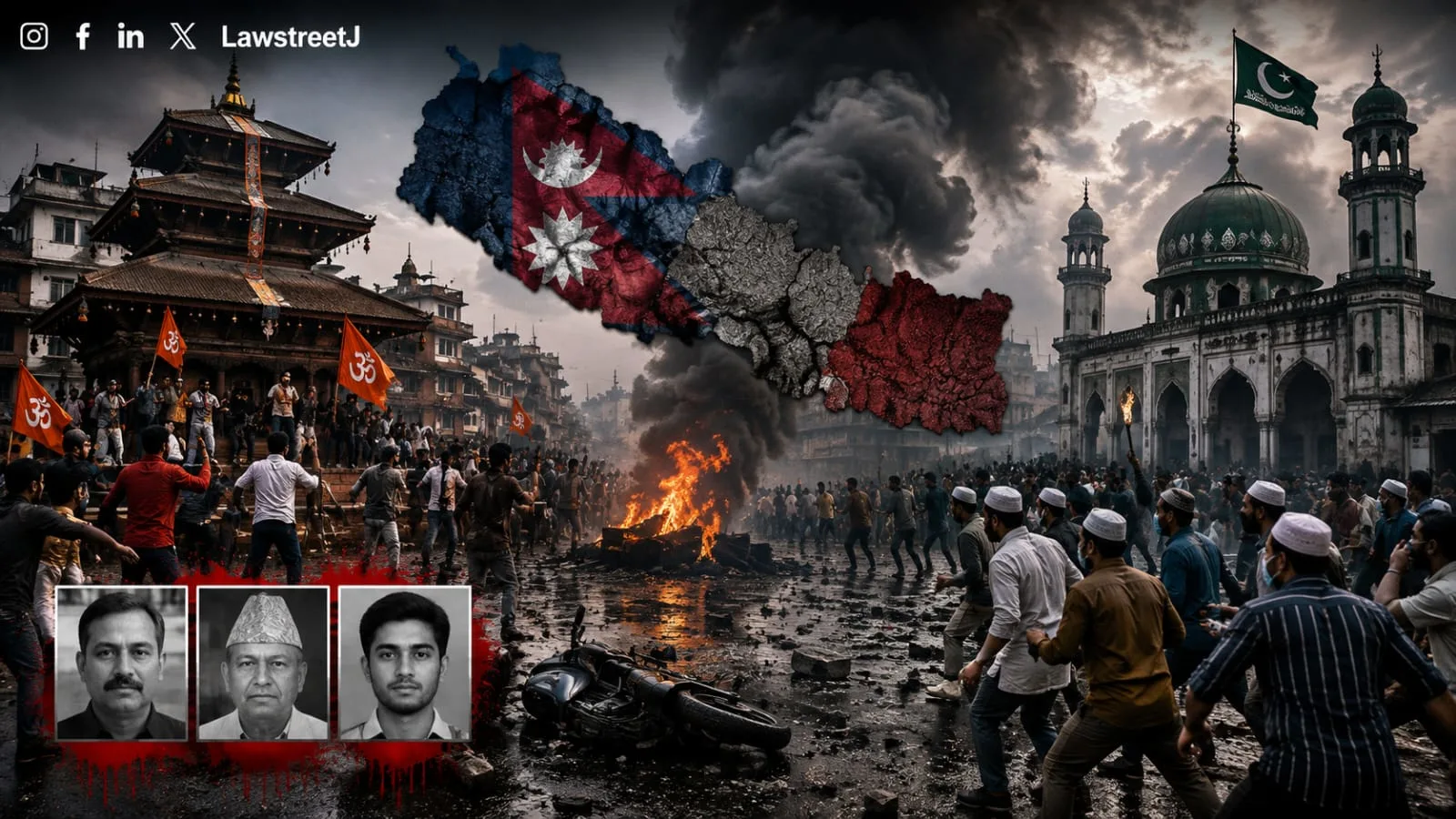
Kathmandu: What began as a dispute over a DJ sound system on a Sunday night in a small municipality bordering India's Bihar has, within days, spiralled into the most serious episode of communal violence Nepal has witnessed in years. Three people are dead. Dozens are injured. Curfews are in force across multiple districts. The Army and Armed Police Force are patrolling the streets. And Nepal's Prime Minister took four full days to address the nation, a silence that has since become as contested as the violence itself.
The violence erupted on the night of July 26, 2026, in Diwanganj, a town in Nepal's Sunsari district bordering India, after a late-night clash between Hindus and Muslims. Officials said the dispute was triggered by loud music and religious flags during a Hindu event. What followed that initial confrontation spread far beyond Sunsari, pulling in neighbouring districts, exposing institutional failures, and raising fundamental questions about how Nepal, a country where Hindus and Muslims have coexisted for centuries, has arrived at this point.
The victims who lost their lives have been identified as Ganesh Yadav, Om Prakash Mehta, and Jay Prakash Mehta. Approximately two dozen people sustained injuries during the unrest.
How the Violence Began and Spread
On the night of July 26, 2026, Hindu devotees in Kaptanganj of Dewanganj Rural Municipality, Sunsari, were moving toward the Koshi Barrage carrying holy water for the Bolbam ritual, the Nepali equivalent of India's Kanwar Yatra. A disagreement over the DJ sound and religious flags led to an altercation, which escalated into violent clashes involving stone-pelting between the two communities.
Police opened fire to disperse the clashing groups. Two men were shot and killed in Sunsari on Sunday, and a third death was reported in neighbouring Siraha district on Thursday as sporadic clashes continued in the area.
The violence did not stay contained. The unrest spread from Sunsari to parts of Saptari, Siraha, Dhanusha, and Parsa, prompting curfews, fresh protests, and heightened security deployment. Several vehicles, shops, and other private properties were damaged in the violence. The violence reached parts of Madhesh Province, including Dhanusha and Siraha districts. Photographs verified by Reuters showed smoke and fire rising from a mall that was vandalized and set ablaze in Siraha on July 30.
The Armed Police Force and Nepal Army personnel were deployed in several areas to maintain order. Authorities also used air surveillance to monitor sensitive areas.
On July 30, a massive protest was organised by several Nepali Hindu organisations in Janakpurdham. Protesters jammed key areas of the city, raised slogans, and burned effigies of the Nepali Prime Minister and Home Minister. Local police intervened using tear gas and subsequently imposed a curfew in the area to prevent further escalation.
A Pattern That Did Not Begin in July
The Sunsari incident did not emerge in isolation. Nepal's southern districts have experienced a recurring pattern of communal friction throughout 2026, and the institutional response to each earlier episode set the stage for the one that followed.
The year 2026 itself began with a communal clash in Birgunj over an allegedly provocative TikTok video shared by two Muslim youth. On January 4, the duo was corralled by local Hindus and handed over to the police, but that did not alleviate tensions. Hindus vandalized a mosque and Muslim households in Dhanusha and Parsa districts, allegedly even burning copies of the Quran. The violence and arson spread across the two districts, leading local administrations to institute a curfew.
On January 26, a clash broke out in Paroha Municipality of Rautahat district over a Hindu procession that was attempting a ritual immersion of a Saraswati idol. Each of these incidents followed a similar arc, a local dispute, rapid escalation, security deployment, a curfew, and a return to fragile calm, without addressing the structural conditions that allowed the spark to travel so far so fast.
In January 2026, then Home Minister Om Prakash Aryal mandated the creation of a District Peace and Social Harmony Committee that would include members of all religious communities. So far, it appears only a handful of districts like Rupandehi, Dang, Sarlahi, and Parbat have created these committees. By the time the Sunsari violence broke out in July, the committees that were supposed to serve as early intervention mechanisms existed in name only across most of the country's districts.
Hindus make up about 80 per cent of Nepal's population, but the country's south has sizeable Muslim populations. The Terai and Madhesh region along the Indian border has historically been home to both communities, and documented accounts of inter-communal coexistence over generations sit uncomfortably alongside the recurring nature of the clashes in 2026. Analysts have pointed to the role of social media, cross-border information flows, and a lack of local dialogue infrastructure in converting manageable local disagreements into district-wide crises.
The Government's Response: Delayed, Criticised, and Contested
The government's handling of the Sunsari violence has attracted as much scrutiny as the violence itself and in some quarters, more.
Restrictive orders were imposed in Sunsari the day after the first deaths, yet the Home Minister reached the district only several days later, having earlier sent a personal assistant. Prime Minister Balendra Shah issued a Facebook post two days into the crisis and delivered a full national address only on the evening of July 30, four days after the initial violence.
Three days after deadly clashes in Dewanganj, residents and opposition leaders questioned the government's response as curfews and high security persisted. Prime Minister Balendra Shah and Home Minister Sudan Gurung faced mounting criticism for not visiting the affected area. With curfews still in place and security personnel maintaining a heavy presence, residents said the absence of the country's top political leadership deepened public frustration at a time when communities were struggling to restore calm.
The Prime Minister's personal connection to the region makes the silence harder to explain. Shah hails from the Madhesh region, the smallest and most densely populated southeastern province of the country, bordered by India's Bihar and is now under fire over his apparently late reaction to the developing situation.
Critics said Prime Minister Balendra Shah and Home Minister Sudan Gurung failed to provide timely political leadership, neglected dialogue with stakeholders, and relied primarily on security measures instead of preventive intervention.
The vacuum left by the government's inaction was filled by other political actors. As tensions escalated, the initiative to convene all-party discussions was taken by Rastriya Swatantra Party Chairman Rabi Lamichhane, who consulted leaders, met President Ram Chandra Paudel, held talks with his party's Madhesh MPs, and publicly urged restraint while calling for an impartial probe. PM Shah was expected to hold consultation with lawmakers from the affected area, but that did not happen.
Participants at those discussions complained that the government's engagement with affected communities had been inadequate and that victims' families had not received the support they expected from the state.
When the Prime Minister finally addressed the nation on July 30, the words were measured. Shah appealed for unity and social harmony, urging citizens to show restraint. He promised a "completely fair and transparent" investigation, adding that those responsible would be brought to justice. He appealed to every citizen to reject rumour, refrain from hate speech on social media, and protect social harmony. He warned that anyone found inciting violence would face legal consequences.
Home Minister Sudan Gurung met the families of the two killed in Sunsari and agreed to provide about $6,660 in relief to each family. The government said the Home Minister was expected to visit neighbouring districts as well.
Nepal's police, meanwhile, defended its conduct in the field. Police spokesperson Kafle told reporters: "We have kept all police officials in the field on alert and are trying to protect public property and prevent any conflicting situation with minimal use of force."
An Institutional Crisis Laid Bare
The unrest reportedly stemmed from disagreements over loudspeakers and religious flags during a procession, but the rapid escalation highlighted significant shortcomings in local conflict resolution mechanisms. While curfews and security deployments have helped restore a measure of order, the incidents have underscored deeper questions about governance, communal relations, and institutional preparedness in Nepal's southern districts.
An investigation committee has been formed, and the National Security Council met. Yet many Madhesi lawmakers and civil society voices argued that visible leadership arrived only after the damage had already spread across four districts.
The facts of the Sunsari episode leave two realities standing side by side. The first is that three people are dead, dozens are injured, and communities that have shared the same geography for centuries are now separated by curfew lines and security cordons. The second is that the institutional architecture meant to prevent precisely this kind of escalation, the peace committees, the dialogue frameworks, the political presence on the ground, was absent when it was needed most.
There is no question about whether Hindus and Muslims can live alongside each other in Nepal; they have done so for centuries. Disputes are natural, they are the price of living in a diverse community. But local disagreements cannot be allowed to turn into civilisational clashes fanned by bad actors.
The Sunsari violence, and the government's handling of it, has made one thing impossible to ignore: Nepal does not yet have a reliable answer to what happens when those local disagreements catch fire.