Washington D.C. / New Delhi: Today is the day. At 12:01 a.m. on July 24, 2026, the 150-day statutory clock on the Section 122 global import surcharge, the tariff framework the Trump administration assembled in the hours after the Supreme Court struck down its IEEPA tariffs in February, ran to zero. The tariff that has governed 99 percent of US imports since February 24 has now expired by operation of law. Congress did not extend it. No executive order can extend it. It is gone.
What replaces it is not relief. It is a new tariff regime, one grounded in different statutory authority, framed around a different rationale, and carrying no expiry date whatsoever.
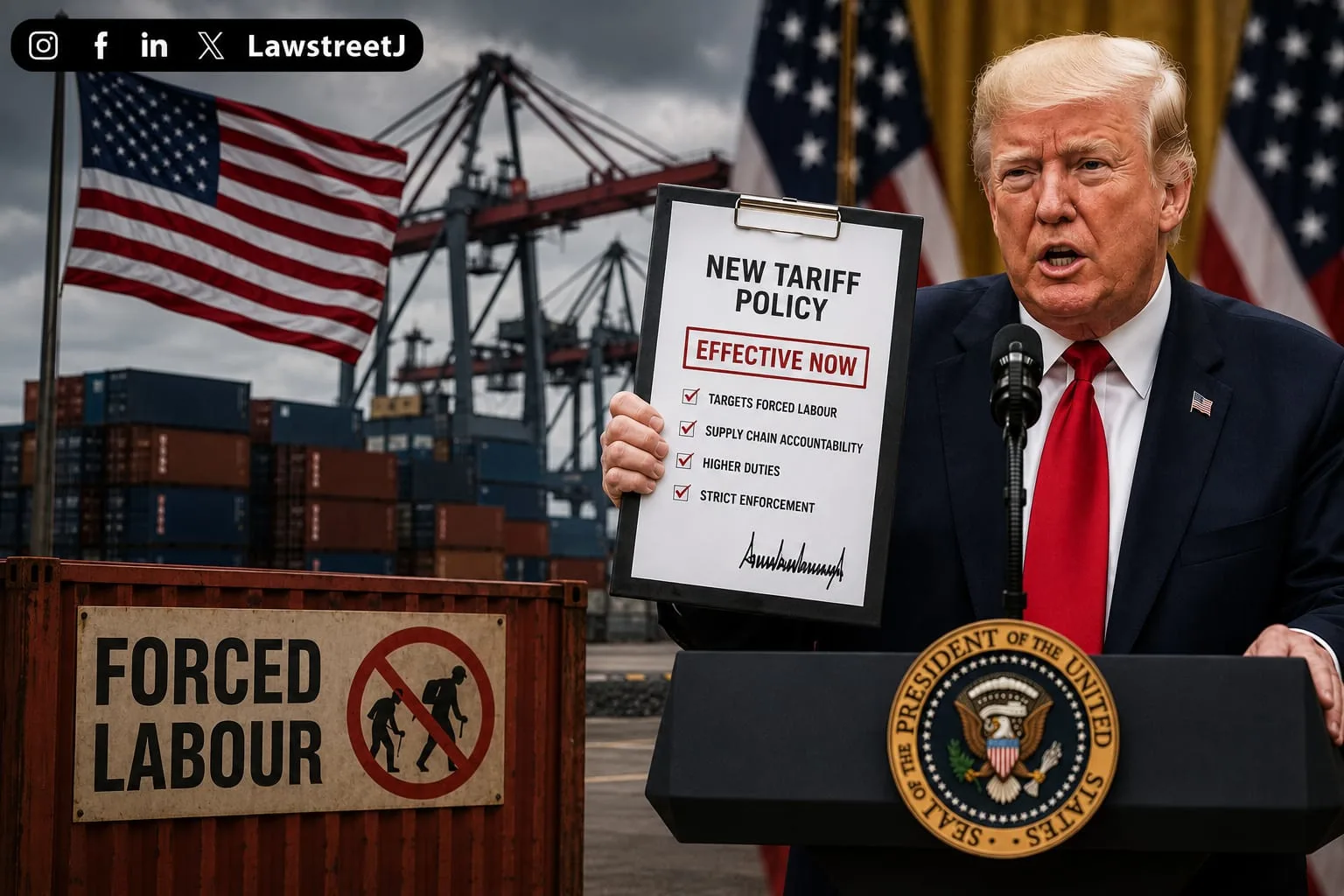
President Donald Trump pressed ahead with new double-digit tariffs on dozens of US trading partners just as the clock ran out on the temporary levies he imposed after a stinging defeat at the Supreme Court. The United States will slap taxes of 10% to 12.5% on imports from 60 countries accounting for 99% of US imports, charging that they have inadequately enforced bans on goods produced by forced labour. The new tariffs take effect just as temporary 10% worldwide tariffs expire.
India is among the 17 countries in the 10 percent category. Forty-three others face 12.5 percent.
What Is the Legal Basis: Section 301 and the Forced Labour Investigation
On June 2, 2026, the Office of the United States Trade Representative issued the notice of determinations and proposed responsive actions in the Section 301 investigations of "Acts, Policies, and Practices of Various Economies Related to the Failure to Impose and Effectively Enforce a Prohibition on the Importation of Goods Produced with Forced Labor," covering 60 economies. USTR determined that the identified acts, policies, and practices are unreasonable and burden or restrict US commerce, and are thus actionable under Section 301(b).
Section 301 of the Trade Act of 1974 authorises the USTR to investigate and respond to foreign trade practices that are unreasonable or discriminatory and that burden or restrict US commerce. It carries no statutory rate cap and crucially and this is the critical distinction from Section 122, Section 301 has no statutory rate cap and no time limit, which is exactly why the administration chose it.
This is the legal architecture of permanence rather than emergency. Section 122 was always a 150-day stopgap. Section 301 is indefinite until the administration decides to remove or renegotiate the tariffs.
USTR proposed additional Section 301 duties, 10% for economies that prohibit but fail to enforce forced-labor import bans and 12.5% for economies with more serious enforcement failures. The public comment period closed July 6. Public hearings were held July 7. The tariffs were finalised and announced by President Trump on July 23, taking effect at midnight.
Why India Got 10% Instead of 12.5%
India's placement in the lower 10 percent tier rather than the higher 12.5 percent category is a specific and consequential diplomatic development.
A senior administration official said the tariff on imports from India initially was set at 12.5% but was reduced to 10% after India tightened forced labour enforcement and qualified for the lower rate.
This means India's government took concrete steps between the June 2 USTR notice and the July 7 public hearing deadline, to demonstrate stronger enforcement of existing prohibitions on goods produced with forced or bonded labour, satisfying the USTR's assessment criteria for the lower rate.
What those steps specifically entailed has not been publicly detailed by either the Indian government or the USTR. But the outcome is directly consequential for Indian exporters: a 10 percent tariff rather than 12.5 percent on most goods entering the United States, with the 2.5 percentage point difference representing tens of millions of dollars annually across India's export basket to the American market.
What Is Covered and What Is Not
The forced labour Section 301 tariffs are broad but carry specific exemptions that distinguish them from the IEEPA "Liberation Day" tariff regime and even from the Section 122 surcharge.
The tariffs cover most US imports but exempt oil, gas, fertilisers, and some food items. This exemption structure is significantly more targeted than the IEEPA tariffs that were struck down in February, the IEEPA regime applied to virtually all goods without energy exemptions.
The energy exemption is particularly significant for India. One of the central elements of the India-US trade framework negotiated earlier this year was India's commitment to purchase American oil and LNG. Because oil and gas are explicitly exempted from the forced labour Section 301 tariffs, India's energy imports from the United States are not subject to the new levy, meaning the trade deal's energy commitments are structurally unaffected by today's tariff change.
Pharmaceuticals and pharmaceutical ingredients were also exempted from the Section 122 tariffs and are expected to carry similar exemptions in the Section 301 framework, a significant protection for India, whose pharmaceutical exports to the United States constitute one of the largest single categories of bilateral trade and whose generic drug manufacturers supply a significant portion of the American generic medicines market.
The Replacement Architecture: Section 122 to Section 301
"As expected, the forced labor tariffs largely replicate current tariff levels as negotiated in various reciprocal trade agreements, and replace the 10% tariffs under Section 122 that expire on Friday," said Tim Brightbill, a trade law partner with Wiley Rein in Washington.
A senior Trump administration official disputed suggestions that the forced labour tariffs were simply a direct replacement for the expiring levies despite the timing, similar duty rates, and vast coverage of nearly all US imports.
The administration's position, that the forced labour tariffs are substantively justified by genuine enforcement failures, not merely a technical mechanism to preserve a tariff level, has important legal consequences. Section 301 tariffs grounded in a substantive USTR investigation and determination are considerably harder to challenge in court than the emergency IEEPA tariffs were. The Supreme Court's February ruling specifically rested on the finding that IEEPA does not authorise tariffs because they are a taxing power vested in Congress. Section 301's authority rests on a different statutory foundation, one that has survived legal challenge before and that the courts have historically treated with greater deference.
For India, this means the tariff environment it must navigate for the foreseeable future is both more stable in its legal grounding and more permanent in its duration than the regime it replaces.
What This Means for India's Exporters
India's major export categories to the United States include pharmaceutical products, textiles and garments, engineering goods, chemicals, gemstones and jewellery, and information technology services. Of these, pharmaceuticals are likely to carry an exemption. IT services are not goods and are therefore not directly covered by any of the tariff frameworks discussed. The remaining categories, textiles, engineering goods, chemicals, gems and jewellery, face the 10 percent forced labour Section 301 tariff from today.
For context, this 10 percent rate replaces a 10 percent Section 122 rate that was itself replacing a 26 percent IEEPA "reciprocal tariff" that the Supreme Court struck down in February. On that basis, the tariff rate actually applicable to most Indian goods entering the United States today is 10 percent, the same rate that has been in place since February 24, but now on a permanent rather than time-limited basis.
The broader India-US trade deal, whose negotiations have been ongoing through this entire tariff transition has not been concluded. The February 2026 framework that reduced tariffs to 18 percent was premised on IEEPA authority that the court subsequently invalidated. The Section 301 forced labour framework does not represent the finalisation of those trade negotiations. It is a tariff baseline from which negotiations continue, not a substitute for a completed agreement.
The Bigger Picture: What Today Means for Global Trade
The United States will impose taxes of 10% to 12.5% on imports from 60 countries accounting for 99% of US imports. The scope of that coverage, virtually the entirety of American imports makes today's tariff change one of the most significant structural shifts in US trade policy in generations.
The 60 countries subject to the forced labour Section 301 tariffs include China, India, Vietnam, Japan, South Korea, Taiwan, Brazil, Mexico, and dozens of others. The EU's goods were separately moved to a trade deal's 15 percent all-inclusive ceiling on July 1, which insulates them from the Section 301 framework. The UK's position under the new Burnham government is currently under active negotiation.
Senator Ron Wyden introduced the Congressional Trade Powers Reform Act on July 22, two days ago, which would repeal Section 122 outright and require congressional approval for future Section 301, 201, and 232 tariffs. That legislation has not passed and faces an uncertain path in the current Senate. But its introduction reflects the continuing bipartisan discomfort with the extraordinary degree of tariff-setting authority that the executive branch has consolidated over the past eighteen months.
For now, the tariffs are here, they are on a permanent statutory footing, and for India the rate is 10 percent. Whether India can negotiate that rate downward or achieve a sector-specific exemption, in the context of the broader trade deal negotiations is the central bilateral trade question that today's announcement has placed at the top of the agenda between New Delhi and Washington.



.jpeg)