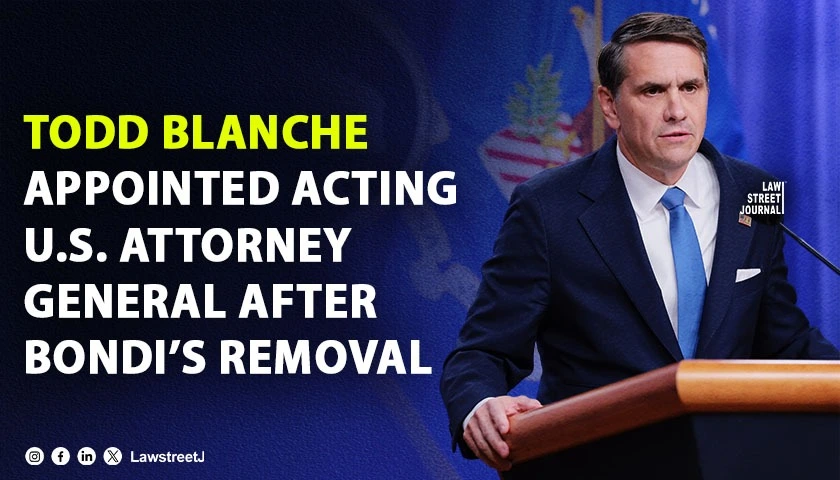
Washington: On April 2, 2026, Donald Trump announced the removal of Attorney General Pam Bondi, citing the need for new leadership at the Department of Justice. Bondi, who had served since March 2025, was a vocal supporter of Trump’s agenda but became the third major figure in his second cabinet to be dismissed. The President immediately elevated Todd Blanche, then serving as Deputy Attorney General, to the role of Acting Attorney General.
Blanche’s appointment comes at a critical juncture, as the Justice Department faces scrutiny over ongoing investigations and the administration prepares for contentious legal battles. His prior role as Trump’s defense attorney during criminal cases between Trump’s first and second terms has drawn attention to the implications of his new position.
Legal Career and Credentials
Todd Wallace Blanche, born in Denver, Colorado, in 1974, is a seasoned attorney with a background in both prosecution and defense. He earned his BA from American University and his JD from Brooklyn Law School.
Blanche began his career as a federal prosecutor in the Southern District of New York, handling cases involving organized crime and financial fraud. In private practice, he became known for representing high-profile clients, most notably Donald Trump, during criminal proceedings that spanned several years. His legal strategy and courtroom presence earned him recognition as a formidable defense attorney. In March 2025, Trump appointed him Deputy Attorney General, where he worked under Pam Bondi until her removal.
Blanche’s political affiliations shifted over time; he was previously aligned with the Democratic Party but formally joined the Republican Party in 2024. His appointment as Acting Attorney General consolidates his role as a trusted legal figure within Trump’s administration.
Legal and Political Implications
Blanche’s appointment raises significant legal and constitutional considerations. As Acting Attorney General, he assumes responsibility for overseeing federal prosecutions, national security matters, and the administration of justice across the United States. His prior representation of Trump in personal legal cases has prompted discussions about conflicts of interest and the independence of the Justice Department.
The U.S. Constitution and federal statutes allow the President to appoint an acting official without immediate Senate confirmation, but a permanent Attorney General must eventually be confirmed. Blanche’s interim role positions him as a potential nominee for the permanent post, though such a nomination would likely face intense Senate scrutiny.
Bondi’s removal underscores the volatility within Trump’s cabinet. Her exit follows mounting tensions over policy direction and legal strategies. Blanche’s appointment signals a shift toward consolidating Trump’s legal team within the Justice Department, potentially aligning prosecutorial priorities with the President’s broader agenda.
Todd Blanche’s rise to Acting Attorney General represents a pivotal moment in U.S. governance. His dual background as a prosecutor and defense attorney, combined with his close ties to President Trump, places him at the center of legal and political debates. The Justice Department now faces questions about independence, impartiality, and the future of federal law enforcement under Blanche’s leadership.
As the search for a permanent Attorney General begins, Blanche’s tenure will be closely watched by legal experts, lawmakers, and the public. His decisions in the coming months will shape the trajectory of the Department of Justice and test the balance between presidential authority and judicial independence.