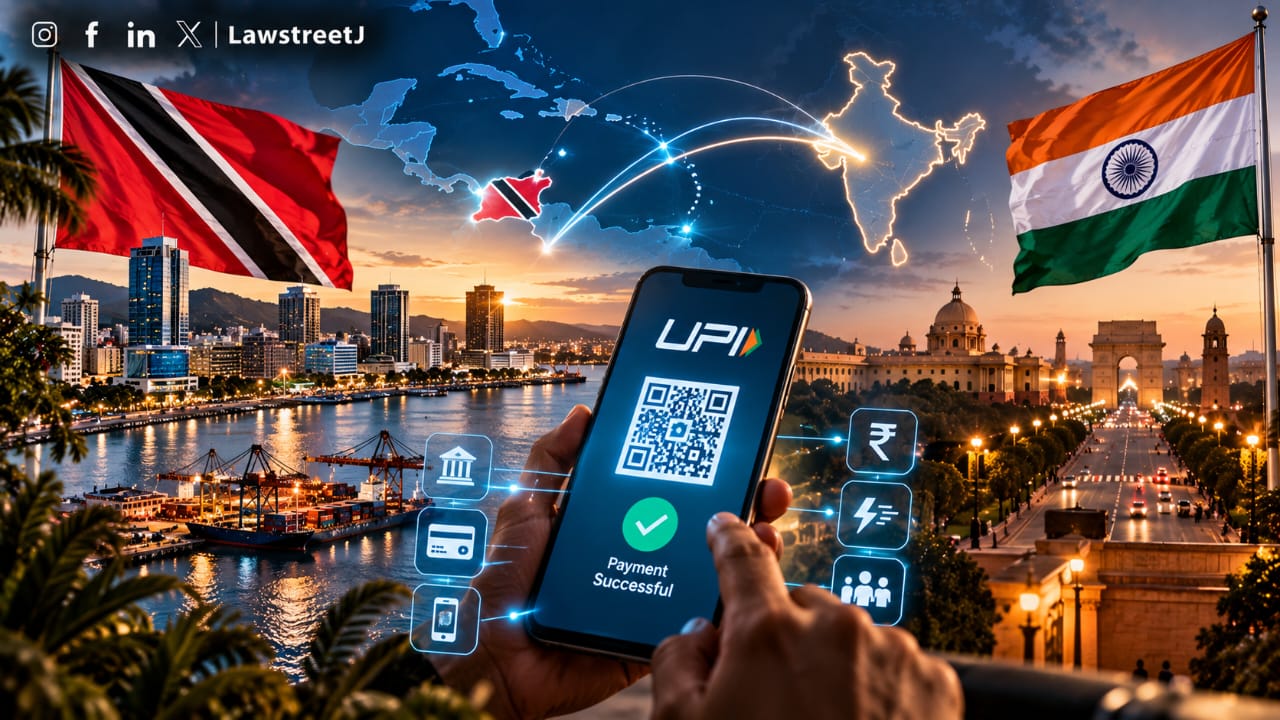
New Delhi / Port of Spain — Trinidad and Tobago is moving forward with plans to adopt India's Unified Payments Interface, a step that would make it the first country in the Caribbean to implement the digital payment technology. The development was confirmed by Trinidad and Tobago's High Commissioner to India, Chandradath Singh, while addressing an event in New Delhi on Monday, September 29, marking the 50th anniversary of Trinidad and Tobago becoming a republic.
The Agreement Behind the Initiative
The UPI rollout is being pursued under an agreement between NPCI International Payments Limited, the global arm of India's National Payments Corporation of India, and Trinidad and Tobago's Ministry of Digital Transformation. The agreement was signed on September 10, 2024, and provides for the exchange of technical expertise and know-how to develop a real-time payments platform modelled on UPI.
According to Trinidad and Tobago's Ministry of Digital Transformation, the planned platform is intended to support person-to-person, person-to-merchant and government-to-person transactions, offering citizens the flexibility to transact from any participating bank account using a mobile phone. NPCI International's Chief Executive Officer, Ritesh Shukla, has said the agreement reflects Trinidad and Tobago's efforts to advance its financial infrastructure, and that NPCI International is committed to supporting the country in building a secure, sovereign and scalable payments platform. Officials in Trinidad and Tobago have described the initiative as a necessary step toward the kind of modern digital payment access that citizens need.
Part of a Wider Bilateral Push
High Commissioner Singh linked the UPI initiative to a broader deepening of ties between India and Trinidad and Tobago. He noted that a recent visit to Trinidad and Tobago by Indian Prime Minister Narendra Modi resulted in six memoranda of understanding and agreements covering trade, investment, technical cooperation and people-to-people exchanges. Singh also highlighted Trinidad and Tobago's recognition of Indian Pharmacopoeia standards and a separate agreement to establish an Indian Chair on Ayurveda at the University of the West Indies, alongside India's continued support through initiatives such as the supply of laptops to schoolchildren and medical assistance through the Jaipur Foot programme. The two countries are currently marking 64 years of diplomatic relations.
Singh also referred to Trinidad and Tobago's recent election to a non-permanent seat on the United Nations Security Council, thanking India for supporting the country's candidature. He said the two-year term would give Trinidad and Tobago the opportunity to contribute to international discussions on peace, security, development and cooperation. He additionally pointed to cricket as a longstanding bridge between the two nations, referencing the historical sporting ties between India and the West Indies.
UPI, developed and operated by the National Payments Corporation of India, has been expanding its international footprint in recent years. The system or UPI-linked payment acceptance has already been extended to or made interoperable with a number of countries, including Singapore, the United Arab Emirates, Sri Lanka, Mauritius, France, Nepal, Bhutan and Namibia, among others, through bilateral arrangements facilitated by NPCI International Payments Limited. Trinidad and Tobago's planned adoption would mark the first instance of a Caribbean nation building a UPI-modelled, real-time domestic payments platform.
Regulatory and Legal Framework
UPI operates in India under a specific statutory and regulatory architecture. The National Payments Corporation of India was incorporated as an umbrella organisation for retail payment systems in India under the provisions of the Payment and Settlement Systems Act, 2007, which empowers the Reserve Bank of India to regulate and supervise payment systems in the country. UPI itself functions as a payment system authorised and regulated by the Reserve Bank of India under this framework, with NPCI operating the technical infrastructure.
NPCI International Payments Limited was established as a wholly owned subsidiary of NPCI specifically to take Indian payment technologies, including UPI and RuPay, to international markets. Cross-border deployment of UPI-based systems typically proceeds through government-to-government or regulator-to-regulator agreements between NPCI International and the central bank, payments regulator or relevant ministry of the partner country, followed by technical integration with that country's banking and payments infrastructure. In Trinidad and Tobago's case, the implementing counterpart is the Ministry of Digital Transformation, in coordination with the country's financial regulatory authorities, which would be responsible for licensing and supervising the resulting domestic payment system under Trinidad and Tobago's own financial services laws.
Any such cross-border digital payments cooperation also typically requires compliance with each country's data protection, anti-money laundering and financial intelligence regulations, since real-time payment systems necessarily involve the processing of personal and financial data. In Trinidad and Tobago, oversight of money laundering and terrorist financing risks connected to financial systems operates under its Proceeds of Crime Act and the supervisory framework maintained by the Central Bank of Trinidad and Tobago, which would ordinarily be involved in approving and supervising any new domestic real-time payments platform of this kind.
The agreement between NIPL and the Ministry of Digital Transformation, as described by Trinidad and Tobago's government, focuses on the exchange of technical expertise and know-how rather than a transfer of ownership or control of the eventual platform, which is intended to remain a sovereign system operated within Trinidad and Tobago's own regulatory jurisdiction.
As of September 30, 2026, the following facts are on record, the agreement between NPCI International Payments Limited and Trinidad and Tobago's Ministry of Digital Transformation was signed on September 10, 2024, the initiative remains in the implementation stage, with High Commissioner Chandradath Singh confirming on September 29, 2026, that Trinidad and Tobago is actively pursuing its rollout, the platform is intended to support person-to-person, person-to-merchant and government-to-person transactions and no confirmed public launch date for the platform has been announced. Trinidad and Tobago would become the first Caribbean nation to implement a UPI-modelled domestic payments system once the platform is operational.