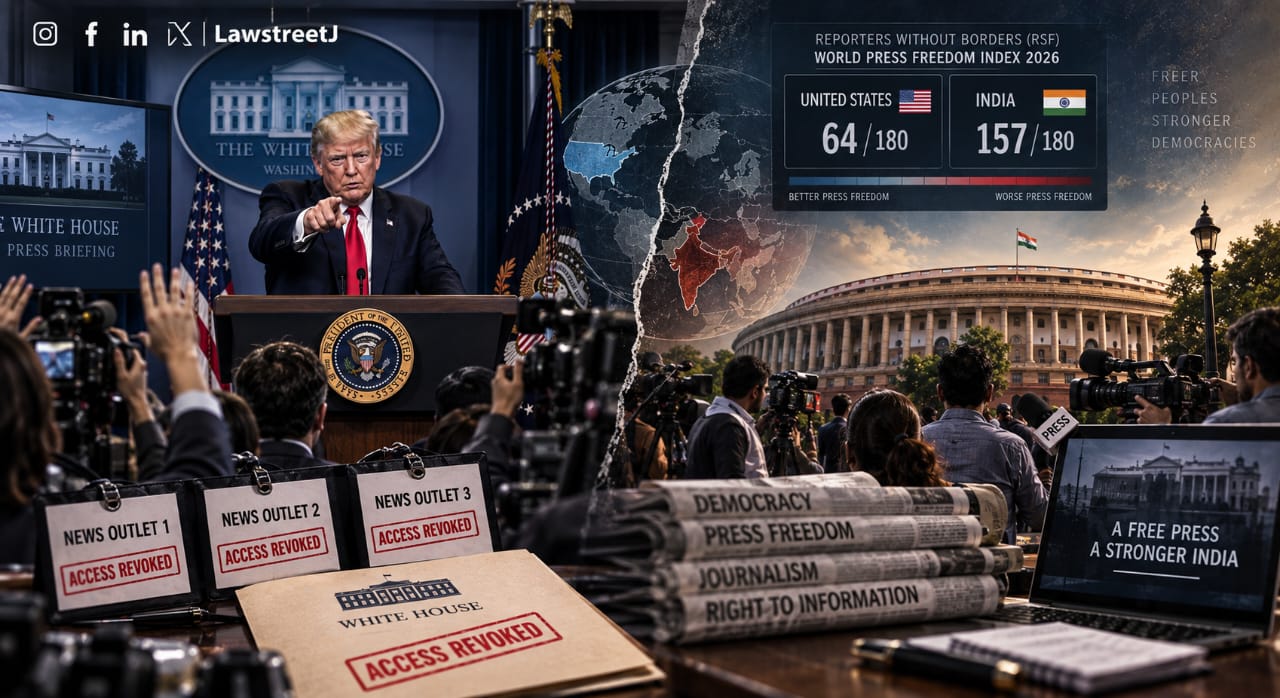
NEW DELHI - Reporters Without Borders published its 2026 World Press Freedom Index back in April. The numbers landed with a thud in India, 157th out of 180 countries, a six-place drop from 151st the year before, keeping the country parked in RSF's "very serious" category. The United States, meanwhile, sat at 64th, down seven places from 57th, but still comfortably 93 spots ahead of India on the exact same list.
Then, months later, that gap started looking a lot harder to explain. On September 18, 2026, President Donald Trump posted on Truth Social that he was "banning" CNN, MS NOW and Politico from the White House, accusing the outlets of pushing "fiction and lies," and warning that other "Fake News Media Outlets" might be next. This wasn't a court case dragging through years of legal filings. It was a sitting US president, in writing, moving to shut three newsrooms out of the building where his own administration operates. And an internationally respected watchdog had still ranked American press freedom nearly a hundred places healthier than India's.
The Score Gap Is Bigger Than the Rank Gap Suggests
Look past the raw rank numbers for a second and the actual scoring makes the comparison even starker. India's score sits at 31.96. The US comes in at 62.61, on a 100-point scale where higher means freer. That's not a close call dressed up as a big gap on paper, it's the difference between a country RSF is willing to call fundamentally functional for journalism and one it places in the same tier of concern as some genuinely repressive states.
To RSF's credit, the report didn't pretend America's press freedom was in great shape either. It flagged the Trump administration's "systematic weaponisation of state institutions" directly, cited funding cuts hitting public broadcasters like NPR and PBS, and used language about a "deterioration that amounts to one of the most severe crises for press freedom in modern US history." Strong words, sitting inside a report that still scored the country 93 places above India, a gap that only got harder to square once the White House ban followed months later.
That US comparison is just the start. Once you actually look at who else sits above India on this list, the numbers get harder to defend with every new name.
Start with Qatar. The Gulf state climbed four places this year to land at 119th, putting it a full 38 spots above India. Qatar is an absolute monarchy. There is no independent judiciary in any meaningful sense, no elected parliament with real legislative power, and foreign correspondents operating in the country do so largely at the pleasure of the state. Al Jazeera, the broadcaster Qatar funds and hosts, is itself routinely accused by press freedom groups of steering clear of criticism of the Qatari royal family even while covering other governments aggressively. And yet Qatar ranks first in the Gulf and second in the Arab world, comfortably ahead of the country widely regarded as the world's largest democracy.
The Philippines sits at 114th, a full 43 places above India, and RSF's own regional report for 2026 doesn't exactly paint a flattering picture of press conditions there. The report specifically flags a tactic called "red-tagging," where journalists investigating subjects sensitive to the government get accused of being "subversive" or outright "terrorists," charges that carry real legal weight and real prison time. RSF names a specific case, journalist Frenchie Mae Cumpio, who the organisation itself describes as having been behind bars for six years, calling it "a symbol of this repression." A journalist imprisoned for six years on terrorism-adjacent charges tied directly to her reporting, in a country ranked 43 places above India.
Then there's the cluster of countries sitting just below or barely above India that are, quite literally, active war zones. Iraq comes in at 162nd. Sudan sits at 161st. Yemen is at 164th. RSF's own explanation cites "recurring armed conflict" as the primary driver of these scores, meaning journalists there are operating amid active combat and bombing. Palestine ranks 156th, just one place above India, in the same report that acknowledges more than 220 journalists have been killed in Gaza since October 2023, including at least 70 RSF says were killed specifically while doing their jobs. That is the most extreme, direct form of press freedom violation there is, and the resulting rank sits a single position above India's.
The Same Pattern, Repeating for Years
This isn't a one-year anomaly either. Historical RSF data shows the same pattern recurring across editions of this index. Singapore, a wealthy, developed, first-world economy, has repeatedly ranked in the bottom half of the entire index, at one point sitting well below Kuwait, the UAE and Qatar, three Gulf monarchies known for tightly controlled state media and minimal independent press infrastructure. RSF's own commentary at the time noted Singapore had the "dubious distinction of being the only developed nation in the entire bottom half" of that year's index, ranked below authoritarian Gulf states almost every year the comparison gets made.
If wealthy, developed democracies can routinely rank below absolute monarchies with state-controlled media, and if war zones with journalist body counts in the hundreds can rank a single position away from a country with a functioning judiciary, the question isn't really about India's specific score. It's about whether the scale itself is measuring what it claims to measure.
What India Actually Has That These Countries Don't
Weigh what India's press landscape actually looks like against some of the countries ranked above it. India has more than a hundred television news channels operating in dozens of languages, a vigorous and often openly adversarial English-language press, satirical political commentary running freely on YouTube and social media with millions of views, opposition politicians who appear on air daily to criticise the sitting government by name, and courts that, however slow, remain open and independent enough that journalists regularly win legal battles against the state.
Compare that to Qatar, where there is no opposition media at all, because there is no political opposition permitted in the first place. Compare it to the Philippines, where RSF's own report documents a sitting journalist's six-year imprisonment on charges the organisation itself frames as repression, not law enforcement. Compare it to Iraq, Sudan and Yemen, where "press freedom" as a functioning concept barely exists because functioning government barely exists. None of these countries offer anything close to the breadth, volume or diversity of independent media that operates daily across India, in Hindi, English, Tamil, Bengali, Marathi and a dozen other languages simultaneously.
If this argument sounds familiar, that's because India's government has been making some version of it for years, and not just about press freedom. Take the Global Hunger Index, which once placed India at 101st out of 116 countries. The Ministry of Women and Child Development didn't quietly accept that. It called the index's methodology seriously flawed, arguing it was "neither appropriate nor representative of hunger prevalent in a country," pointing out that only one of the index's four components, undernourishment, is actually a direct hunger measure.
On democracy rankings, where organisations like V-Dem and Freedom House have placed India in categories alongside states with far more overtly authoritarian records, External Affairs Minister S. Jaishankar was blunt, calling the compilers of such indices "self-appointed custodians" who are, in his words, "not motiveless." In Parliament, Minister of State Rao Inderjit Singh told lawmakers that "many international agencies are publishing global indices based on different databases and methodologies, some of which are often questionable on many grounds," adding that many rely on "open-source data or perception-based data which do not reflect India's position in true sense."
RSF's Own Numbers Tell an Inconsistent Story
Even RSF's own scoring, when you sit with it, doesn't hold together as cleanly as the headline rank suggests. The index assigns numerical scores from 0 to 100 across five categories, political, legal, economic, social and security conditions, and India's overall score sits at 31.96. But a country like Qatar, operating with zero electoral accountability and state control over its flagship broadcaster, still manages a score that lands it 38 places higher.
That's the real problem with treating a single composite number as gospel. It flattens enormously different realities, a monarchy with no free press infrastructure by design, a democracy with legal disputes playing out in open court, a war zone where reporters are getting killed, into one comparable line on a chart. When RSF's own regional breakdown describes Iraq, Sudan and Yemen's low rankings as driven by "recurring armed conflict," and separately describes Qatar's high ranking without ever grappling with the absence of any independent political press in the country at all, the inconsistency isn't hidden. It's sitting right there in RSF's own published analysis.
The 157 gets repeated in headlines, in op-eds, in social media posts, treated as a settled verdict on India's press freedom. What almost never gets repeated in the same breath is that this "verdict" places India below an absolute monarchy with no opposition press, one position below a country whose government has overseen the killing of more than 220 journalists in two years, dozens of places below a country where a journalist has spent six years in prison for reporting the government didn't like, and nearly a hundred places below a country whose own president moved to formally bar three newsrooms from the White House the same year.
None of that makes India's own press freedom challenges disappear, defamation cases, national security law usage and concentrated media ownership are real issues worth scrutiny in their own right. But a ranking system is only as credible as the comparisons it produces, and when those comparisons routinely place freer, louder, more diverse media environments below monarchies, war zones and countries actively jailing reporters or banning newsrooms from their own capitals, the fair question isn't why India ranked 157th. It's why anyone should treat that number as a clean, objective measure of anything at all.
![Allahabad HC Curtails District Administration’s Arbitrary Power to Withhold Government Advertisements [Read Order]](/secure/uploads/2026/04/lj_1861_Allahabad_HC_curbs.webp)