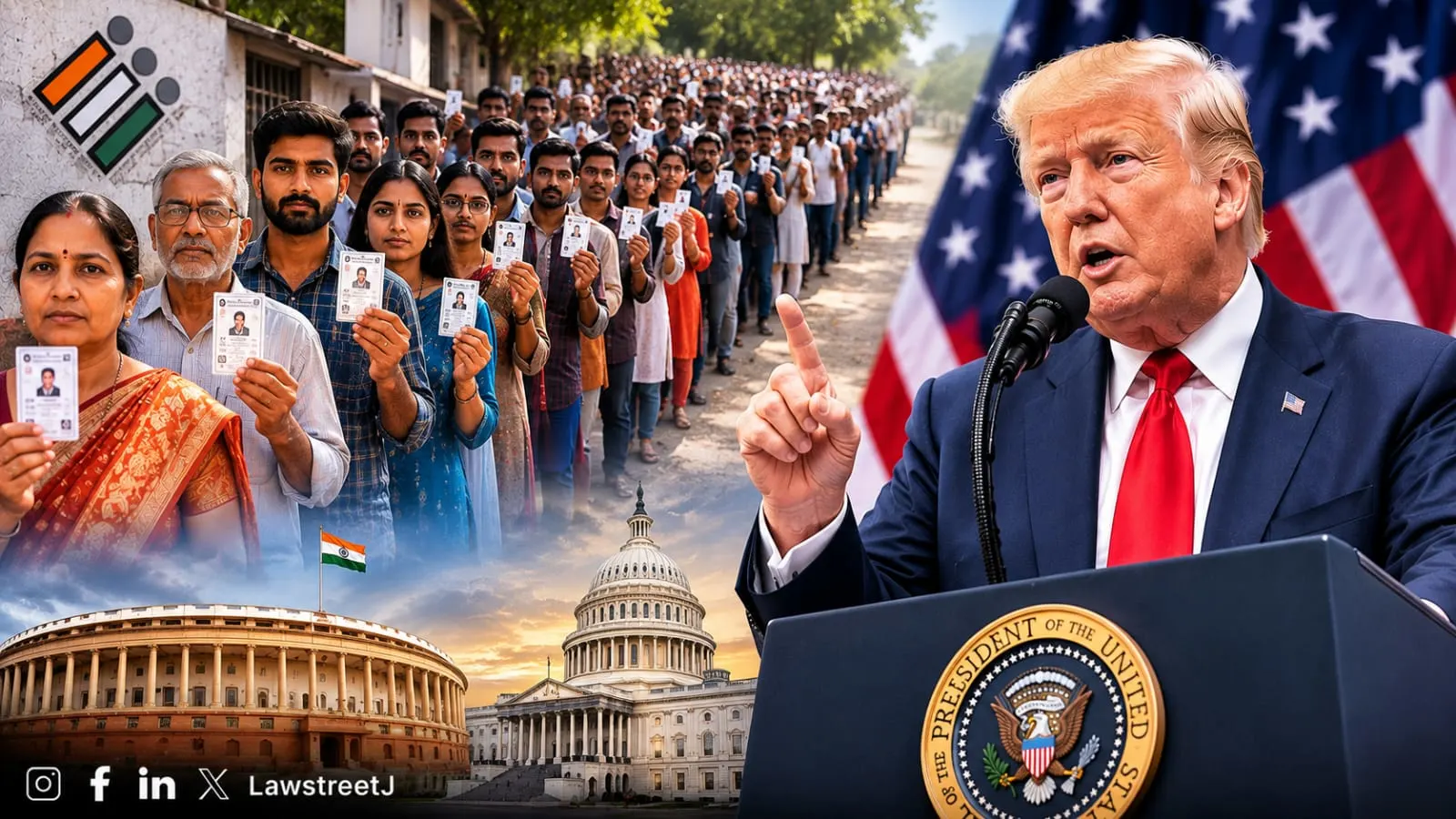

WASHINGTON D.C. - President Donald Trump turned to India's electoral system on Monday to make his most pointed push yet for mandatory voter identification in the United States, invoking a question attributed to India's Chief Election Commissioner Gyanesh Kumar and pointing to the scale and standards of India's 2024 general election to argue that American elections should require a valid photo ID from every voter.
In a post on Truth Social, Trump said India's Chief Election Commissioner, Gyanesh Kumar, had recently questioned how elections could be conducted in the US without requiring voters to present a valid photo identification card.
Trump's post read in full: "Earlier this month, India's Chief Election Commissioner, Gyanesh Kumar, asked our Administration, How can you have Elections in the U.S. without a valid Photo ID? India's last Election had 646,000,000 Voters! Less than 1% voted by mail, and every single Voter had to have a VALID Photo Identity Document. We need to pass THE SAVE AMERICA ACT, now!"
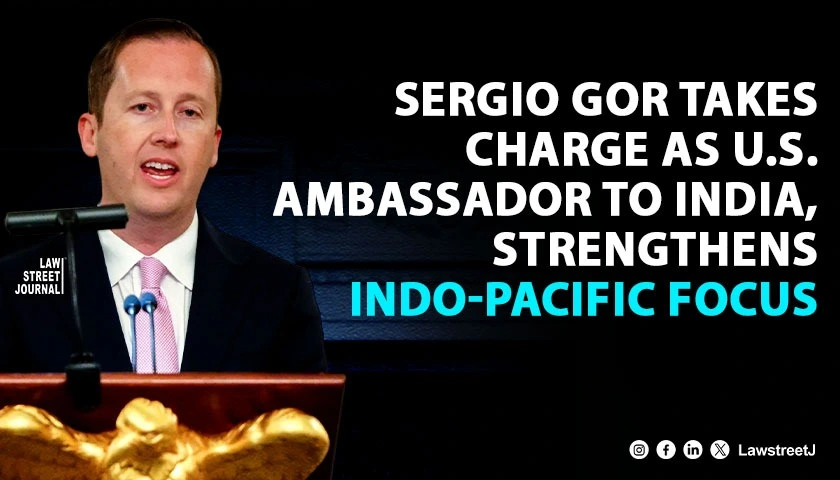
The post received immediate and prominent backing from the United States' most senior diplomatic representative to India. US Ambassador to India Sergio Gor endorsed Trump's call, posting on X: "President Donald J. Trump is absolutely correct! 646 MILLION voters, every single one required an ID in India's last election. Congress should pass THE SAVE AMERICA ACT!"
What the SAVE America Act Proposes

The legislation Trump is pressing for is formally titled the Safeguard American Voter Eligibility Act. The SAVE America Act would require Americans to show proof of citizenship to register to vote, impose a nationwide voter identification requirement, and severely limit voting by mail.
The updated SAVE America Act passed the US House in February 2026 by 218-213, with one Democrat joining Republicans in supporting the measure. The legislation has faced opposition in the Senate and has not become law.
Currently, no federal law mandates photo identification for American elections. Individual states determine their own voter ID requirements, resulting in a patchwork system in which some states require a government-issued photo ID, others accept a wide range of documents, and several states do not require any identification at all. The SAVE America Act would standardise this at the federal level by requiring a specific form of citizenship documentation at the point of voter registration.
The White House has highlighted India and Brazil as examples of countries linking voter identification with biometric databases while advocating changes to US election rules.
India's Electoral System: The Numbers Behind Trump's Claim
The figures Trump cited are accurate and sourced from India's 2024 general election, the largest democratic exercise in the history of representative government.
India's 2024 Lok Sabha elections saw 646 million voters participate across a country of more than 1.4 billion people. Every voter was required to carry a valid photo identity document, most commonly the Voter ID card issued by the Election Commission of India, though a range of other government-issued photo IDs are accepted at polling stations. The proportion of votes cast by mail remained below one per cent, a figure that reflects India's emphasis on in-person, booth-based voting as the default mode of electoral participation.
Chief Election Commissioner Gyanesh Kumar assumed the chairmanship of the Council of Member States of the International Institute for Democracy and Electoral Assistance for the year 2026. In his acceptance speech, Kumar highlighted the scale of India's democratic exercise, noting that the country has over 900 million registered electors across 28 states and eight Union Territories.
Kumar is among the most internationally engaged Chief Election Commissioners India has seen in recent years. In January 2026, Kumar held bilateral meetings with the Heads of 32 Election Management Bodies on the sidelines of the India International Conference on Democracy and Election Management. India offered to collaborate with Election Management Bodies to help them develop technology platforms similar to ECINET and to provide training support to election officials of those bodies. Many Election Management Bodies showed interest in collaborating with India to adopt similar technological solutions in their respective countries.
The question attributed to Kumar, asking the Trump administration how American elections could be conducted without photo identification, reflects a recurring theme in how Indian electoral officials describe their own system to international counterparts. The Election Commission of India's voter ID framework has been built over decades, with each elector receiving a Voter ID card linked to their registration in the electoral roll, which is revised annually and shared with all recognised political parties.
The Political Argument Trump Is Making
Trump's invocation of India's voter ID system is both a factual comparison and a deliberate political move. By pointing to the world's largest democracy, a country that managed 646 million in-person votes with near-universal photo identification and minimal mail-in voting, he is pre-empting the argument that mandatory voter ID is administratively impractical or suppresses turnout at scale.
The comparison also carries a specific rhetorical weight. Critics of voter ID requirements in the United States have argued that such laws disproportionately affect minority voters, elderly voters, and low-income voters who are less likely to possess government-issued photo identification. By pointing to India, a country with significant rural populations, diversity of languages and demographics, and a large proportion of voters who are not wealthy, Trump is making the case that photo ID requirements are compatible with mass democratic participation and do not inherently exclude vulnerable populations.
India's electoral system has additional features that provide context for the comparison. The Election Commission of India runs an active programme to ensure that every eligible voter is enrolled and has access to a voter ID card including outreach to marginalised communities, migrants, and rural voters. The card is free of charge and available to every Indian citizen who registers. This universal issuance infrastructure is a significant factor in ensuring that photo ID requirements do not result in disenfranchisement.
Whether the United States would accompany any voter ID law with a comparable programme of universal free ID issuance, a question that bears directly on whether the comparison to India's system is fully applicable has been a central point of debate between Republicans and Democrats in the US Congress.
The Senate Obstacle and What Comes Next
The SAVE America Act's passage in the House in February 2026 was a significant legislative milestone for the Trump administration's election integrity agenda. But it stopped there. The Senate, where the threshold for advancing major legislation is 60 votes under normal procedures, has not moved the bill forward.
The legislation has faced opposition in the Senate and has not become law.
Democratic senators have argued that the proof-of-citizenship requirement would create barriers for millions of legally registered American voters who do not routinely carry passports or birth certificates, particularly naturalized citizens who may not have documents easily accessible. They have also questioned the premise that US elections suffer from the kind of non-citizen voting that the bill is designed to prevent.
Trump's Monday post is designed to put pressure on the Senate by generating momentum and public support. The invocation of Gyanesh Kumar's reported question, framed as a foreign election official being astonished by the absence of mandatory photo ID in American elections is a specific rhetorical device: using international opinion to reinforce domestic political arguments.
The Election Commission of India has not publicly commented on Trump's post or on the reported conversation between Kumar and Trump administration officials. The Indian government has not indicated any position on the SAVE America Act or the US voter ID debate.
Why This Moment Matters Beyond the Legislation
The fact that the President of the United States is publicly citing conversations with India's Chief Election Commissioner to advance domestic legislation is itself notable. It reflects both the depth of the current US-India engagement, particularly under the Trump-Modi relationship and the elevated status of India's electoral system as a reference point in international democratic discourse.
Gyanesh Kumar's international profile has grown considerably in recent months. As chair of the International IDEA Council for 2026, he has positioned India's election management framework as a model for the developing world. India's offer to help other countries develop ECINET-style voter roll technology platforms represents an active effort to export India's electoral infrastructure as a form of democratic soft power.
Trump's post, whatever its primary domestic political intent, adds American presidential endorsement to that positioning, describing India's election system not merely as a system that works for India, but as a system that the United States itself should emulate.
Whether that endorsement translates into legislative action in the US Senate, and whether the SAVE America Act eventually becomes federal law, will determine whether the comparison that both Trump and Gyanesh Kumar's reported question have now placed in the political record has any lasting consequence for the American democratic framework.


.jpeg)