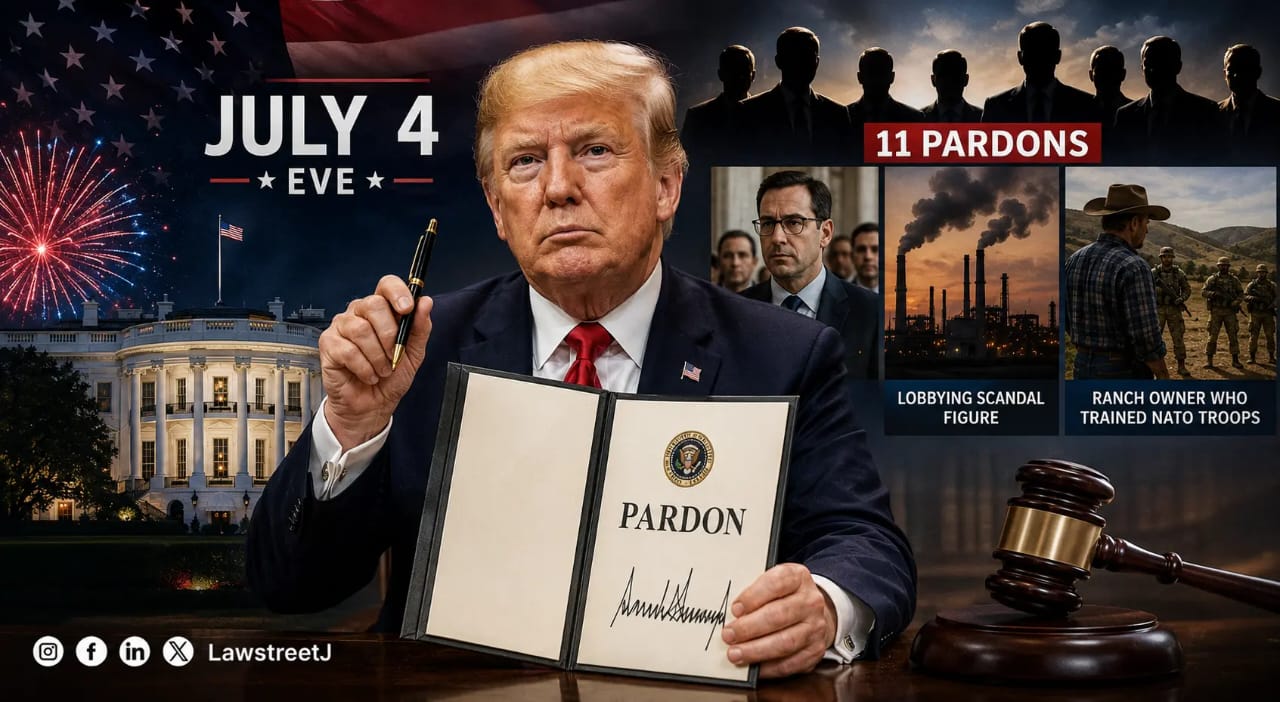
President Donald Trump pardoned 11 people on Friday, July 3, the eve of the 250th anniversary of American Independence, in the latest instalment of what has become one of the most expansive uses of presidential clemency power in modern American history. The eleven recipients include Adam Kidan, a former business partner of disgraced Washington lobbyist Jack Abramoff, nine individuals convicted of bypassing vehicle emissions control systems under the Clean Air Act, and a Texas ranch owner praised by the White House for allowing the US military and NATO troops to train on his land free of charge.
Trump announced a portion of the pardons on Truth Social before the full White House list was released, writing: "It is my Great Honor to have just signed Pardons for six people who were persecuted by the Biden Administration, and were in, or being sent to, prison, for 'fixing their car.'" The framing, that the convictions were political persecution rather than enforcement of federal environmental law, reflects a pattern that has defined Trump's approach to clemency throughout his second term.
The Emissions Pardons: What the Clean Air Act Cases Involved
Nine of the eleven pardons issued on Friday involved individuals convicted of violating the Clean Air Act by disabling or helping others disable the emissions monitoring systems installed in vehicles, systems required under federal law to limit the release of pollutants including nitrogen oxides, carbon monoxide, and particulate matter into the atmosphere. The specific violations typically involve the installation of so-called "defeat devices", equipment designed to bypass or disable the onboard diagnostic and emissions control systems that modern vehicles are required to carry under federal and state environmental regulations.
The pardons come just three days after Trump signed a White House memo on Monday directing the Environmental Protection Agency to allow Americans to repair and modify their own vehicles as they see fit. As he signed that memo, Trump referenced a diesel mechanic he had pardoned last year on similar grounds. The Monday memo also addressed aftermarket auto parts and stated that its provisions would supersede the ability of the California Air Resources Board, the nation's most stringent vehicle emissions regulator, to evaluate aftermarket parts that affect vehicle emissions. The White House, in releasing Friday's pardon list, described Trump as having "relieved consumers from these regulatory burdens."
The Clean Air Act, signed into law in 1970 and significantly strengthened in 1990, sets national ambient air quality standards and empowers the EPA to regulate vehicle emissions. Violations of its emissions tampering provisions carry criminal penalties, including prison sentences for individuals who knowingly disable required systems or manufacture and sell devices designed to circumvent them. The federal government has pursued such prosecutions consistently across administrations of both parties, most notably in the criminal cases that followed the Volkswagen "Dieselgate" scandal, in which the company admitted to installing defeat devices in nearly 600,000 vehicles in the United States.
Environmental law experts have noted that the pardons, combined with the Monday EPA memo, signal a significant policy shift, using the clemency power not merely to address individual injustices but to send a broader signal about the administration's regulatory philosophy.
Adam Kidan: The Abramoff Connection
The most politically significant of Friday's pardons is that of Adam Kidan, who pleaded guilty in 2005 to fraud and conspiracy charges connected to the purchase of a fleet of gambling boats in Florida. In 2006, Kidan was sentenced to nearly six years in federal prison. His case was one thread in a much wider web of corruption investigations involving Jack Abramoff, one of Washington's most notorious lobbyists, that consumed the Capitol Hill of the early 2000s.
The Abramoff lobbying scandal involved the systematic defrauding of Native American tribal clients, the corruption of public officials across multiple federal agencies including the Interior Department, and the involvement of members of President George W. Bush's White House. Abramoff himself pleaded guilty in 2006 to fraud, tax evasion, and conspiracy to bribe public officials, and cooperated with federal investigators, providing information that led to the convictions of over a dozen individuals, including a White House official and congressional staffers. Representative Bob Ney of Ohio was among those who went to prison as a result of the investigation.
Abramoff himself was not among Friday's pardon recipients. Kidan, his former partner, served his time in prison, was released in 2009, and subsequently built a new career in the staffing industry. He now serves as president of Empire Workforce Solutions. The White House said Friday that in March 2026, Newsday had reported that Kidan was among the hosts of a fundraiser held at Trump's Mar-a-Lago resort in Palm Beach for a Long Island Republican congressional candidate — a detail that critics noted places him squarely within the circle of politically connected figures who have benefited from Trump's clemency in his second term.
Jack Harvard: The Ranch Owner With NATO Ties
The eleventh pardon issued on Friday went to Jack Harvard, described by the White House as a ranch owner with an "upstanding record" following his conviction. The White House praised Harvard for allowing the US military and NATO troops to train on his property free of charge, a detail Trump cited as central to his decision to grant clemency. The White House did not release additional details about Harvard's specific conviction, and the nature of the charges against him had not been independently confirmed by major outlets at the time of publication.
The Pattern of Pardons: A Second Term Defined by Clemency
Friday's eleven pardons are the latest chapter in what legal scholars and political analysts have described as one of the most consequential and controversial exercises of the presidential pardon power in recent history. Trump's use of pardons in his second term has been extensive, deliberately targeted, and transparently ideological in many cases.
The pardon power granted to the President under Article II, Section 2 of the United States Constitution is sweeping and subject to very few legal constraints. The President may pardon any individual for federal offences at any time, without the consent of Congress or the courts, and the Supreme Court has consistently upheld the pardon power as essentially unreviewable. There is no requirement that a pardon be accompanied by a statement of reasons, and the President is not required to follow the recommendations of the Department of Justice's Office of the Pardon Attorney, though historically most presidents have done so.
Trump's second term has been characterised by a marked departure from that conventional approach. Pardons in this administration have been granted to political allies, to individuals whose prosecutions Trump has characterised as politically motivated, to January 6 defendants, and now to individuals convicted of environmental law violations that the administration has framed as regulatory overreach. Each pardon carries a dual function, a legal remedy for the individual recipient, and a political signal about the administration's broader governing priorities.
The emissions pardons, taken together with the Monday EPA memo, constitute a coherent regulatory message: that the administration views environmental enforcement in the automotive sector as illegitimate and that it is willing to use the pardon power to reinforce that position in concrete terms. Whether Congress or the courts can or will respond to that use of clemency in any meaningful way remains an open question, the pardon power, as written, does not invite easy constraints.


.jpeg)