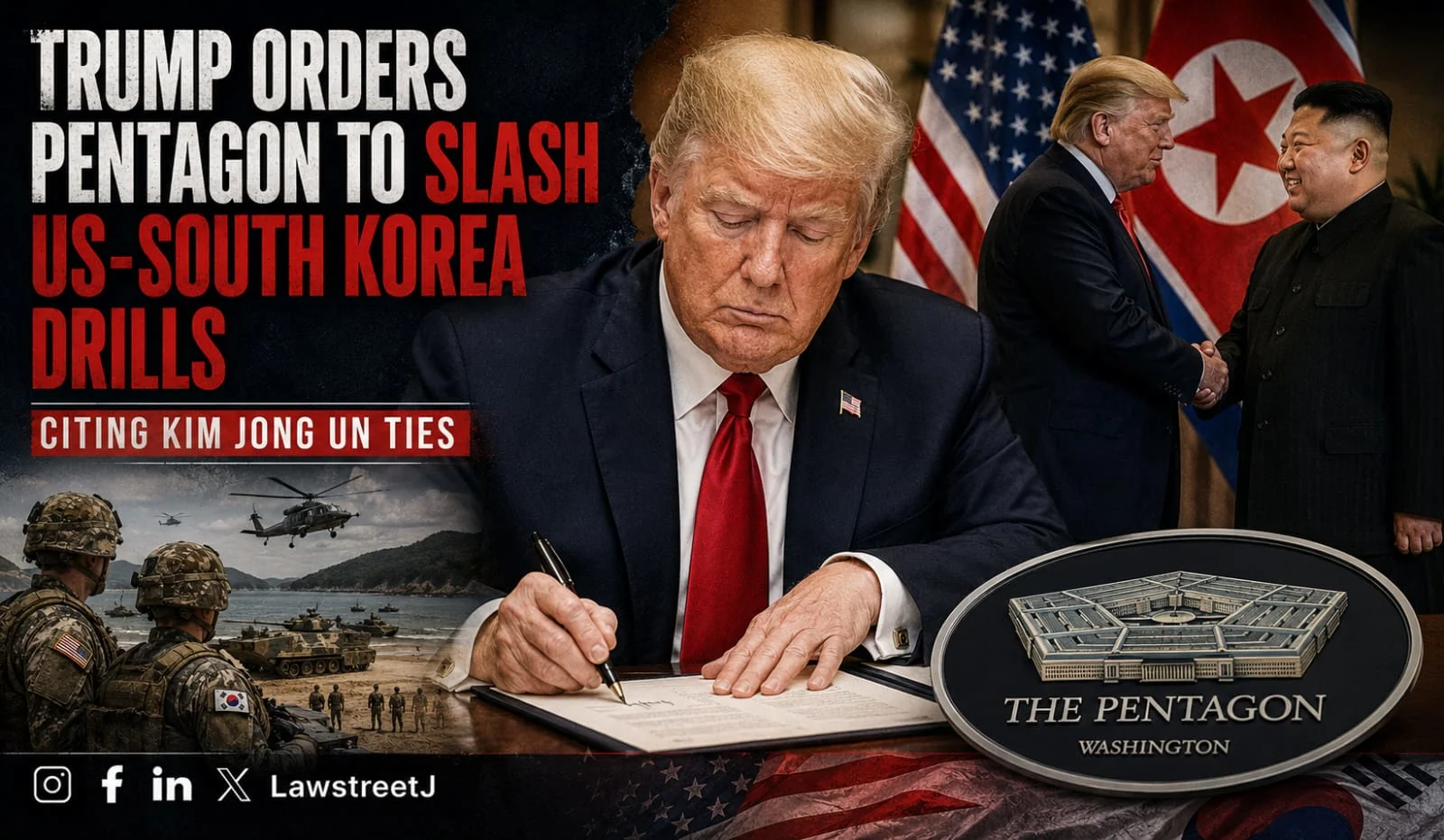
WASHINGTON D.C. — In a move that stunned Seoul, rattled military planners, and delighted Pyongyang, President Donald Trump announced on Sunday evening, just hours before the exercises were scheduled to begin, that he had ordered the Pentagon to substantially scale down the joint US-South Korea military drills known as Ulchi Freedom Shield. The directive, delivered through a post on Truth Social rather than through formal military channels, was directed at Defense Secretary Pete Hegseth and cited two distinct grievances: Trump's personal relationship with North Korean leader Kim Jong Un, and South Korea's refusal to join the United States in what the president called the "denuclearization" of Iran.

Trump announced the move in a post on his Truth Social platform just hours before the United States and South Korea were set to kick off Ulchi Freedom Shield, one of the allies' two major annual exercises.
Trump said on Sunday that he had instructed Defense Secretary Pete Hegseth to "substantially reduce" planned joint military exercises with South Korea, citing their cost and his relationship with North Korean leader Kim Jong Un.
In his own words, published on Truth Social on Sunday evening, Trump wrote: "Based on my very good relationship with Kim Jong Un, of North Korea, I am not happy with the fact that the United States has, long ago, agreed to participate in Joint Military Exercises with South Korea. These exercises are not only costly, with much of these costs paid for by the United States of America (as usual!), but send a signal that is totally inappropriate and hostile, to a Country that, as long as Donald J. Trump has been President, has been unthreatening and respectful."
He concluded: "Based on the fact that it is too late to cancel, I have instructed Secretary of War, Pete Hegseth, to substantially reduce the Joint Military Exercises!"
Two Grievances in One Post: Kim Jong Un and Iran
The Truth Social post contained two distinct arguments that together reveal the full scope of Trump's current frustration with the US-South Korea security relationship and neither is straightforwardly about military strategy.
The first argument is the Kim Jong Un relationship. Trump argued that the drills sent what he described as an inappropriate and hostile signal to Pyongyang, which he said "has been unthreatening and respectful" while Trump has been in the White House. The day following his Truth Social post, Trump posted a photo of himself standing next to Kim and wrote that the two leaders got along great, "despite the unfriendly look on this particular picture."
The second argument is the Iran dimension, one that connects the Korean Peninsula decision to the broader US military engagement in the Middle East. Trump also noted on Truth Social that South Korea declined his request to help the US denuclearize Iran. Trump recounted that Seoul had turned down a request to back the US effort against Tehran, writing: "While somewhat unrelated (?), I recently asked the President of South Korea if they would like to join us in the Denuclearization of the Islamic Republic of Iran, and they declined."
The president said he has directed the Pentagon to scale down the exercises, citing South Korea's refusal to join the war in Iran and his "very good" relationship with North Korea's Kim Jong Un.
The parenthetical question mark Trump placed after "somewhat unrelated" is not accidental. It signals that Trump himself views the two issues as connected, that Seoul's unwillingness to contribute to the US effort against Iran has reduced the weight he gives to the alliance obligation of joint military preparedness on the Korean Peninsula. It is a form of conditional alliance management, in which security commitments are implicitly linked to whether the other party reciprocates US requests in other theatres.
The Exercises That Were About to Begin
The military exercise whose scope Trump reduced on Sunday evening is Ulchi Freedom Shield, the largest annual joint military exercise between the United States and South Korea, and one of the most significant demonstration exercises of the US-South Korea alliance in the Indo-Pacific.
The exercises are meant to build understanding among several agencies to ensure "their ability to fortify the combined defense posture and enhance Alliance response capabilities against a spectrum of security threats."
The command was set to carry out the Ulchi Freedom Shield training Monday, which would include 18,000 South Korean soldiers, according to the South Korean military.
Because the exercises, officially called the 2026 Ulchi Freedom Shield, are set to begin Monday and it's too late to cancel, Hegseth has been ordered to cut back on the scope of the ten-day event.
The Ulchi Freedom Shield exercises have been held annually under that name since 2022, though the underlying US-South Korean summertime exercises they evolved from date back decades as part of a military partnership rooted in the 1953 Mutual Defense Treaty. The United States currently maintains approximately 28,500 troops permanently stationed in South Korea, a force level that has been the central element of the US security commitment to the peninsula since the Korean War armistice.
The drills happen every year on a large scale during spring and summer to sharpen the US-South Korea alliance and its readiness against regional threats. The 2025 edition was described as among the most extensive ever conducted, incorporating both field exercises and computer simulation drills across all military services.
North Korea's Reaction: Ballistic Missile, War Rehearsal Accusation
The timing of Trump's announcement is inseparable from North Korea's own actions in the days preceding it.
North Korea last week called the drills a "war rehearsal" and threatened to retaliate. Trump's announcement comes days after North Korea launched a ballistic missile toward the sea, conducting weapons testing in possible protest of the exercises.
North Korea's standard characterisation of any US-South Korea military exercise as a rehearsal for invasion is a long-standing element of Pyongyang's diplomatic posture. What is notable in the current moment is that Trump's language, describing the drills as sending a signal that is "totally inappropriate and hostile", closely mirrors North Korea's own framing. The alignment between Trump's public characterisation of the exercises and Pyongyang's characterisation of them is not lost on South Korea's military planners or on US alliance managers in the region.
A Pattern With History: This Has Happened Before
Sunday's Truth Social post is not the first time Trump has used his personal relationship with Kim Jong Un as a justification for reducing military exercises with South Korea. The pattern began in his first term.
During his first term, Trump met Kim three times. This is not the first time that the US president has sought to end the exercises with South Korea. After a historic 2018 summit in Singapore with Kim, he called the military drills "expensive" and "provocative."
Trump has now essentially adopted the standard North Korean line, calling the military exercises a "provocative" drain of money and announcing they would stop while he continues talks with Kim, whom he repeatedly praised as a solid negotiating partner.
After the 2018 Singapore summit, Trump announced the suspension of what were then called the Key Resolve and Foal Eagle exercises, catching South Korea and the US military command by surprise. The suspension was eventually reversed when the diplomatic track with North Korea stalled and the exercises were reinstated under different names, eventually becoming Ulchi Freedom Shield in 2022.
Trump and Kim have not met since he returned to office. Analysts say Kim's deepening ties to Moscow and Beijing have handed him greater leverage on the world stage. North Korea's relationship with Russia has deepened considerably since 2022, with Pyongyang reportedly providing artillery ammunition and other military equipment to Moscow for use in the Ukraine conflict, while receiving economic and technological support in return.
South Korea's Position and the Alliance Calculation
For Seoul, Sunday's announcement carries both immediate operational consequences and longer-term strategic implications for the reliability of the US security commitment.
The immediate practical question is how significantly the exercises will be scaled down, and what military readiness gaps result. The scope of Ulchi Freedom Shield, involving thousands of personnel from both militaries, practising joint command procedures, logistics, communications, and multi-domain operations cannot be substituted by reduced exercises without degrading the preparedness that the exercises are designed to maintain.
The longer-term implication is more fundamental. Putting allies on notice that America's military commitments are not a one-way street has long been part of Trump's foreign-policy approach, one that he's kicked up several notches in his second administration. The explicit linking of the Ulchi Freedom Shield reduction to South Korea's refusal to participate in the Iran conflict introduces a form of conditionality into the alliance relationship that Seoul has not previously had to navigate.
South Korea's position on the Iran war, declining to participate in what Trump called the "denuclearization" of Iran, reflects Seoul's own strategic calculations about its relationships in the Middle East, its energy security from Gulf oil supplies, and its constitutional and legal constraints on overseas military deployments. Those calculations have now been publicly assigned a cost by the US president: reduced exercise scope and a public suggestion that the security guarantee itself is contingent on reciprocal cooperation in US military ventures elsewhere.
Whether the exercises will be formally reduced in scope, and by how much, was not specified in Trump's Truth Social post. The Pentagon and the South Korean military had not issued public statements on the specific modifications to the Ulchi Freedom Shield as of the time of publication. The exercises are scheduled to run for ten days.


.jpeg)