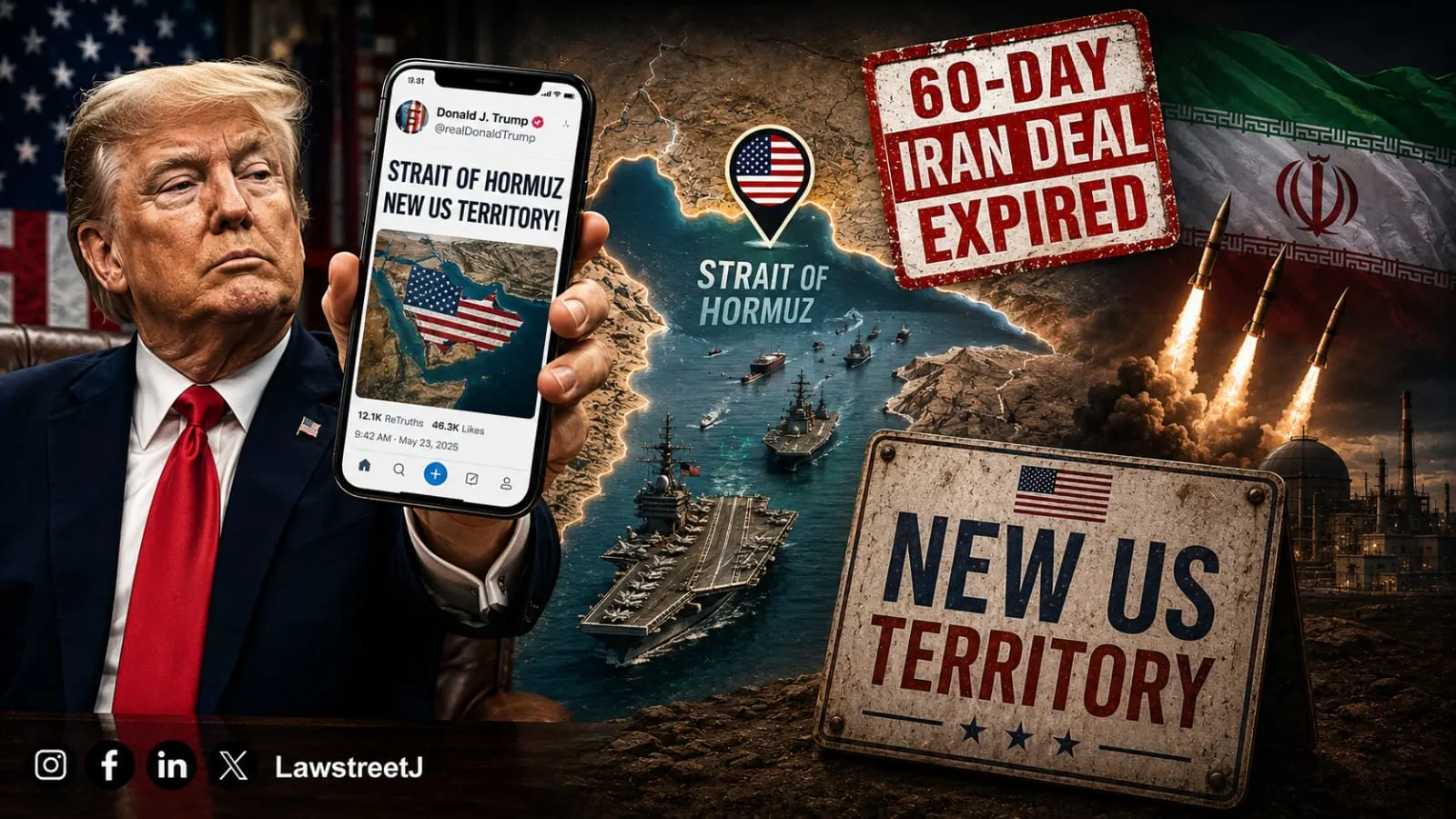

WASHINGTON D.C. / TEHRAN - President Donald Trump escalated his rhetoric over the Strait of Hormuz to its most provocative level yet on Tuesday, posting an image on Truth Social depicting a map of the strategic waterway with the words "New U.S. Territory", a day after the 60-day deadline under the US-Iran memorandum of understanding expired without producing a broader peace agreement, and on the same day the United Arab Emirates suspended all trade with Iran following a ballistic missile incident.
Apparently reflecting his latest change of tack, the US president posted an image on his Truth Social platform showing a map of the Strait of Hormuz captioned "New US Territory," a repetition of his threat last week to declare the strait as such after Iran's "surrender."
The announcement came after reporters asked Trump in the Oval Office on Monday whether he intended to make such a declaration. "I think it's an excellent idea. We control it through the blockade, and I like the idea of declaring it our territory," he replied.
President Donald Trump has asserted that the United States is not engaged in talks with Iran and has not scheduled any, but has meanwhile insisted that the Strait of Hormuz remains open. The US leader insisted in a social media post on Tuesday that while the naval blockade of Iranian ports remains "in full force and effect", all other marine traffic was free to pass. He also posted a map depicting the strategic waterway as US territory.
In the same Truth Social post, Trump wrote: "The Naval Blockade remains in full force and effect. The Hormuz Strait is open and operating. All water mines have been removed or detonated."
Iran Rejects the Claim and the Map
Tehran did not let the "New US Territory" map pass without a formal response.
Iran's Deputy Foreign Minister Ali Gharibabadi responded to Trump's map post, describing it as "delusional."
Top Iranian negotiator Mohammad Bagher Ghalibaf, meanwhile, said in comments published by state media on Tuesday that the Strait would remain shut until the US met the conditions of the MoU. Those conditions include the US lifting its blockade of Iranian ports, lifting oil sanctions, releasing Tehran's frozen assets, and ending threats and military operations on all fronts, Ghalibaf told parliament.
The legal status of the Strait of Hormuz, it is worth stating clearly, has not changed. The Strait of Hormuz is an international strait used for navigation under the UN Convention on the Law of the Sea, with Iran and Oman as the coastal states. A social media map does not alter that status. What the map does represent is the most extreme public statement Trump has made about the US's long-term intentions regarding the waterway and a deliberate act of maximum pressure at a moment when negotiations have effectively stalled.
The rhetoric emerging on both sides illustrates that outward progress towards peace talks and the return of maritime traffic through Hormuz has ground to a halt, threatening to extend the conflict.
The 60-Day Deadline That Came and Went
The chain of events that produced Tuesday's map post began on Monday, August 17, the day the 60-day period associated with the US-Iran memorandum of understanding formally expired.
A June memorandum of understanding was supposed to freeze the fighting, reopen the waterway, and start a 60-day clock toward a broader deal, including the nuclear file. Trump even posted at the time that ships should start their engines. The clock ran out on Monday. Both sides had already treated the ceasefire as broken. Ships were hit. The United States reimposed and then maintained a naval blockade of Iranian ports. Iran kept restricting or attacking traffic and talked of shifting from a defensive to a "fully offensive" posture if diplomacy failed. A senior Iranian official told Reuters as much on Monday.
The MOU, which represented the most substantive diplomatic framework the US and Iran had reached since the conflict began on February 28, was always fragile. It provided a pause in hostilities and a partial opening of shipping through the Strait, but the 60-day timeline was supposed to produce a comprehensive agreement covering Iran's nuclear programme, the end of US sanctions, the release of frozen assets, and the withdrawal of US military assets from the region. None of that happened. The 60-day clock ran out on Monday with negotiations at an "uncertain stage," as described by multiple parties.
Tuesday's remarks appear to reflect Trump's frustration, as Iran and Oman, countries that border Hormuz, continue talks on managing the strait, despite the US president's demand for Iran to surrender and his threat to bomb Oman should it interfere in the issue.
The Strategic and Legal Reality Behind the Rhetoric
The legal status of the Strait of Hormuz remains that of an international strait used for navigation, with Iran and Oman as coastal states.
Trump's "New US Territory" post does not constitute a formal legal claim, a presidential proclamation, a Congressional resolution, or any instrument recognised under international law as an assertion of sovereignty. The US cannot unilaterally declare an international strait, which passes through the territorial waters of Iran and Oman to be American territory. What the post does is signal maximum pressure: a statement that the US regards control of the Strait through its naval blockade as equivalent to sovereignty, and that it has no intention of surrendering that control simply because Iran refuses to negotiate on US terms.
Iran's conditions for reopening the Strait remain unchanged and, as SNSC Secretary Ghalibaf reiterated on Tuesday, non-negotiable without American compliance: lift the naval blockade, lift oil sanctions, release frozen assets, and end all military threats and operations. Trump's conditions, nuclear disarmament, end of Iranian support for armed groups, and effectively regime-level changes in Iran's security posture are equally maximalist.
Iran has maintained that the Strait will remain closed until Washington meets its demands, while the US continues to press for its reopening, keeping tensions between the two countries high.
A map posted to Truth Social has not changed that equation. The 60-day clock has expired. The ship was struck on Tuesday morning. The UAE has cut its trade with Iran. And both sides are, by their own accounts, further from a deal today than they were when the MOU's 60-day countdown began.


.jpeg)
.jpeg)