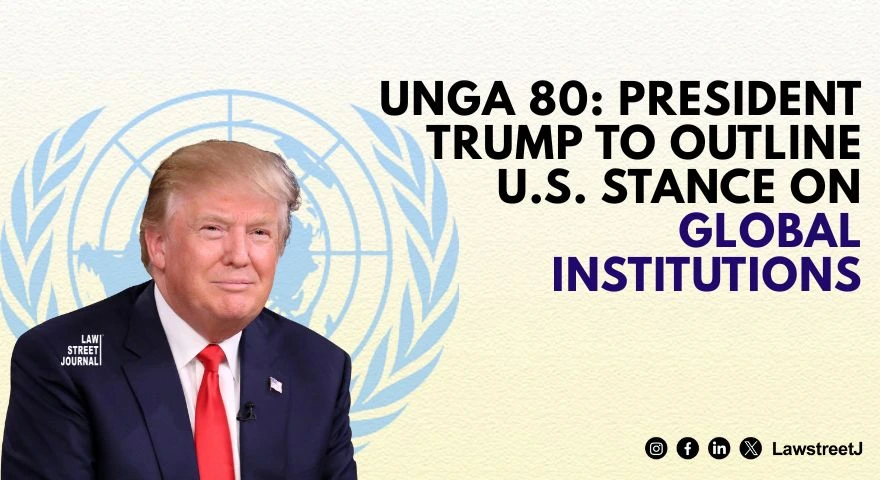
DALLAS - President Donald Trump promised on Wednesday, September 9, 2026, that every adult American citizen would receive a $5,000 payment, which he dubbed the "Trump dividend," if Republicans retain control of both the House of Representatives and the Senate in the upcoming midterm elections. The announcement, made during a nearly two-hour speech at the Republican Party's midterm convention in Dallas, quickly drew scepticism from economists and lawmakers in the United States, while also sparking a wave of jokes on Indian social media comparing the pledge to India's own election-time cash welfare schemes.
What Trump Actually Announced
Speaking to the crowd at the Republican National Midterm Convention held at the American Airlines Center in Dallas, Trump said, "Here is my promise: If the Republicans win the House of Representatives and the United States Senate, I will issue a dividend to every adult citizen in the United States of America for $5,000, very much like a successful company will do a cash distribution to its shareholders." He added elsewhere in his remarks, "If the Republicans win, you win with us and you get $5,000." Trump said the money would need to be spent within the United States, though he did not offer any specifics on how such a restriction would actually be enforced, nor did he provide details on the mechanism through which the payments would be distributed.
Any such proposal would require congressional approval to become law, since the federal government cannot issue mass payments of this kind through executive action alone. Republican Senator Bernie Moreno of Ohio publicly endorsed the idea shortly after Trump's speech, writing on social media platform X that he intended to introduce legislation to get the "Trump Dividend" passed immediately after the November 3 election. Treasury Secretary Scott Bessent was also present at the Dallas convention during the announcement.
Why Critics Are Skeptical: The Legal and Fiscal Hurdles
Trump's promise faced immediate scrutiny over both its cost and its legal footing. Multiple estimates put the total price tag of sending $5,000 to every adult American citizen at more than $1 trillion, with some reports citing a figure as high as $1.3 trillion. Trump did not explain in detail how this cost would be covered, saying only that "tremendous economic success" was making the dividend possible, even as America's total gross national debt has recently surpassed $40 trillion. Former International Monetary Fund chief economist Kenneth Rogoff warned that such a plan would only worsen an already unsustainable federal deficit and increase the risk of a debt crisis over the coming years.
The proposal has also raised a more unusual legal question, whether promising a cash payment specifically conditional on a preferred election outcome could potentially constitute a form of bribery under U.S. law, given that the payout is explicitly tied to Republicans winning control of Congress rather than being framed as a general economic policy. Adding to the scepticism is the fact that a related funding source Trump has previously cited, tariff revenue, has run into serious trouble. The U.S. Supreme Court ruled earlier this year that many of Trump's tariffs were unconstitutional, forcing the government to begin issuing refunds rather than collecting the revenue Trump had previously said would fund similar dividend payments, and overall tariff revenue has since turned negative as a result of those refunds.
White House spokesperson Davis Ingle defended the announcement, telling reporters that Trump had "consistently proven his doubters wrong," while drawing a contrast with what he described as the Democratic Party's record on inflation, immigration and crime. Vice President JD Vance also defended the proposed dividend, arguing that Trump's tariff policies had made such a payout possible. Democratic National Committee Rapid Response Director Kendall Witmer criticised the announcement as an empty promise, arguing that Trump's economic policies had primarily benefited Trump himself, his family and wealthy donors.
A Pattern of Unfulfilled Dividend Promises
This is not the first time Trump has promised a large cash payout to American citizens, and his history with similar pledges has fuelled much of the scepticism surrounding this latest announcement. In 2025, during efforts to cut government spending, Elon Musk proposed a "DOGE dividend" of $5,000 per household, based on returning 20 percent of the Department of Government Efficiency's targeted $2 trillion in spending cuts to roughly 79 million taxpaying households. Trump publicly called the idea a "great idea" at the time, but it never advanced into law, and DOGE itself achieved only a fraction of its promised savings before being quietly dissolved in late 2025.
Separately, Trump repeatedly floated the idea of a $2,000 "tariff dividend" for Americans throughout late 2025, funded by what he described as trillions of dollars in tariff revenue, a promise that similarly never materialised and was further undermined by the Supreme Court's tariff ruling. Earlier in 2026, more than one million U.S. military service members did receive a one-time "warrior dividend" payment of $1,776, one of the few such payout promises that has actually been carried out.
Trump has also spoken of directing healthcare funds "directly" to Americans as part of a long-promised "Great Healthcare Plan," though no concrete details have emerged and no such payments have gone out, with Axios reporting that the administration may instead be preparing more modest $500 rebate checks for some unsubsidised Affordable Care Act enrollees.
Indian Social Media's Reaction: "Laadli Behna Yojana Goes International"
The announcement did not stay confined to American political discourse. Social media users in India quickly picked up on the parallels between Trump's proposed dividend and the country's own election-linked cash welfare schemes for women, jokingly declaring that "Laadli Behna Yojana has gone international," a reference to the direct cash-transfer scheme for women run in Madhya Pradesh and adopted in various forms by several other Indian states ahead of elections. Some users online reworked the comparison further, coining the term "Laadla Ameriki Yojana" and joking that Trump may have borrowed a page from the Indian election playbook of promising direct cash benefits to voters.
Commentary circulating online also drew attention to the scale of the amount involved, questioning where the funding would realistically come from, with some describing the moment as America discovering its own version of what is colloquially referred to in India as "revdi politics" a term used to describe the practice of political parties promising direct freebies or cash benefits to voters ahead of elections. The comparison has also found its way into Indian media commentary, with observers noting the structural similarity between Trump's proposed one-time dividend and India's various direct cash-transfer schemes aimed at specific voter groups.


.jpeg)