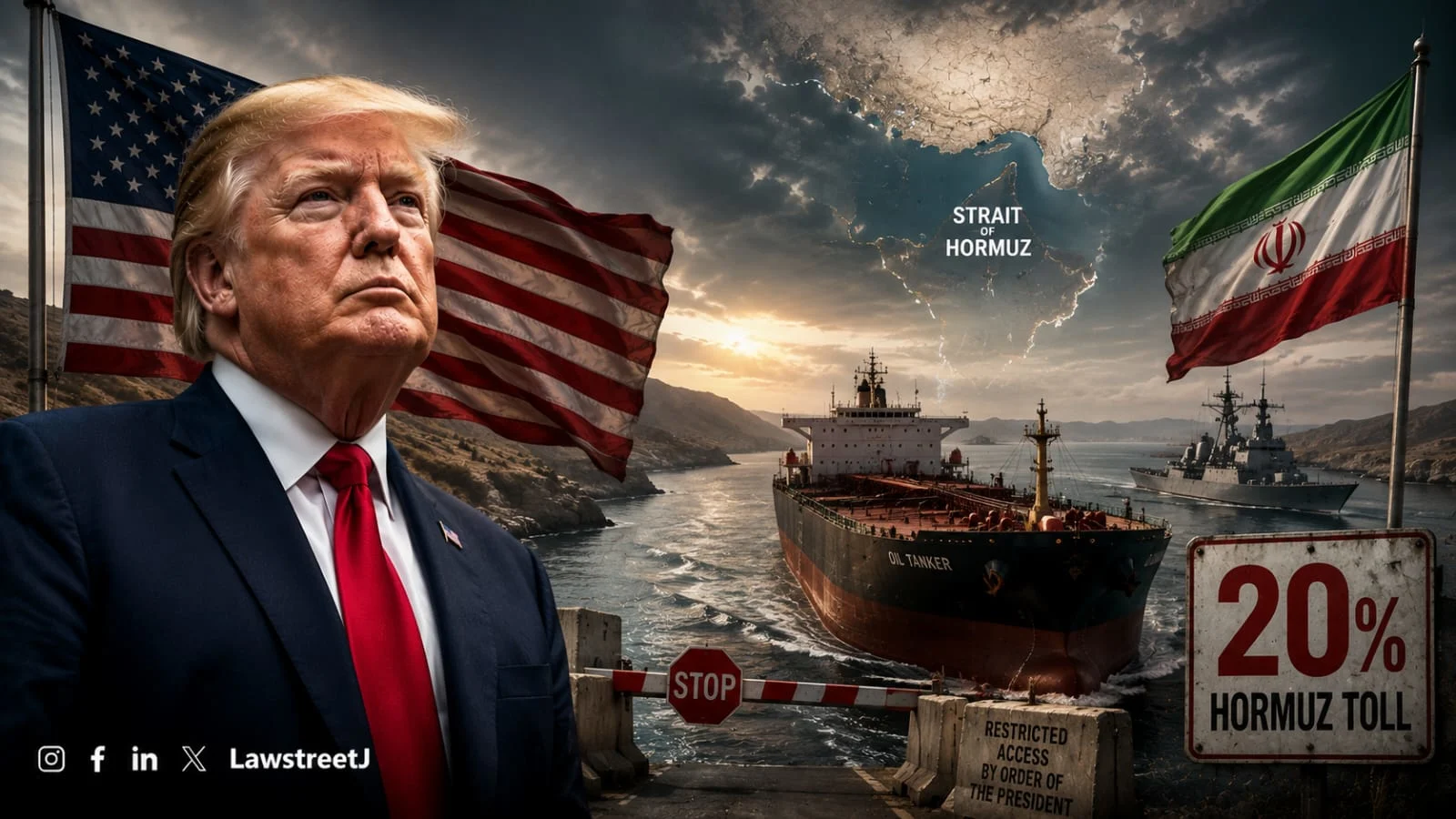
Washington D.C. / Persian Gulf: President Donald Trump announced on July 13 that the United States naval blockade of Iranian ports near the Strait of Hormuz was being reimposed, effective July 14 at 4 p.m. New York time, and simultaneously declared that the United States would impose a fee of 20 percent on the value of all cargo passing through the waterway, a toll that his own Secretary of State described as a violation of international law when Iran proposed an identical charge six weeks earlier. US Central Command confirmed that strikes against Iran had resumed, with CENTCOM announcing on X that as of 4:45 p.m. New York time on July 13, the United States had begun "a third consecutive night of strikes against Iran."

The announcement collapsed the fragile preliminary peace agreement signed at the Palace of Versailles on June 18 and broke off the technical negotiations that had been taking place at Bürgenstock in Switzerland, plunging one of the most consequential diplomatic processes of the year back into open military conflict. Oil prices jumped and stock markets fell on the news. Iran's government stated the agreement had "undoubtedly entered a crisis phase" and declared it would not abide by its terms as long as the United States violated its commitments.
In the same 24-hour period, the United Arab Emirates' Defence Ministry confirmed that two of its tankers, the Mombasa and Al Bahiyah, had been struck by Iranian cruise missiles. One Indian national was killed and eight others were wounded in the attacks, according to the UAE's statement.
What Trump Announced: The Truth Social Post and the Fox News Interview
Trump's announcement came in a Truth Social post on July 13 that combined a declaration of American maritime authority with the announcement of the toll. "The U.S.A. will be, from this point forward, known as 'THE GUARDIAN OF THE HORMUZ STRAIT,'" he wrote. "But as such, and as a matter of FAIRNESS, will be reimbursed, at the rate of 20% on all cargo shipped, for any and all costs necessary to do the job of providing safety and security to this very volatile section of the World. The process and formation will begin immediately."

He confirmed that all countries other than Iran would have "fair and open use of the Strait," but that the United States would reimpose its blockade of Iranian ports. In a Fox News interview earlier the same morning, Trump had telegraphed the announcement. "We're going to keep the strait, and we'll probably run it," he said. "We'll become the guardian of the strait, maybe we'll call it the guardian angel of the strait. And we should be reimbursed for that." He added: "We can't be expected to do that for nothing, unlike we had for many years. We guarded it for nothing, and now we're going to guard it, we're going to get paid for guarding it. A lot of money."
Trump was equally direct about resuming hostilities. "We're going to hit them very hard tonight, and we're going to hit them hard tomorrow," he said in a radio interview on July 13. He formally notified Congress of the resumption of military activities on July 10 through a letter dated that day, submitted under the requirements of the War Powers Resolution. The letter stated that the United States had commenced new military action against Iran on July 7.
The International Law Problem: Rubio's Own Words
The 20 percent toll announcement has created an immediate and acute legal and diplomatic problem for the Trump administration, one rooted in its own prior public statements.
In June 2026, when Iran threatened to impose tolls on ships transiting the Strait of Hormuz, Secretary of State Marco Rubio was explicit in condemning the idea as a violation of international law. "That's the law, it's an international waterway," Rubio said. "No country is allowed to charge tolls or fees. That's existing international law. That's the way it is in international waterways all over the world and that's the way we expect it here."
The United Nations' International Maritime Organisation, the UN agency tasked with regulating maritime shipping, similarly stated at the time that no country has the legal power to impose charges on vessels transiting international straits. Under the United Nations Convention on the Law of the Sea, the Strait of Hormuz is an international strait through which all ships enjoy the right of transit passage, a right that cannot be suspended or conditioned on payment by any state, including a state exercising de facto military control over the waterway.
Trump addressed the legal contradiction directly, though without resolving it. "47 years in a row they were pushing people around," he said of Iran. "They're not pushing us around, we're pushing them around." The White House did not provide details on how the 20 percent toll would be administered, whether it had been communicated to US allies in the Gulf, or what the legal instrument under which it would be collected would be.
The practical consequences of a 20 percent toll, if actually implemented, would be staggering. A fully-loaded Very Large Crude Carrier at current oil prices would face a single-voyage charge of approximately $32 million under the proposed levy. For comparison, Iranian tolls previously described as reaching $2 million per vessel, which the United States had already characterised as illegal extortion, would be sixteen times lower than the American toll. A shipping consultant quoted by CNBC described the announcement as "really just bluster," arguing that if the United States could safely escort ships and guarantee no threat from Iran, "we would have seen that happen in the past few weeks."
More than ten people involved in shipping markets, including several whose vessels had passed through Hormuz in recent weeks, said they were blindsided by the announcement and had received no prior communication from the US government or its Gulf allies.
The Collapse of the Versailles Agreement: What Broke Down and When
The reimposition of the blockade and the resumption of strikes represent the formal end, at least temporarily, of the preliminary peace process that had appeared to be making cautious progress since the June 18 Versailles signing.
The Versailles memorandum of understanding had established a 60-day window for technical negotiations on Iran's nuclear programme, the Strait of Hormuz, and the release of frozen Iranian assets. A deconfliction cell covering Lebanon had been established. A line of communication specifically for Hormuz shipping safety had been created. Iran had committed to diluting its enriched uranium stockpile under IAEA supervision. The United States had lifted its naval blockade and issued sanctions waivers for Iranian crude exports.
That framework began unravelling almost immediately. Israel's continued military operations against Hezbollah in Lebanon, neither Israel nor Hezbollah was a signatory to the agreement, created persistent tension throughout June. The first round of technical talks at Bürgenstock on June 21 and 22 survived Trump's public Truth Social threats during the negotiations, but produced only a preliminary roadmap rather than substantive agreements.
The situation deteriorated further in early July. Trump's letter to Congress, dated July 10, notified lawmakers that new US military action against Iran had commenced on July 7, three weeks before the 60-day window of the Versailles agreement would have expired. The reimposition of the full blockade on July 14 confirms that Washington has effectively abandoned the Versailles framework, at least in its current form.
Iran's government said its decision not to abide by the agreement's terms was a direct response to American violations of the deal's commitments, specifically, the resumption of military strikes while the 60-day negotiating window was still technically running.
The War Powers Resolution: Congressional Challenge and Its Limits
The legal status of the resumed conflict between the United States and Iran is itself a contested question. Under the War Powers Resolution of 1973, the President is required to notify Congress within 48 hours of introducing US armed forces into hostilities and to terminate those hostilities within 60 days unless Congress has declared war or enacted specific authorisation.
Congress last month approved a measure directing an end to US hostilities in Iran under this provision. That step was described at the time as mostly symbolic, it required a congressional majority but not a veto-proof supermajority, and Trump was expected to veto any such resolution. Democrats have now stated that the war is illegal and that Trump cannot restart the 60-day clock by simply sending a new War Powers notification, arguing that the resumption of hostilities after Congress voted to end them represents a constitutional overreach that cannot be cured through procedural notification.
The constitutional question of whether a president can restart a military conflict after Congress has directed its termination and whether the War Powers Resolution's 60-day clock is reset by each new notification or runs continuously from the initial commencement of hostilities has not been definitively adjudicated by any court. It is now a live question in the US-Iran conflict's legal architecture.
India's Exposure: One National Dead, Energy Route Threatened
The Indian dimension of Monday's developments is significant on two levels.
First, the death of an Indian national in the Iranian cruise missile strike on the UAE tankers Mombasa and Al Bahiyah is an immediate consular matter for the Indian government. The UAE's Defence Ministry confirmed the casualty on X, with eight others wounded. The Indian Ministry of External Affairs had not issued a statement as of the time of publication.
Second, the reimposition of the blockade and the resumption of US-Iran hostilities directly affects India's energy security. India is the world's third-largest oil importer and relies heavily on Gulf crude transiting the Strait of Hormuz. When the strait was effectively closed between February and mid-June 2026, India's energy import costs rose substantially, contributing to the RBI's foreign exchange reserve drawdown and generating inflationary pressure on fuel prices. A return to blockade conditions, even with the United States promising "fair and open use" for non-Iranian vessels, introduces the same logistical risks and price volatility that the June peace agreement had appeared to resolve.
The 20 percent toll, if implemented on Indian tankers transiting Hormuz, would add a very large additional cost to every barrel of Gulf oil India imports. On an annualised basis, applied to India's total Gulf import volumes, the cost implications would run into tens of billions of dollars, a figure that makes the toll proposal, if it becomes operational rather than rhetorical, a bilateral economic issue of significant magnitude.
Market Reaction and What Comes Next
Oil prices jumped following Trump's announcement, reversing much of the decline that had followed the June Versailles deal. Equity markets fell. Shipping stocks were volatile as market participants assessed the credibility and operational feasibility of a 20 percent toll on Hormuz cargo.
The resumed conflict leaves the diplomatic path forward deeply uncertain. Iran has declared the agreement to be in crisis. The United States has reimposed its blockade. CENTCOM has confirmed that strikes are ongoing. The IAEA's access to Iran's nuclear sites, which had been negotiated as part of the Versailles framework is now of uncertain status.
Qatar and Pakistan, the mediators of the Bürgenstock process, had not issued public statements as of the time of publication. Whether either is willing or able to restart a mediation effort while active hostilities continue is an open question.
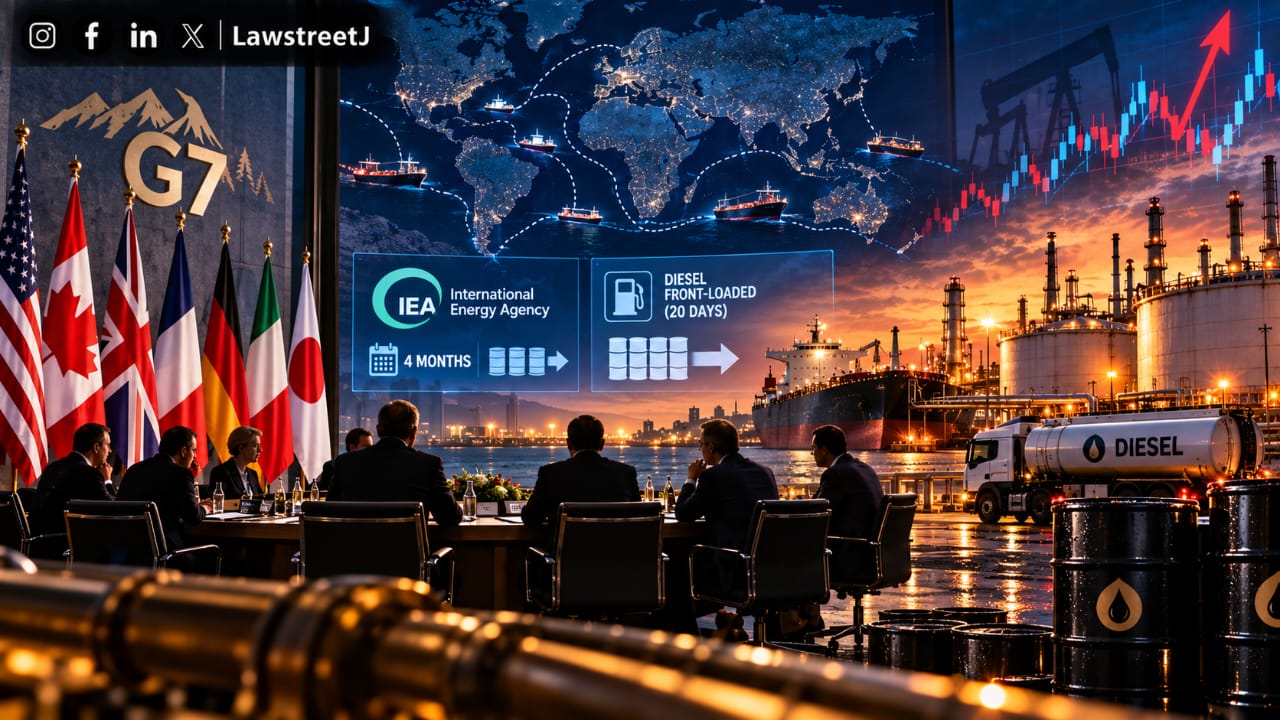
What is not in question is the scale of the disruption. The Strait of Hormuz carries approximately 20 percent of the world's daily oil flows. A naval blockade, combined with a legally contested toll and resumed US-Iran strikes, has returned the world's most critical maritime chokepoint to precisely the conditions that drove oil to its 2026 highs in May, conditions that the June peace agreement had, briefly, appeared to end.


.jpeg)