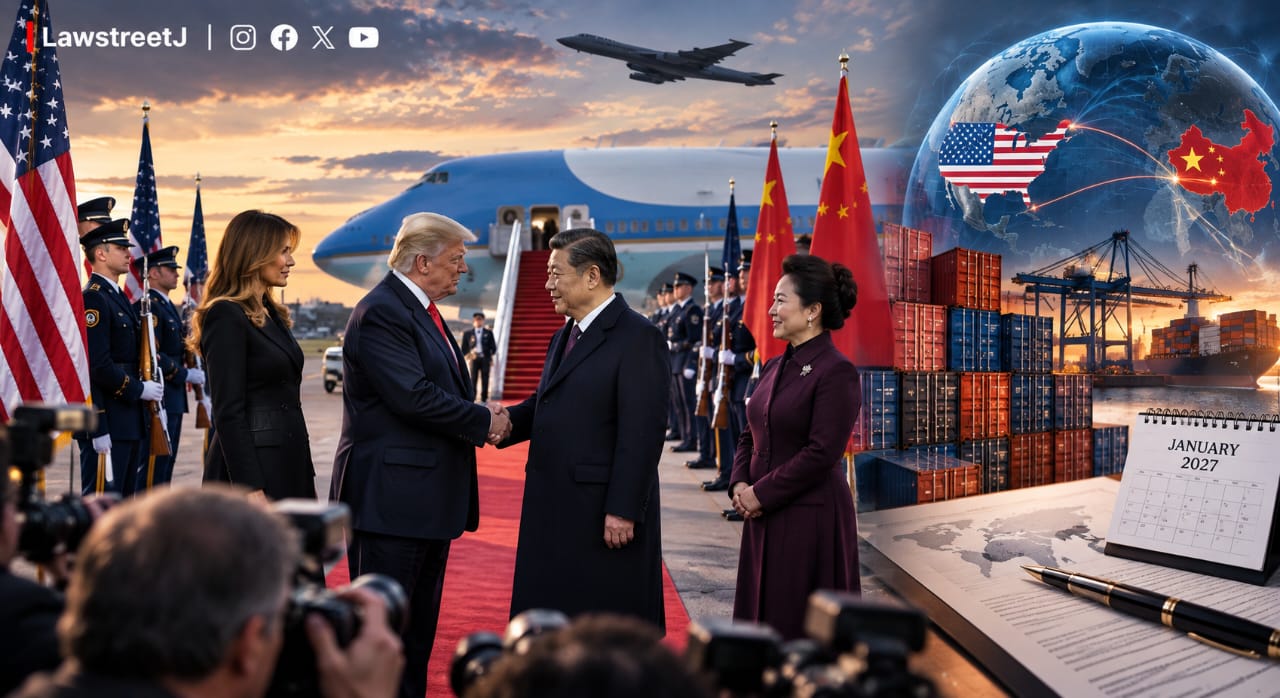
WASHINGTON — Donald Trump did something on Wednesday he almost never does for a visiting head of state, he showed up in person to meet the plane.
Chinese President Xi Jinping landed at Joint Base Andrews outside Washington on Wednesday, September 23, 2026, for the start of a three-day state visit, and Trump was there waiting on the tarmac when he stepped off, joined by First Lady Melania Trump. It marked the first time in eleven years that a sitting US president has personally greeted a foreign leader at Andrews rather than receiving them later at the White House, according to reporting tracking presidential protocol. Under normal State Department procedure, arriving heads of state are typically met by the Chief of Protocol, senior military officials, or the ambassador to their home country, not the president himself.
The reception had all the trimmings of a full state occasion. As Xi's aircraft touched down around 4pm local time, a military band played, cannons fired in salute, and a B-1 bomber flew overhead. Trump and Xi, along with their wives, Melania Trump and Peng Liyuan, shook hands, exchanged a few words, and posed for photographs before the ceremony wrapped. Trump later called it a "great greeting" when speaking to reporters back at the White House, adding that he was pleased to land on what he described as "the most beautiful helipad ever built."
A Gesture Xi Didn't Quite Return in May
The warmth of Wednesday's reception stands out partly because of how it compares to what Trump himself received a few months earlier. When Air Force One touched down at Beijing Capital International Airport on May 13 for Trump's own state visit to China, Xi did not come out to the tarmac to meet him. That reception was instead led by Vice-President Han Zheng, accompanied by ambassadors, senior foreign ministry officials, an honour guard, a military band, and flag-waving youth, a formally correct welcome, but not one involving China's top leader personally.
Trump's decision to meet Xi at Andrews therefore reads as a deliberate, if slightly asymmetric, gesture, a courtesy he has not extended to any other visiting leader during his second term. During that earlier Beijing trip, Xi hosted Trump for a dinner banquet in the Golden Room of the Great Hall of the People, and it was there that Trump extended an invitation for Xi to make a reciprocal state visit to the United States, an invitation that has now been fulfilled with Wednesday's arrival.
Timed almost precisely with Xi's landing, US Treasury Secretary Scott Bessent announced that Washington and Beijing had agreed to extend their existing trade truce, an arrangement both sides refer to as the Busan Agreement, first struck when Trump and Xi met on the sidelines of a summit in Busan, South Korea, on October 30, 2025. That original one-year truce had been set to expire on November 10. Under Wednesday's extension, it will now run through January 10, 2027, instead.
"We have agreed today that we will extend what we call the Busan Agreement. The detente, economic detente between the two countries that was scheduled to end on Nov. 10, that is going to be extended until Jan. 10, to give us more time to see what we can do on the," Bessent said, speaking to Fox News shortly after Xi's arrival. He noted the extension was designed to buy additional time for negotiators to work through the more difficult technical details still separating the two sides, rather than representing a final, comprehensive settlement of the broader trade relationship.
The stakes behind that truce are considerable. Peak baseline US tariffs on Chinese goods reached 145 percent during last year's escalation, matched by retaliatory Chinese levies of similar scale, a level of economic confrontation neither government appears eager to revisit while unresolved issues remain on the table. Analysts tracking the relationship have suggested Trump and Xi could either reach a more durable, comprehensive agreement by January, or simply extend the current truce again if talks aren't finished by then.
What's Actually on the Table for Thursday's Talks
The ceremonial welcome was only the opening act. Trump and Xi were scheduled to sit down for substantive talks on Thursday at the White House, and the list of unresolved issues between the two governments is long. China has so far resisted pressure, including economic pressure, from the Trump administration to use its leverage over Iran to help bring an end to the war there, now stretching into its seventh month.
On the other side of the table, Xi is expected to press Trump on two long-standing priorities, a permanent halt to US arms sales to Taiwan, and a loosening of export restrictions currently limiting China's access to cutting-edge advanced semiconductor chips.
Beyond Taiwan and chips, the two leaders are expected to cover a wider range of subjects during the visit, including artificial intelligence safety, the broader trade relationship, and access to critical minerals, an area where China holds substantial global leverage through its dominance of rare earth processing. Asked by reporters whether Iran specifically would come up in his conversations with Xi, Trump was noncommittal but didn't rule it out. "We'll see. We'll see. I'll be talking about that and many other subjects. We'll see, but it's all coming along well, including that," he said.
Why Both Leaders Have Reason to Keep the Peace
Both governments appear to have their own domestic reasons for wanting this relationship to stay stable, at least for now. Trump's Republican Party is heading into the November midterm elections facing real headwinds in its effort to maintain control of Congress, and another round of tariff-driven economic disruption is not something the party can easily absorb during a competitive election cycle.
On the other side, Xi is managing an uneven Chinese economy, one where domestic consumption and growth remain sluggish even as the country's high-tech export sector continues performing strongly, giving Beijing its own incentive to avoid reopening a costly trade fight.
Xi's own public statement following the arrival ceremony, released through China's state-run Xinhua news agency, struck a similarly conciliatory tone, with Xi saying China and the United States should be partners rather than rivals. One regional analyst speaking to international media described the broader significance of this exchange of visits as genuinely unusual by historical standards, noting there has never before been a precedent in US-China relations for the top leaders of both countries to visit each other's capitals within the same calendar year.
The red-carpet treatment wasn't confined to the tarmac either. Trump indicated that Wednesday night's state dinner for Xi would draw a substantial guest list from America's business and finance world. "The entire tech world, the entire banking world, and a lot more will be in attendance at tomorrow night's state dinner for Chinese President Xi," Trump told reporters, adding, somewhat wistfully, "I wish we had more seats," a comment suggesting demand to attend had outstripped the dinner's actual capacity.
With the ceremonial portion of the visit now complete and the trade truce extension already locked in before substantive talks even began, attention turns to Thursday's White House meeting, where the harder, unresolved questions, Taiwan arms sales, chip export controls, and whether Beijing will apply any real pressure on Iran, are set to be addressed directly between the two leaders.