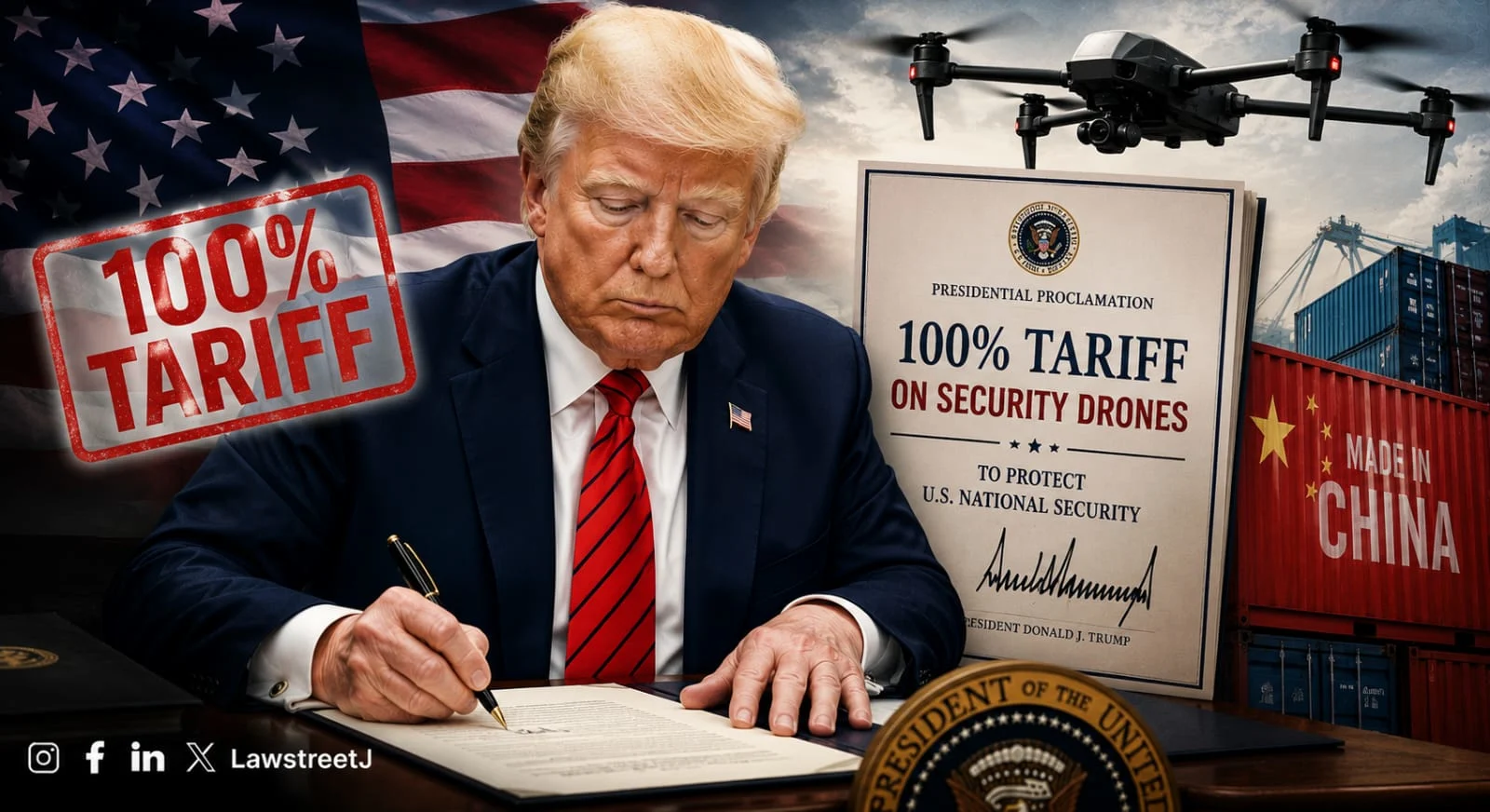
WASHINGTON D.C. — President Donald Trump signed a proclamation on Thursday imposing sweeping new tariffs on imported drones and their components, with the heaviest duties targeting large, security-capable unmanned aircraft systems that the administration characterised as a direct threat to American national security. The move, based on a formal Section 232 national security investigation, creates a tiered tariff structure that could fundamentally reshape the global drone supply chain and one that arrives just a day after the White House released a separate report accusing more than 40 countries of helping China evade existing US tariffs.
A proclamation signed by Trump imposes a 100% ad valorem tariff on drones of a certain size or with certain capabilities that are particularly sensitive for national security purposes. A 25% tariff will be imposed on drones that are smaller in size.
The United States is "too reliant" on foreign sources of unmanned aircraft systems, according to Commerce Secretary Howard Lutnick, whose department conducted the Section 232 investigation that provided the legal basis for Thursday's action. "The Secretary found that import penetration from foreign producers of UAS is substantial and that the United States is too reliant on foreign sources of UAS and UAS components," Trump said in the proclamation text released by the White House.
Most of the new tariffs are to take effect on September 3, 2026, while component tariffs on non-sensitive parts will be delayed for 180 days until February 9, 2027, giving domestic manufacturers time to adjust sourcing strategies.
The Tiered Structure: What Gets Hit at What Rate
The most significant feature of Thursday's proclamation is not the 100% headline rate, it is the precision of the tier system that determines exactly which drones face which duty.
Heavy industrial and military-grade drones, specifically those with a maximum takeoff weight exceeding 25 kilograms or equipped with national security capabilities such as thermal imaging and docking stations will face a 100% ad valorem tariff. The maximum rate also applies to docking stations and essential hardware, while smaller commercial and recreational drones that lack sensitive operational features will be subjected to a 25% duty.
A 15% tariff will be imposed on drones and components from the European Union, Japan, Liechtenstein, South Korea, Switzerland, and Taiwan, and a 10% ad valorem tariff will be imposed on drones from the United Kingdom, provided that substantially all hardware, software and technology originates from within those countries and the United States.
The allied-nation rate of 15% for countries like Japan, South Korea and EU member states suggests the administration wants to penalise foreign dependence broadly while still maintaining some preferential treatment for geopolitical partners. That structure effectively channels the heaviest tariff burden toward non-allied suppliers, chiefly China, which dominates global drone and component manufacturing, while offering allied and partner nations a materially lower rate.
The structure is deliberately calibrated. A 100% tariff on drones weighing more than 25 kilograms with thermal imaging capability directly targets the industrial, agricultural, infrastructure-monitoring, and defence-adjacent segments of the market, the segments where Chinese manufacturers have the deepest penetration and where the national security rationale is most direct. The 25% rate on smaller drones consumer quadcopters, hobby aircraft, and lightweight commercial models, applies a significant but less prohibitive duty to a segment where the security risk is lower but Chinese market dominance is equally entrenched.
Why Drones Are a National Security Question
The White House's justification for invoking Section 232, a trade authority typically associated with steel and aluminium tariffs, rests on a national security argument about the dual-use nature of drone technology.
The White House stated that drones "are inherently dual-use: they are both commercial platforms and potentially military or paramilitary sensors and weapons," and that foreign production of drones and their components "could enable persistent surveillance, data exfiltration, and destructive operations over US territory."
The war in Ukraine has underscored how commercial and hobbyist drones can be outfitted for frontline attacks.
The Ukrainian conflict has provided the most documented modern evidence of this dual-use character. Drones originally manufactured for agricultural surveys, photography, or recreational use have been adapted with explosive payloads, modified guidance systems, and electronic warfare capabilities first by Ukrainian volunteer groups and later by both sides at industrial scale. The resulting battlefield reality has forced every major military power to rethink its assumptions about the security implications of civilian drone supply chains.
The legal basis for the tariffs is a Section 232 investigation into unmanned aircraft systems, which was initiated in July 2025. Section 232 is the same authority previous administrations have used to impose tariffs on steel and aluminium.
The commerce secretary's investigation that preceded the proclamation found two related problems: that US domestic drone manufacturing capacity is insufficient to meet military and national security requirements, and that the current supply chain, heavily dependent on Chinese components even for drones assembled elsewhere creates vulnerabilities that could be exploited by adversaries in a conflict scenario.
Lutnick found that drone and drone components from certain foreign entities "pose security and safety risks" and that the domestic US industry does not produce enough to meet security needs.
DJI and China: The Unmistakable Target
The tariff structure's effect is felt most acutely by one company, Shenzhen-based DJI Technologies.
The measure takes aim at China's dominant position in the unmanned aircraft market, where manufacturers like Shenzhen-based DJI Technologies account for roughly 70% of the US commercial drone sector.
DJI is the world's largest drone manufacturer by market share, a position it has built over the past decade by producing reliable, affordable, feature-rich drones across consumer, prosumer, and industrial categories. Its dominance in the US commercial market roughly 70% of the commercial sector means that the tariffs will be felt immediately and significantly by American businesses, agriculture operations, film productions, real estate companies, and infrastructure inspection firms that depend on DJI equipment.
DJI's products are already on several US government restricted lists, including the Federal Communications Commission's Covered List of equipment deemed to pose national security risks. Under Thursday's proclamation, products on those lists face the standard tariff timeline unless they fall under the 180-day delayed implementation for non-sensitive components.
The White House's position is that even if DJI drones are not being actively used for espionage by their Chinese manufacturer, the theoretical capability of Chinese-manufactured drones to collect and transmit data to Chinese government entities under China's national security laws, which require Chinese companies to cooperate with intelligence services on request constitutes a standing security risk that the tariffs are designed to price out of the American market.
The Onshoring Programme: A Path for Companies to Invest Domestically
The proclamation does not simply impose costs on foreign manufacturers. It creates a pathway for US domestic production that includes a significant financial incentive for companies willing to build new manufacturing infrastructure.
The administration built an onshoring program that grants temporary tariff exemptions to companies committing to build new manufacturing facilities in the United States before January 20, 2029. Qualifying firms that submit verified capital expenditure plans will be permitted to import necessary components duty-free during the construction phase to support operational scaling.
January 20, 2029 is the end of Trump's second presidential term, making the onshoring deadline explicitly tied to the administration's timeline and framing domestic drone manufacturing investment as a deliverable that the Trump administration expects to see completed before it leaves office.
The Commerce Department is authorised to administer the programme, evaluate capital expenditure plans, and determine which companies qualify for the temporary duty-free component import exemption. The structure mirrors, in its broad outlines, the domestic manufacturing incentives embedded in the CHIPS and Science Act for semiconductor production, an acknowledgement that strategic industries require active government facilitation of domestic supply chain development, not just tariff pressure on foreign suppliers.
The Broader Context: Robots, Tariffs, and the US-China Technology Decoupling
Thursday's drone tariff proclamation is one of several technology-sector actions the Trump administration has taken in recent weeks as part of what is emerging as a systematic decoupling of US supply chains from Chinese manufacturers in defence-adjacent technology categories.
That move came days after the US imposed fresh tariffs on China and 59 countries. In late July 2026, the US government also added humanoid and quadruped robots to a blacklist of products and companies barred from import into the United States, saying they posed critical national security risks.
The addition of humanoid and quadruped robots to the import blacklist, announced in late July, placed a category of emerging robotics technology alongside drones in the US government's formal national security threat assessment. The common thread across both decisions is the dual-use logic: technologies that are commercially available and widely used in civilian applications, but which have demonstrated or foreseeable military applications that make their foreign origin a strategic vulnerability.
Combined with the onshoring authorisation for Commerce and the parallel shipbuilding memorandum, this reads as part of a broader push to rebuild US defence-adjacent manufacturing capacity, a theme likely to keep showing up alongside the administration's tariff and industrial policy agenda through the rest of the year.
In June 2025, President Trump had signed an Executive Order "Unleashing American Drone Dominance" to ensure continued American leadership in the development, commercialisation and export of drones by prioritising US-manufactured drones and promoting their export. Thursday's tariff proclamation is the most consequential implementation step of that earlier executive direction.
What Happens Next
The September 3 implementation date gives affected companies, importers, and government contractors approximately three weeks to adjust to the new tariff regime. For the consumer and commercial drone market, the 25% rate on smaller models will translate into immediate price increases for end users, increases that will be most acutely felt by small businesses and individual operators who depend on affordable Chinese-manufactured equipment.
For the larger industrial and defence-adjacent drone market, the 100% rate represents a structural disruption that cannot be absorbed through price adjustment alone. Companies that have built their operations around DJI or other Chinese industrial drone platforms will need to either absorb prohibitive import costs, transition to allied-nation suppliers at the 15% tariff rate, or wait for US domestic alternatives to scale, the latter being the outcome the onshoring programme is explicitly designed to accelerate.
China, which has not yet formally responded to Thursday's proclamation, is widely expected to issue counter-measures. The previous rounds of Section 232 tariffs on steel and aluminium triggered retaliatory actions from multiple trading partners. Whether China's response to the drone tariffs takes the form of reciprocal duties on US goods, restrictions on Chinese component exports, or other measures will become clear in the days following the announcement.



.jpeg)