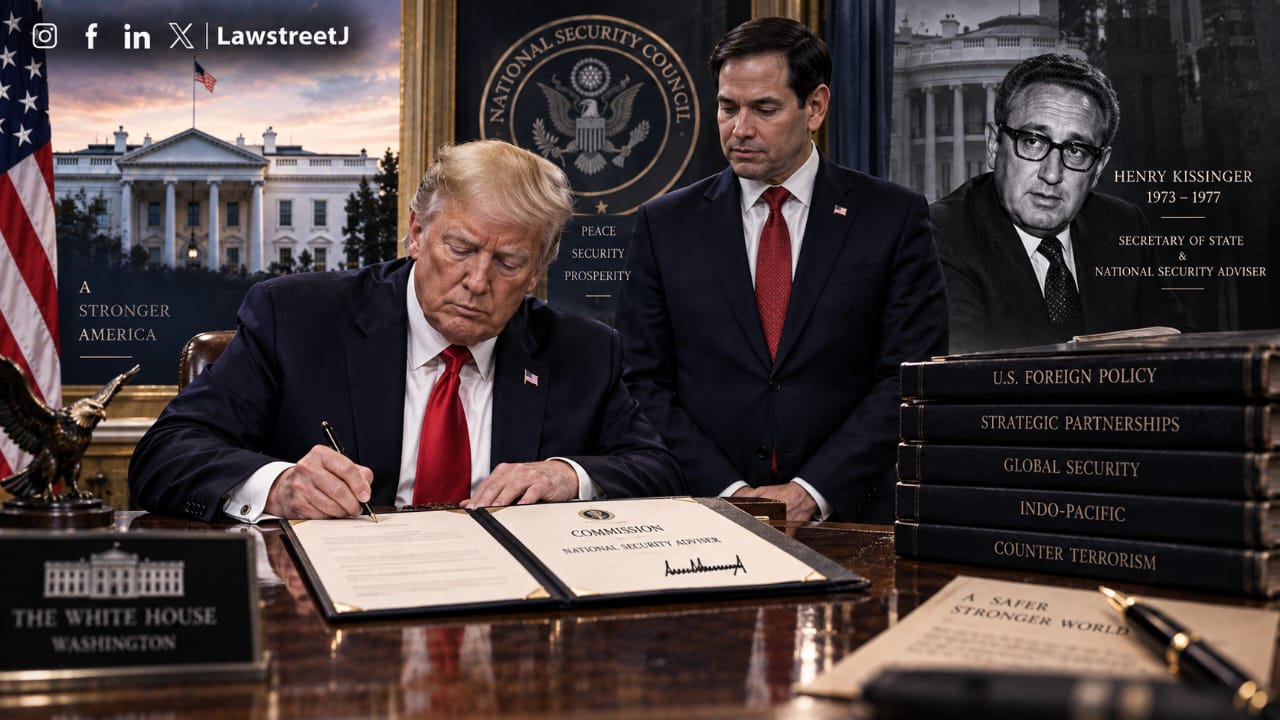
WASHINGTON — President Donald Trump signed a commission this week formally making Secretary of State Marco Rubio his permanent national security adviser, three administration officials confirmed to Fox News Digital on Tuesday, September 22, 2026. The move ends more than sixteen months of Rubio holding the position on an acting basis and locks in what is, by any historical measure, an unusual concentration of power in a single official's hands.
The appointment makes Rubio only the second person in American history to simultaneously hold the titles of secretary of state and national security adviser. The first was Henry Kissinger, who ran both roles under Presidents Richard Nixon and Gerald Ford from 1973 to 1975. That's the company Rubio now keeps, a fifty-year gap between the only two people who've ever tried running America's diplomatic and national security apparatus out of the same office at the same time.
How Rubio Ended Up Here
Rubio didn't walk into this role by plan, it was more accident of circumstance than deliberate strategy. He'd been serving as acting national security adviser since May 2025, when Trump removed Michael Waltz from the post following the so-called "Signalgate" episode.
Waltz had created a private group chat on the encrypted messaging app Signal where senior officials, including Defense Secretary Pete Hegseth and Vice President JD Vance, discussed military planning against the Houthis in Yemen, and the chat reportedly included a journalist who wasn't supposed to be there. Waltz was pushed out of the West Wing role and later nominated as US ambassador to the United Nations, a post he still holds.
Trump turned to Rubio to fill the gap, and by most accounts, never really moved on from that arrangement. "When I have a problem, I call up Marco. He gets it solved," Trump said at the time he tapped Rubio for the acting role, a line that's been quoted repeatedly since as shorthand for how the president views his secretary of state. What started as a stopgap fix following a security scandal has now, sixteen months later, become permanent policy.
One detail that matters here, and explains why this could happen through a signed commission rather than a drawn-out confirmation fight, the national security adviser position does not require Senate confirmation. It's a White House staff role, not a Cabinet post requiring the usual advise-and-consent process that Rubio's secretary of state nomination went through back in January 2025, when he was sworn in as America's first Hispanic secretary of state.
That procedural quirk means Trump could formalize this dual arrangement essentially by signature, without the kind of public hearing or vote that typically accompanies a major cabinet-level appointment. The White House confirmed the move through multiple channels, MS NOW first reported the news, and outlets across the political spectrum, from The Hill to Newsmax to VINnews, independently confirmed it through administration sources within hours of each other.
What the Job Actually Involves Now
With the commission signed, Rubio will continue managing the National Security Council process, the interagency body that coordinates foreign policy and defense decisions across the federal government, while also serving as what's been described as a direct line to the president on intelligence, defense and diplomatic questions.
In practice, that means Rubio now sits at the center of essentially every major national security decision the administration makes, both formulating the diplomatic response as secretary of state and shaping the security and intelligence framing as national security adviser, two jobs that, in most administrations, exist specifically to check and balance each other from separate vantage points.
Beyond these two headline roles, Rubio has also picked up a string of additional titles during Trump's second term that have made him something of a running joke in Washington circles, not maliciously, but as a genuine acknowledgment of just how much he's been asked to take on. He's served as acting administrator of USAID and as acting head of the National Archives, appointments that, taken together with his State Department and now permanent NSA duties, have made him the subject of what Fox News described as "meme-worthy" internet commentary, including a wave of jokes built around images of Rubio depicted wearing a different outfit for each job he's simultaneously holding down.
The Kissinger Comparison, and Why It's Complicated
Drawing a direct line to Kissinger is the natural historical comparison here, but it's worth being precise about what that comparison actually means. Kissinger's dual tenure in the 1970s remains one of the most scrutinized arrangements in the history of American foreign policy, precisely because concentrating both roles in one person raises structural questions that go beyond any individual official's competence.
The national security adviser role exists, in part, to give a president an internal check on the State Department's institutional instincts, someone positioned to push back on diplomatic groupthink from inside the White House itself. When one person holds both jobs, that internal tension effectively disappears.
Other officials have held both positions at different points in their careers without ever holding them simultaneously, Colin Powell and Condoleezza Rice both served as secretary of state and, separately at other times, as national security adviser, but never at the same moment. Rubio's arrangement is different in kind, not just degree, and that distinction is exactly why the pairing has, according to reporting from VINnews, "drawn both praise and criticism" from people across the foreign policy establishment.
The appointment also lands at a moment when Rubio's name keeps surfacing in conversations well beyond his current portfolio. The former Florida senator has been floated repeatedly as a potential 2028 Republican presidential contender, often mentioned in the same breath as Vice President Vance. Asked about it directly earlier this month during an interview with Colombian news station RCN, Rubio kept his answer deliberately noncommittal. "I don't know what the future holds, but I have no plans at this time," he said, according to a translation carried by NBC News. "I'm not a candidate for anything right now."
Whatever his longer-term ambitions, Rubio's immediate reality is now defined by an unusually heavy workload sitting at the intersection of diplomacy, national security, and, apparently, whatever else the administration decides needs a steady hand.
As he put it himself during that same Colombia trip, addressing just how stretched his current responsibilities already are, "I'm 100% focused on my job, and I have to be because I have two jobs." As of this week, that description is now more accurate, and more permanent, than it's ever been.



.jpeg)