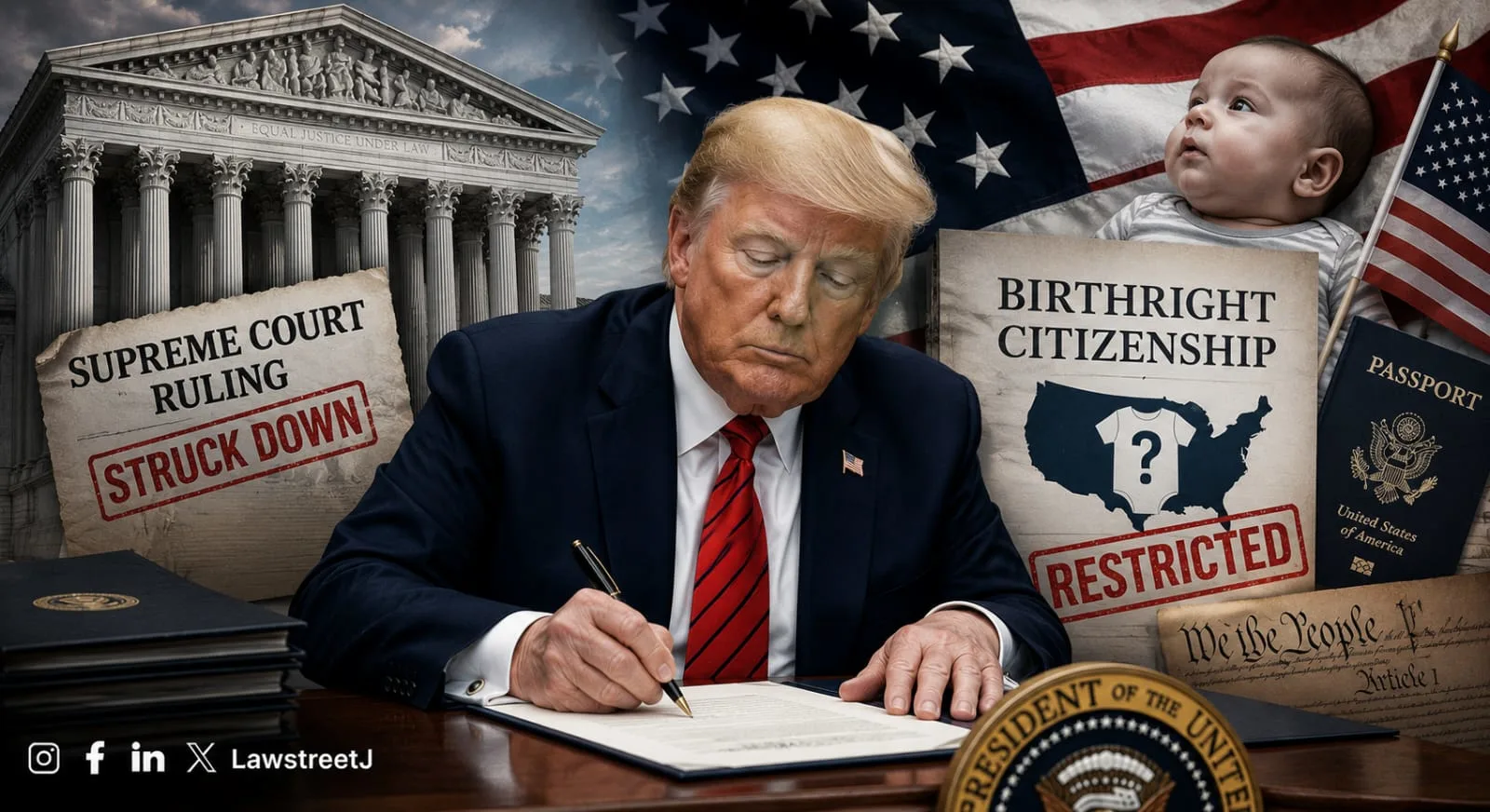
WASHINGTON D.C. — President Donald Trump signed two executive orders on Thursday targeting birthright citizenship, one of the most constitutionally entrenched rights in American law, just months after the Supreme Court of the United States struck down his first attempt to limit it by a vote of six to three. The signing, which took place in the Oval Office, represents the Trump administration's most direct response yet to that ruling, and signals a determination to continue challenging the scope of automatic citizenship through executive action even after the country's highest court upheld its constitutional protection in June.
The president said he was signing two executive actions on immigration, including one limiting the number of people eligible for US citizenship after being born in the United States, while another focused on stopping people from coming to the US to give birth.
Speaking from the Oval Office, Trump denounced the Supreme Court for making a "very unfortunate decision" in striking down his initial effort to limit birthright citizenship. "They've taken birthright citizenship and they've made a joke out of it," said Trump, adding that his administration is "making adjustments" to its approach.
"I thought we were going to win it at the Supreme Court. Unfortunately, we had a bad decision, very unfair decision. Our country suffers because of it and we're ending it a different way," Trump said.
What the Two Orders Actually Do
The two executive orders signed on August 6 are more narrowly drawn than the sweeping Day One order Trump signed at the start of his second term, a deliberate attempt to construct a more legally defensible version of the same policy after the Supreme Court's rejection.
One of the executive orders signed by Trump targets "alien enemies," members of foreign terrorist organizations and categories of people who lobby and act on behalf of foreign government, making children born to people in those groups ineligible for birthright citizenship, said White House deputy chief of staff Stephen Miller, the architect of the administration's immigration policies.
One of the orders seeks to expand a narrow exception to birthright citizenship, which bars US citizenship from being conferred to the babies of foreign diplomats or invading forces. Trump's expansion would also exclude the children of alleged "terrorists," people deemed to be attempting to "purchase" citizenship and certain people born in US territories.
A second order seeks to curb what Trump called "birth tourism" by increasing restrictions on visitors to the US who want to obtain visas to give birth while in the country.
The second order calls on the Secretary of State and the Secretary of Homeland Security to halt so-called "birth tourism", the practice of mothers travelling to the US for the sole purpose of giving birth.
The written executive order released Thursday was narrower in scope than the previous one shot down by the Supreme Court and appeared to focus on restricting automatic citizenship in specific, targeted categories rather than ending it broadly.
However, legal experts noted a significant problem with the birth tourism order specifically. The Migration Policy Institute noted that it is already considered fraud and grounds to restrict a visa if someone seeks a visa specifically to come to the US and obtain citizenship for a child. US law already bans people from obtaining a visa "for the primary purpose of obtaining US citizenship for a child by giving birth in the United States." The second executive order therefore appears, in substantial part, to reinforce existing legal prohibitions rather than create new ones.
How the First Order Was Defeated: From Day One to the Supreme Court
To understand the significance of Thursday's signing, it is necessary to trace the full arc of the administration's first attempt because what was attempted, how it failed, and how the Supreme Court ruled all bear directly on what happens next.
On Trump's first day in office of his second term, he signed an executive order aimed at ending birthright citizenship, which allows anyone born in the United States to automatically become an American citizen. Trump's administration was immediately sued by opponents who said the executive order went against the 14th Amendment, adopted after the Civil War, which makes anyone born in the country a citizen, with very limited exceptions. The executive order was blocked by several lower courts and never took effect.
On April 1, 2026, Trump took the extraordinary step of personally attending the Supreme Court oral arguments on his administration's appeal, the first sitting President in American history to attend oral arguments at the nation's highest court.
In June, the Supreme Court struck down Trump's order by a 6-3 vote. The majority opinion stated: "If Congress intended to limit American citizenship to the children of those domiciled in the United States, nothing in the succinct language of the Citizenship Clause conveyed that design."
The vote of six to three was notable and has been acknowledged to be discomfiting for immigration advocates who had expected a more decisive margin. The closeness of the vote has been cited as one of the reasons the administration is pressing ahead with fresh attempts rather than accepting the June ruling as a settled matter.
The 14th Amendment: The Constitutional Foundation at Stake
The legal battle over birthright citizenship is ultimately a battle over the meaning of one sentence in the United States Constitution.
The 14th Amendment, ratified in 1868 in the aftermath of the Civil War, states: "All persons born or naturalized in the United States, and subject to the jurisdiction thereof, are citizens of the United States and of the States wherein they reside." The amendment was designed to guarantee citizenship to formerly enslaved people and has since been interpreted to confer citizenship to virtually anyone born on American soil.
The Supreme Court established this interpretation definitively in 1898, in United States v. Wong Kim Ark, where it ruled that a child born in San Francisco to Chinese immigrants was a US citizen by birth regardless of his parents' citizenship status or immigration classification. That ruling has stood for 128 years as the binding constitutional interpretation of birthright citizenship and it is that interpretation that the Trump administration has now twice sought, through executive action, to narrow.
The new orders do not directly challenge the 14th Amendment on its face. Instead, they seek to reinterpret who is "subject to the jurisdiction" of the United States, the clause that has historically been read to include virtually all persons physically present in the country. By targeting specific categories of people, enemy aliens, foreign terrorist organisation members, and those deemed to be purchasing citizenship, the administration is attempting to carve out exceptions within the existing constitutional framework rather than dismantle it entirely.
Legal Response: Challenges Expected Immediately
The legal community's reaction to the August 6 orders was swift and pointed.
Mark Wofsy, who served as lead counsel for the plaintiffs in the Supreme Court case, said: "The Supreme Court already decided this issue: Birthright citizenship is guaranteed by the Constitution. No additional executive order can change the meaning of the Constitution."
Like Trump's earlier attempt, the new executive orders are expected to face legal challenges. Civil liberties organisations, immigration advocacy groups and the attorneys who successfully challenged the first executive order are expected to file suits in federal district courts seeking injunctive relief before the orders can take effect.
The administration's argument, that the new orders are narrower and more constitutionally precise than the first, will need to survive that scrutiny. The June Supreme Court ruling does not necessarily insulate the new orders from challenge. The court struck down the first order on the specific grounds that it broadly reinterpreted the Citizenship Clause. Whether the new, more targeted orders fall within or outside that ruling's scope will be determined by the lower courts in the first instance, with a likely return to the Supreme Court to follow.
Trump said he thought his latest actions would be constitutional. Whether the courts agree will determine whether these orders suffer the same fate as the first or whether the administration has found a version of the policy that can survive constitutional review.
The Broader Immigration Context
Birthright citizenship is one plank in a much wider immigration enforcement agenda that the Trump administration has been pursuing across its second term. The administration has simultaneously moved to expand deportation operations, restrict legal immigration categories, tighten asylum processing, and pursue legislation that would reduce the overall level of both legal and undocumented immigration.
Trump has made a hardline approach to immigration a centrepiece of his political career. The August 6 signing, taking place just hours before the current date of publication is the latest act in a sustained effort to reshape the legal and constitutional framework around American citizenship and immigration, an effort that has now explicitly survived one Supreme Court rejection and shows no indication of stopping.


.jpeg)