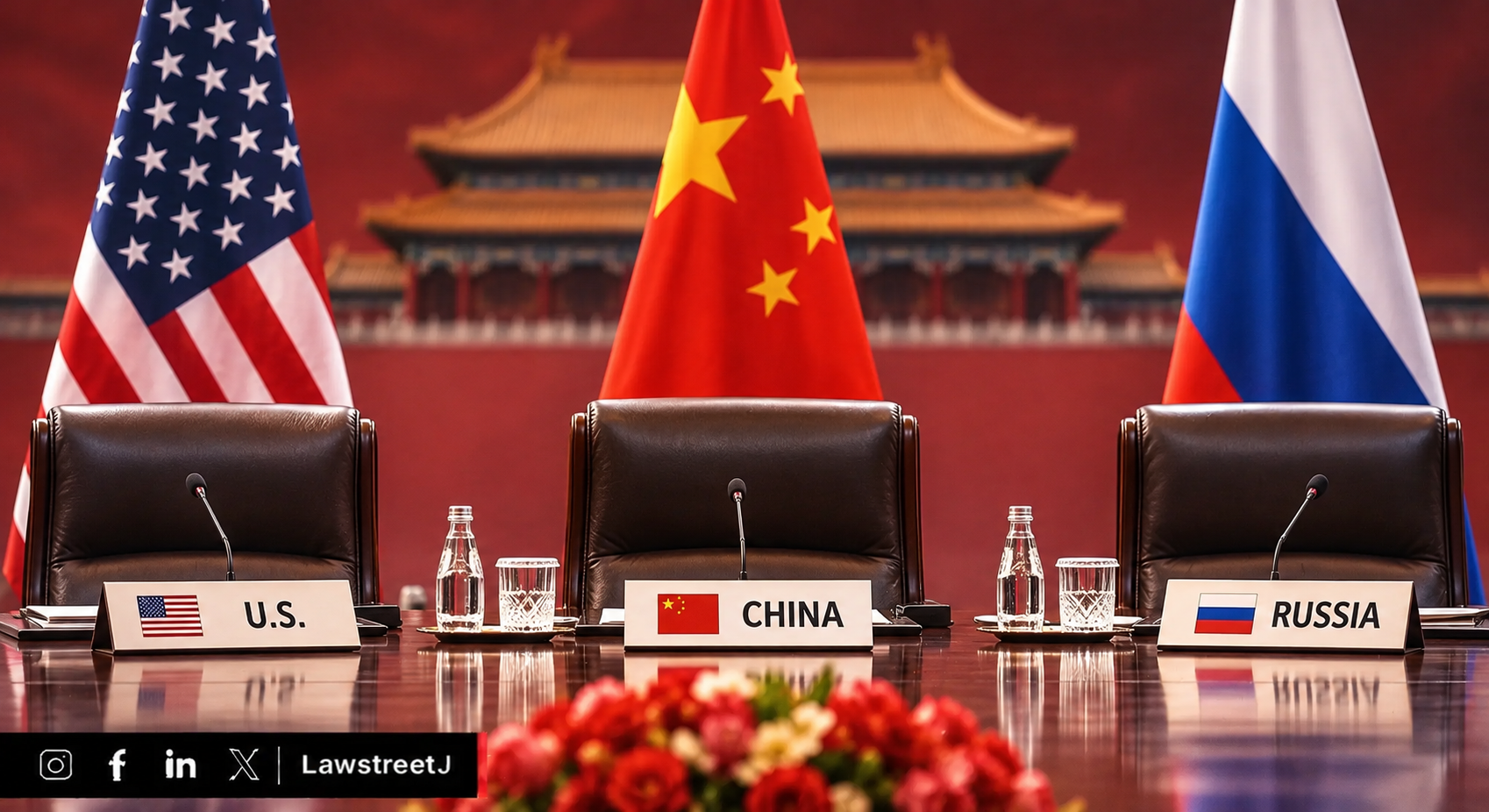
SHENZHEN: US President Donald Trump, Chinese President Xi Jinping and Russian President Vladimir Putin are scheduled to hold an unprecedented trilateral meeting in Shenzhen, China, on November 19, on the sidelines of the Asia-Pacific Economic Cooperation (APEC) summit. The proposed meeting brings together the leaders of the world’s three major powers at a time of heightened geopolitical tensions over the Russia-Ukraine war, the conflict involving Iran, trade disputes and nuclear security.
As of November 18, the three-way meeting has been confirmed by the White House, the Kremlin and China’s Foreign Ministry, but it has not yet taken place. Therefore, no agreement or outcome can be attributed to the summit at this stage.
First Three-Way Meeting Amid Global Tensions
The planned gathering is significant because it would bring the American, Chinese and Russian presidents together in a formal trilateral format for the first time. The meeting is expected to take place during the 33rd APEC Economic Leaders’ Meeting, being hosted in Shenzhen on November 18 and 19.
China confirmed the proposed meeting on November 16. The White House also confirmed that Trump would participate, while Kremlin officials said Putin would attend.
Trump arrived in Shenzhen on November 18 after attending the ASEAN summit in Manila. Chinese President Xi Jinping personally received him at the airport, according to reports. Earlier on Wednesday, Xi and Putin held bilateral talks in Shenzhen ahead of the planned three-way meeting. The timing is particularly important because relations among the three countries remain complicated by competing security, economic and diplomatic interests. Washington and Beijing continue to face disagreements over tariffs, technology restrictions and trade, while Moscow remains under Western sanctions following its invasion of Ukraine in February 2022.
Ukraine, Iran and Nuclear Disarmament Among Key Issues
Nuclear disarmament is one of the issues Trump has explicitly said he wants to discuss. White House Assistant Press Secretary Olivia Wales said the President would raise the reduction of nuclear weapons, describing their proliferation as a serious danger. Trump has also indicated that the Russia-Ukraine war and the conflict involving Iran could feature in the discussions. However, statements from US officials have not been entirely consistent about whether Ukraine would be formally included in the trilateral agenda.
China has not publicly released a detailed agenda for the meeting. Its Foreign Ministry has described the proposed discussions in broader terms, referring to issues of international peace and stability.
The three leaders approach these questions from different strategic positions. The United States has sought to limit nuclear proliferation and influence the course of the wars involving Russia and Iran. Russia has defended its military and security positions while seeking relief from Western isolation. China has presented itself as an advocate of dialogue and international cooperation, while maintaining close strategic and economic ties with Moscow.
Whether the leaders can find common ground on any of these issues remains uncertain.
Xi and Putin Promote Trade and a Multipolar World
Ahead of the planned trilateral, Xi and Putin used their appearances at the APEC-related events to underline their positions on international trade and global governance. Addressing the APEC gathering, Xi called for freer trade and greater international cooperation, including in artificial intelligence. He also spoke about lowering tariffs, expanding market access and improving international cooperation on technology and regulation.
Putin, meanwhile, criticised Western sanctions imposed on Russia and argued that they had failed to weaken the country's economy. He called for greater unity, equality and partnership in international relations, while promoting closer economic cooperation. Their remarks reflected the broader geopolitical backdrop to the Shenzhen meeting, China is seeking to strengthen its position in global trade and technology, while Russia is attempting to expand economic partnerships as it faces continuing Western restrictions.
The trilateral meeting could therefore carry significance beyond the immediate conflicts. It may offer an opportunity to discuss strategic stability, economic relations and the role of major powers in international affairs. However, it would be premature to describe it as a breakthrough or a new geopolitical agreement before the discussions take place.
Why the Meeting Matters
The proposed summit has attracted attention because decisions or understandings reached by Washington, Beijing and Moscow could have consequences for countries beyond the three participants. Ukraine and European governments, in particular, have reason to watch discussions concerning the war closely. Any negotiations affecting Ukraine's territorial integrity or security would raise questions about the participation and consent of Kyiv itself.
For Asian economies, the discussions could influence the regional environment for trade, technology and supply chains. APEC brings together 21 member economies and provides a forum for cooperation on economic growth, investment and regional trade.
The meeting also comes as Trump seeks to maintain direct engagement with both Xi and Putin. A separate bilateral meeting and working lunch between Trump and Xi are also planned during his visit, according to the White House. For now, the significance of the gathering lies in the fact that all three leaders are expected to sit at the same table. Whether the encounter produces concrete agreements on Ukraine, Iran, nuclear weapons or trade will become clear only after the talks.