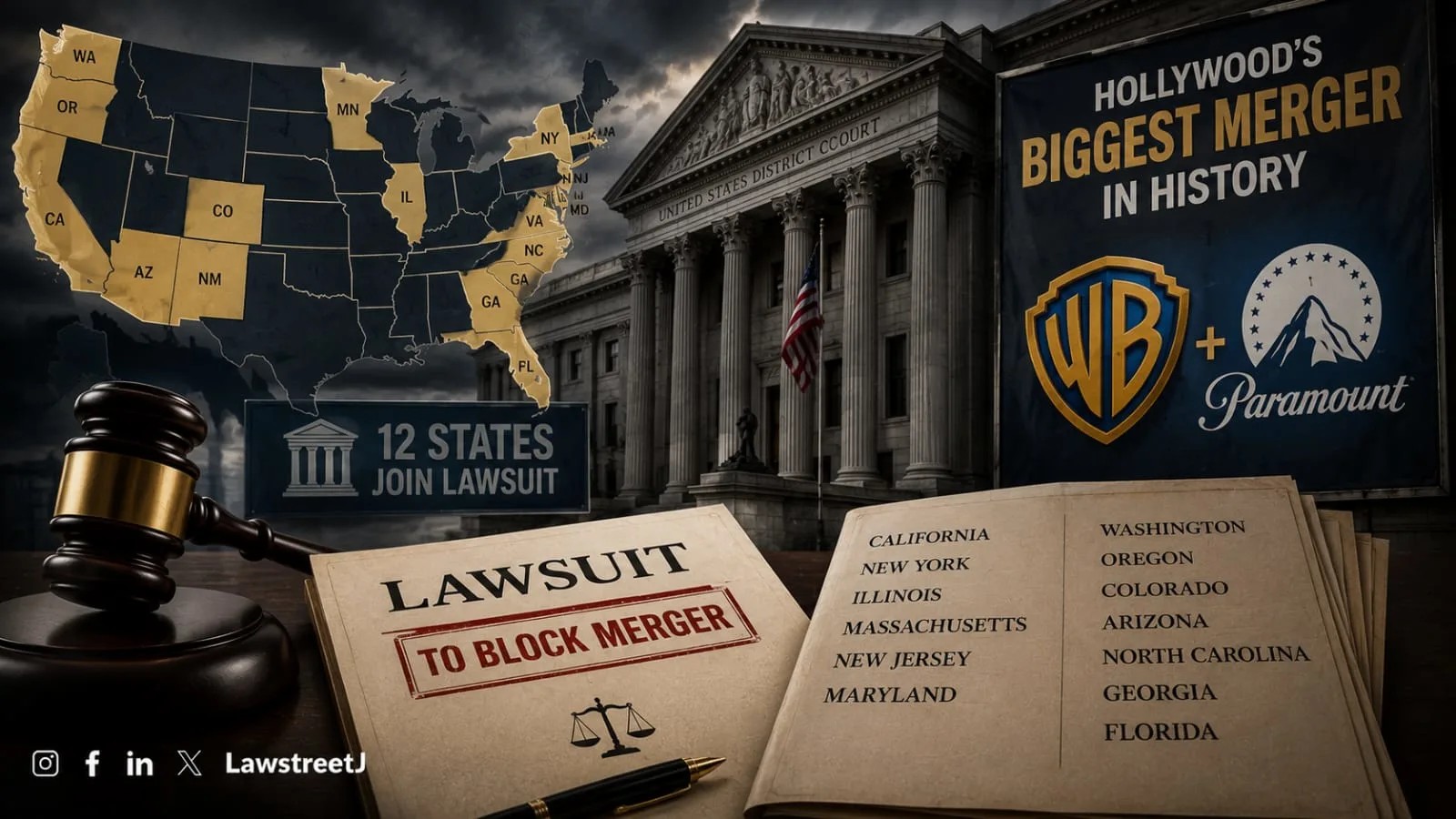
Los Angeles / New York: A coalition of twelve state attorneys general filed a federal antitrust lawsuit on Monday, July 13, 2026, seeking to block Paramount Skydance's $110 billion acquisition of Warner Bros. Discovery, the largest proposed merger in the history of Hollywood, just one month after the US Department of Justice cleared the deal under circumstances that a senior senator publicly described as reeking of corruption. The lawsuit was filed in the Northern District of California and brings what could prove to be the most consequential media antitrust battle in American legal history.
The coalition is led by California Attorney General Rob Bonta and includes the attorneys general of Arizona, Colorado, Connecticut, Massachusetts, Minnesota, Nevada, New Jersey, New Mexico, New York, Oregon, and Washington. All twelve are Democrats. The complaint asserts antitrust claims under Section 7 of the Clayton Antitrust Act, which prohibits acquisitions when the effect "may be substantially to lessen competition, or to tend to create a monopoly." On Monday night, the states separately filed a motion for a temporary restraining order and a preliminary injunction to halt the merger while the litigation proceeds.
On Tuesday, the Writers Guild of America filed its own separate lawsuit to block the merger, alleging it would lead to lower pay and fewer opportunities for thousands of television, film, news, and online writers who the guild represents.
What Is Being Merged and What It Would Create
To understand the scale of the legal battle, the scale of the transaction must first be understood.
Paramount Skydance Corporation is a media and entertainment conglomerate whose holdings include Paramount Pictures, one of Hollywood's original studios, with over a century of film history and the CBS broadcast network, as well as cable channels including Nickelodeon, MTV, Comedy Central, and BET. Its streaming service, Paramount+, has tens of millions of subscribers globally. The company has been controlled by the Redstone family since its separation from CBS and was acquired by David Ellison's Skydance Media in a transaction completed in 2024.
Warner Bros. Discovery is itself the product of a prior major merger, the 2022 combination of WarnerMedia (spun off from AT&T) and Discovery Inc. Its holdings include the Warner Bros. film studio, HBO, arguably the most prestigious cable network in the world, CNN, TNT, TBS, TLC, and the streaming services HBO Max and Discovery+.
Under the terms of the merger agreement signed on February 27, 2026, Paramount agreed to acquire all outstanding shares of Warner Bros. Discovery for approximately $110 billion, $31.00 per share in cash, representing a 147 percent premium to WBD's unaffected stock price of $12.54. WBD shareholders voted to approve the transaction at a special meeting on April 23, 2026. The WBD board unanimously recommended shareholders vote in favour.
If completed, the combined entity would be by far the largest traditional media company in the United States, with a portfolio spanning two major film studios, two major broadcast and cable empires, and a dominant combined streaming platform. The companies intend to merge Paramount+ and HBO Max into a single service following the transaction.
The twelve states' lawsuit alleges that the combined company would control 27 percent of US basic cable TV licensing and 75 percent of wide-release theatrical film distribution, figures that, if proven at trial, would represent a degree of market concentration that antitrust law is specifically designed to prevent.
The Legal Arguments: What the States Are Alleging
California Attorney General Rob Bonta stated at a Monday press conference: "We have antitrust laws and merger controls for a reason, because competition is the lifeblood of a healthy and vibrant economy. Competition pushes companies to produce their best work, to innovate, and to offer fair and reasonable prices. This merger would snuff out competition, drive up prices, diminish content quality, and produce fewer movies and shows each year."
The complaint, filed in parens patriae, a legal doctrine that allows state governments to sue on behalf of their residents' collective economic interests, identifies three principal markets where the states allege competition would be substantially lessened.
The first is theatrical film distribution. The states argue that with 75 percent of wide-release theatrical film distribution concentrated in a single company, independent cinema operators, already under severe financial pressure from the streaming era, would face an entity with the pricing power to dictate terms for the films they screen. Ticket prices would rise. The variety of films available in cinemas would narrow. Independent and arthouse films, which depend on distribution relationships with multiple studios, would face structural disadvantage.
The second market is basic cable TV licensing. With 27 percent of US basic cable licensing under single ownership, cable and satellite operators, already squeezed between the traditional carriage model and streaming competition, would face a counterparty with unprecedented leverage in retransmission consent negotiations. The states argue this would translate directly into higher cable bills for consumers.
The third concern is the broader news and entertainment market. The combination of CNN, CBS News, HBO documentary programming, and the Discovery factual networks would create a single entity with dominant reach across both scripted entertainment and news, a concentration that the states argue raises concerns distinct from the pure market-share analysis, touching on the diversity of voices available in American news media.
The lawsuit also alleges harm to entertainment industry workers, arguing that when two of Hollywood's largest employers merge, the result is fewer competing buyers for creative talent, writers, directors, producers, and crew, which suppresses wages and reduces the number of projects commissioned. This argument formed the basis of the Writers Guild of America's separate lawsuit filed the following day.
The DOJ Approval: Why the States Are Challenging Their Own Federal Government
The twelve-state lawsuit arrives in an unusual procedural posture, one that has directly injected the case into the broader political debate about the Trump administration's antitrust enforcement priorities.
The US Department of Justice's Antitrust Division approved the Paramount-WBD merger in June 2026, after what the DOJ described as a thorough investigation. The DOJ's approval was expected by many in the industry but came without any conditions, remedies, or behavioural undertakings, an unusual outcome for a transaction of this size and market concentration.
The approval was clouded immediately by allegations of political favouritism. Paramount has close ties to President Trump and members of his administration. David Ellison's Skydance-owned Paramount agreed in 2025 to settle a lawsuit brought by Trump over CBS's 60 Minutes coverage of the 2024 presidential campaign, a settlement widely described as a concession to the administration. In a separate development, the Paramount-owned CBS News reached an agreement with the Federal Communications Commission in connection with its broadcast licence renewal.
Senator Elizabeth Warren said publicly when the DOJ approved the deal in June: "This reeks of corruption." Attorney General Bonta's decision to file the state lawsuit specifically after the DOJ approval, rather than alongside the federal government in a coordinated enforcement action, reflects a deliberate decision by Democratic state officials to contest both the merger and the federal government's handling of it through litigation.
The legal precedent for state-level antitrust enforcement of federal merger law is well established. Under Section 16 of the Clayton Act, state attorneys general may seek injunctive relief in their own right against mergers that violate Section 7. The parens patriae authority under the Sherman Act independently allows states to sue on behalf of their citizens' economic interests. The states are not required to wait for federal approval and a DOJ decision not to block a merger is not legally binding on state enforcers.
A directly relevant precedent was cited in the reporting around the case: earlier in 2026, a federal judge blocked the $6.2 billion Nexstar-Tegna broadcast merger following a lawsuit by a similar coalition of state attorneys general, finding that the states were likely to prevail on their antitrust arguments. That ruling, which came after the DOJ had separately declined to block the Nexstar-Tegna deal, established the viability of the state enforcement pathway in the media sector and is expected to be central to both sides' arguments in the Paramount-WBD litigation.
What Paramount Said: "Distorts Settled Antitrust Law"
Paramount responded to the lawsuit with a sharply worded statement rejecting the states' legal analysis. The company argued the lawsuit "distorts settled antitrust law and is based on a misrepresentation of competition in the entertainment industry today," and reiterated that it believes the deal "creates a stronger competitor against dominant streaming and technology platforms who have harmed the market for theatrical exhibition and jobs in the entertainment industry."
A company spokesperson added: "Delaying this transaction will only harm entertainment workers who have already suffered over recent years as technology has disrupted their livelihood and cost California tens of thousands of entertainment jobs." The statement was notable for its direct counter-argument to the workers' welfare case, in effect, Paramount argued that the merger would help the workers whose welfare the attorneys general were claiming to protect.
The company noted that regulators in markets around the world have already approved the merger, and reiterated that the DOJ, the primary federal antitrust authority for this transaction had completed its review and cleared the deal.
The Writers Guild's Separate Lawsuit: Labour's Antitrust Case
The Writers Guild of America's lawsuit, filed on Tuesday July 14, adds a significant dimension to the legal challenge. The WGA represents thousands of TV, news, film, and online writers across the American entertainment industry.
The guild alleged that if Paramount succeeds in buying Warner Bros. Discovery, the merged firm will be the largest buyer of original film and television programming in the United States, giving it monopsony power, the buyer-side equivalent of monopoly power, over writers' compensation and working conditions. This argument specifically invokes Section 7 of the Clayton Act's application to labour markets as well as product markets, building on a line of antitrust thinking that has gained significant traction in enforcement circles since the early 2020s.
The WGA's legal standing to bring such a claim directly, rather than through a state attorney general acting in parens patriae, reflects the guild's status as a direct economic participant in the market allegedly being harmed. The guild's members are buyers of studio commissions and sellers of their own creative labour to studios. The concentration of buying power in a single entity directly affects the economic terms on which those labour transactions occur.
What Comes Next: The Race to Court
The immediate legal battleground is the motion for a temporary restraining order and preliminary injunction filed on Monday night. Paramount and Warner Bros. Discovery will file their opposition to the motion. A federal judge in the Northern District of California will then decide whether to impose a temporary halt to the merger while the full litigation plays out.
The standard for a preliminary injunction requires the moving parties to show that they are likely to succeed on the merits of the underlying claim, that they would suffer irreparable harm without the injunction, that the balance of equities favours the injunction, and that the public interest supports the injunction.
The Nexstar-Tegna precedent, in which a federal judge found that a similar coalition of state AGs was likely to prevail on the merits in a media merger case gives the twelve states a basis to argue that the preliminary injunction standard is satisfied. Paramount will argue that the entertainment market has been fundamentally transformed by streaming competition from Netflix, Amazon, Apple, and Disney, and that analysing the merger through a traditional cable TV and theatrical distribution lens understates the competitive constraint those platforms impose.
Whether the court agrees with the states' market definition which focuses on traditional cable and theatrical distribution or with Paramount's, which includes streaming platforms as direct competitors across all relevant markets will likely determine the outcome of both the injunction motion and the underlying case.
The closing of the $110 billion deal now depends on what a federal judge decides, possibly in a matter of days. If the restraining order is granted, the merger halts. If it is denied, Paramount could move rapidly to complete the transaction, making an eventual court victory by the states significantly more complex to remedy.

![India reacts to US accusing Indian in foiled plot to kill Khalistan separatist [Read Unsealed Indictment]](/secure/uploads/2023/11/lj_1593_Khalistan_Row.jpg)