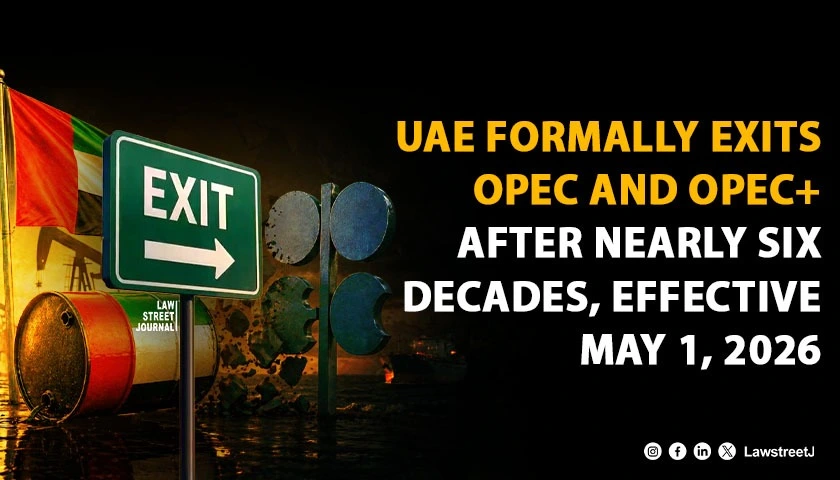
The United Arab Emirates has announced its decision to withdraw from the Organization of the Petroleum Exporting Countries, or OPEC, along with the broader OPEC+ coalition, effective Friday, May 1, 2026. The announcement was carried by the UAE's official state news agency, WAM, on Tuesday, April 28, 2026, and confirmed through a public statement from the UAE's Ministry of Energy. The move reflects what the UAE described as its "long-term strategic and economic vision and evolving energy profile," according to its official statement. "During our time in the organisation, we made significant contributions and even greater sacrifices for the benefit of all," the statement read. "However, the time has come to focus our efforts on what our national interest dictates."
The UAE had been a member of OPEC first through its emirate of Abu Dhabi in 1967, and later as a sovereign nation following its formation in 1971, a membership spanning nearly 59 years. The departure ends one of the longest-standing institutional relationships in the history of global energy governance. UAE Energy Minister Suhail Al Mazrouei confirmed the decision in a statement on X, saying: "The UAE's decision to exit from OPEC reflects a policy-driven evolution aligned with long-term market fundamentals. We remain committed to energy security, providing reliable, responsible, and lower-carbon supply while supporting stable global markets."
The announcement arrives at a moment of acute regional strain. The UAE has been the target of missile and drone attacks for weeks by fellow OPEC member Iran, and Tehran's actions around the Strait of Hormuz have severely constrained the UAE's ability to export oil, directly threatening the foundation of its economy.
Production Quotas, Capacity Disputes, and Legal Sovereignty Over Output
The UAE's exit from OPEC carries significant implications for both the cartel's collective output management and the UAE's own production trajectory. OPEC quotas had most recently limited the UAE to 3.2 million barrels of production per day, while its actual production capacity stands closer to 5 million barrels per day, according to Robin Mills, Chief Executive of Dubai-based consultancy QamarEnergy.
Abu Dhabi National Oil Company, or ADNOC, which manages the UAE's state oil production, has set a target of reaching 5 million barrels per day by 2027, a figure it has moved forward by three years from its original timeline. The UAE has also stated it believes it could increase production to 6 million barrels per day if market conditions required such output, which would make it the fourth-largest global producer behind the United States, Saudi Arabia, and Russia. Baker Institute researchers estimated in 2023 that unconstrained production could generate the UAE upwards of $50 billion in additional annual revenues, a figure that helps explain why Abu Dhabi's patience with OPEC's quota discipline had reached its limit.
At sustained Brent crude prices above $100 per barrel, 1 million barrels per day of stranded capacity represents more than $36 billion in forgone annual revenue, a calculation that the UAE's government and ADNOC had been making with increasing urgency as the cartel's internal negotiations repeatedly failed to expand Abu Dhabi's assigned baseline.
From a legal and institutional standpoint, OPEC membership binds member states to collective production decisions reached through consensus within the Vienna-based secretariat. By exiting the organization, the UAE formally terminates its obligations under the OPEC Statute and its subsequent production-sharing agreements within OPEC+. Following its exit, the UAE stated it would "continue to act responsibly, bringing additional production to market in a gradual and measured manner, aligned with demand and market conditions," according to its state news agency.
Energy Minister Al Mazrouei confirmed in an interview with Reuters that the exit was a unilateral policy decision and that the UAE did not consult any other member nation, including Saudi Arabia, before making the announcement. "This is a policy decision. It has been done after a careful look at current and future policies related to level of production," he stated.
Market Impact, Geopolitical Consequences, and OPEC's Structural Shift
The timing and scale of the UAE's departure carry consequences that extend well beyond Abu Dhabi's own oil ledger. The UAE's exit will reduce OPEC's share of global crude oil supply from approximately 30 percent to around 26 percent, according to Dan Pickering, Chief Investment Officer at Pickering Energy Partners. U.S. crude oil surpassed $100 per barrel following the announcement, while international benchmark Brent crude rose to approximately $113 per barrel in early trading, its highest level in several weeks. The nationwide average gasoline price in the United States reached $4.18 per gallon on Tuesday, the highest level recorded in 2026 so far, according to data from AAA.
Rystad Energy's head of geopolitical analysis, Jorge León, described the UAE as one of OPEC's most strategically vital members, noting that Saudi Arabia and the UAE together controlled the majority of the world's total spare production capacity. "The UAE's departure therefore removes one of the core pillars underpinning OPEC's ability to manage the market," León said. OPEC will become "structurally weaker" as a consequence.
Robin Mills of QamarEnergy told CNN that the exit could trigger further departures from the cartel. "If there is a time to leave, now is the time. You might see Kazakhstan leave as well. That's another significant producer that wants to grow," he said. OPEC has absorbed member departures before, Qatar left in January 2019 and Angola departed in 2024, both citing quota-related disputes. However, the UAE is categorically different. Along with Saudi Arabia and Iraq, the UAE had been among the cartel's most consequential producers, and critically, the Saudis and the UAE had been growing increasingly at odds even before the current regional conflict, with disputes spanning production baselines, regional politics, and strategic priorities.
The near-term effect on physical oil supply is constrained by a separate reality on the ground. Gulf producers are collectively operating under shipping constraints affecting approximately 9.1 million barrels per day, and Iran's actions around the Strait of Hormuz continue to affect roughly 20 percent of global oil and gas supplies. The UAE's additional production capacity therefore remains largely stranded at source until commercial tanker traffic through the strait normalizes. However, analysts were clear that the longer-term structural consequences are substantial. With the UAE's exit, OPEC loses its most agile buffer against supply shocks. Future supply disruptions will be absorbed by market forces rather than by coordinated cartel deployment, introducing what energy analysts have described as a permanent volatility premium into crude pricing.
Energy Minister Al Mazrouei stated that the UAE remains committed to market stability and will continue to cooperate with producers and consumers. "Our exit at this time is the right time for it, because it will have a minimum impact on the price and it will have a minimum impact on our friends at OPEC and OPEC+," he said. The minister also confirmed that the UAE's ambition to reach 5 million barrels per day of capacity by 2027 was central to the decision, and that more freedom of action to pursue that goal was necessary.
The UAE has also signaled it expects any United States-Iran peace settlement to explicitly guarantee freedom of navigation through the Strait of Hormuz, effectively inserting Abu Dhabi as a participant in the broader diplomatic framework around the ongoing regional conflict.
As of May 1, 2026, the UAE will operate as an independent oil producer outside any coordinated production framework for the first time in nearly six decades. The full consequences of that shift, for global supply, for OPEC's institutional standing, and for energy markets, will unfold in the months ahead as the geopolitical situation in the Gulf region continues to develop.

![Former Kerala CM's Principal Secretary Granted Interim Bail on Medical Grounds by Supreme Court in FCRA Violation Case [Read Order]](/secure/uploads/2023/08/lj_9503_interim_bail_to_ex-principal_Secretary_of_Kerala_CM_M_Sivasankar.jpg)