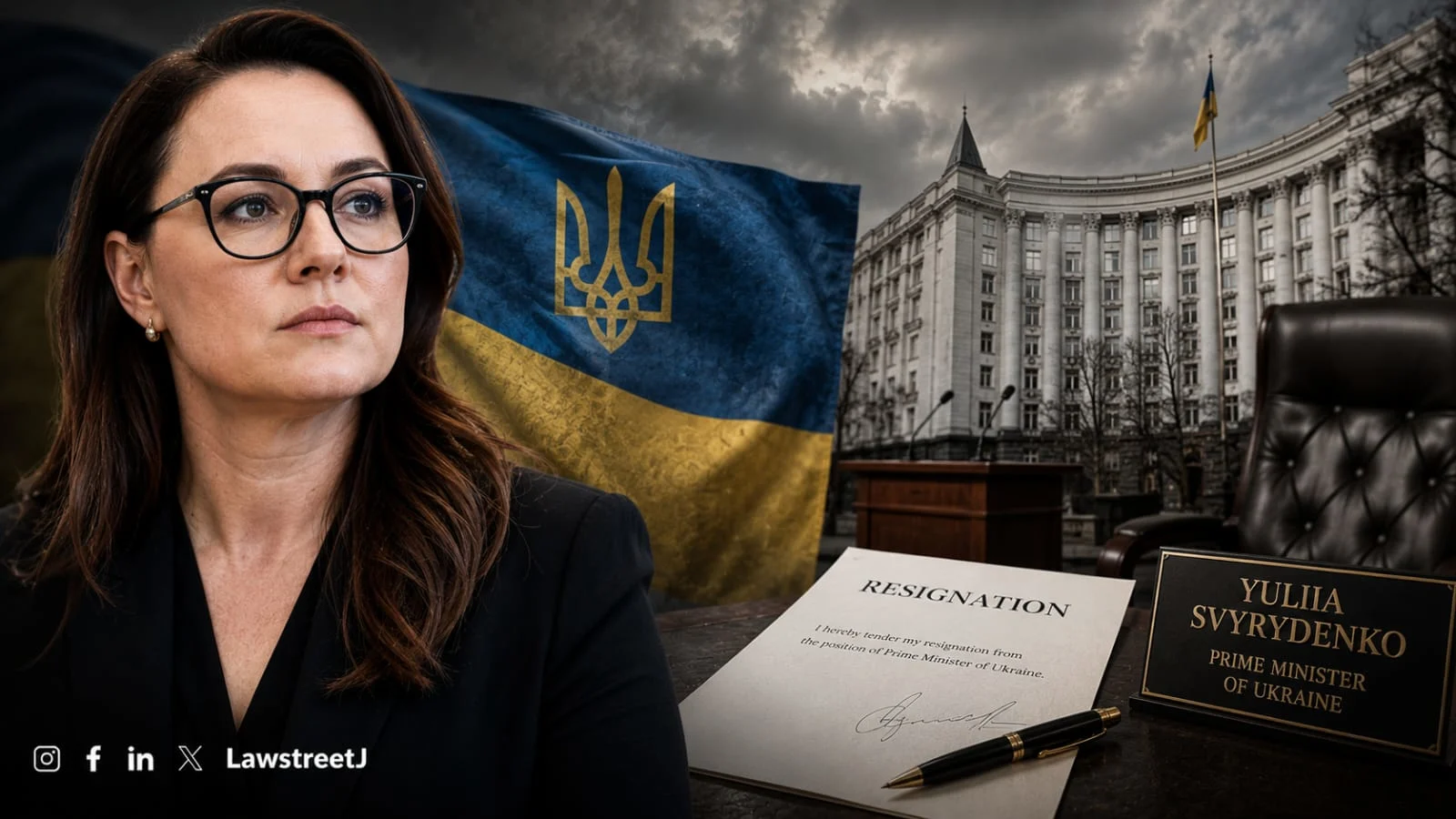
Kyiv: Ukraine's parliament voted on Tuesday, July 14, to accept the resignation of Prime Minister Yulia Svyrydenko, formally dismissing her government after just under one year in office and triggering a full cabinet reshuffle in the middle of an active war. The motion passed in the Verkhovna Rada, bringing down a government that had been formed in July 2025 following one of the most significant corruption scandals of President Volodymyr Zelensky's presidency.
Zelensky announced the planned overhaul on July 12, saying only that Ukraine "is changing its political strategy" and that "new people are needed." He offered little further explanation, though he said he had offered Svyrydenko a new role leading cooperation with one of Ukraine's "key partners", language that fuelled immediate speculation she could be appointed Ukraine's next ambassador to Washington, a city she knows well after leading the negotiations on last year's US-Ukraine minerals deal. A person with direct knowledge told the Kyiv Independent that Svyrydenko had not yet agreed to accept that post.
Svyrydenko's dismissal triggers the resignation of the entire government. Ukraine's constitution provides that when the prime minister resigns or is dismissed, the entire cabinet automatically falls with them, requiring Zelensky and parliament to reconstitute the government from scratch.
Who Is Yulia Svyrydenko and Why She Became PM
Svyrydenko, who previously served as Ukraine's economy minister, was appointed prime minister in July 2025 at age 39 after playing a key role in negotiating a minerals agreement between Ukraine and the United States. The deal was widely viewed as a way to strengthen US economic interests in Ukraine while reinforcing Washington's long-term commitment to the country's security. Her appointment marked the first time Ukraine had a female prime minister, and her elevation was seen as a direct reward for her work in securing the minerals deal, a diplomatic achievement that carried both economic and geopolitical significance in the context of Ukraine's effort to keep American attention and resources focused on the war.
Within days of taking office in July 2025, her government was rocked by the biggest corruption scandal of Zelensky's presidency, leading to the dismissal of two ministers implicated in the case. The scandal, involving alleged procurement fraud in the defence and energy sectors, cast a shadow over the government's credibility from the outset and was referenced obliquely by opposition lawmakers at Tuesday's dismissal vote.

In her farewell speech to parliament, Svyrydenko said: "Every day this year demanded difficult decisions and decisive action. I am deeply grateful for the trust and support I received. You also know that I have always believed results matter most." She posted a photo of herself making a heart symbol with her hands during the address. In a separate social media statement she said she was "proud to have had the honour of leading the Government during one of the most difficult periods in Ukraine's modern history" and that she remained "ready to serve the Ukrainian state."
Why She Was Removed: The Unexplained Reset
While President Volodymyr Zelensky portrayed the reshuffle as a "change in political strategy," the actual reasons behind the move remain unclear.
Political analyst Volodymyr Fesenko told the Kyiv Independent that the main reason was that Svyrydenko "never managed to build a good working relationship with parliament." "She struggled to establish good relations even within the ruling faction, where there were tensions with some of its influential members," he said. "A whole range of important bills had stalled, especially those related to European integration."
As soon as Yermak was dismissed, Svyrydenko distanced herself from him and quickly repositioned herself politically, a move that did not go unnoticed within Zelensky's inner circle. Yermak, the former head of the Presidential Office, had been her principal political patron, and his departure weakened her standing within the administration.
Opposition lawmakers were less restrained. Yaroslav Zhelezniak, a lawmaker from the opposition Holos party, mocked the outgoing government's record: "We were promised results every day. The government has kept that promise: presentations every day, press conferences every day, and every day we had a new suspect in a corruption case.

Some lawmakers praised her work and expressed unease about such an abrupt change while the country is at war. Svyrydenko's resignation caught both lawmakers and government officials off guard, even within the Verkhovna Rada, her departure was described as sudden and without adequate advance warning.
This marks the fourth major reorganisation of Zelensky's government since Russia launched its full-scale invasion of Ukraine in February 2022, a frequency of government change that reflects the unusual pressures of wartime governance, including the intersection of battlefield demands, anti-corruption pressures, and the management of Ukraine's complex relationships with its Western backers.
Who Comes Next: Koretskyi as Frontrunner
Naftogaz CEO Serhii Koretskyi is widely expected to succeed Svyrydenko. A Ukrainian official and a person familiar with the matter told the Kyiv Independent that he is set to become Ukraine's next prime minister.
Ukrainian media reports suggest she could be replaced by Sergii Koretskyi, chief executive of the state-owned energy company Naftogaz, who recently accompanied Zelenskyy to the NATO summit in Ankara, Turkey. Koretskyi would take office as Ukraine faces sustained Russian attacks on its energy infrastructure.
His proximity to Zelensky at Ankara and his attendance at the very summit where Ukraine's energy security was a central agenda item is being read as a deliberate signal. Zelensky met Koretskyi at the weekend, after he had announced plans to remove Svyrydenko and hailed his "effective leadership" in an "extremely complex sector."
The energy focus is not incidental. Svyrydenko said preparing for winter would be the main challenge for the new government, as Russia is expected to double down on attacking Ukraine's electric grid and gas system. Ukraine's power grid has been systematically targeted by Russia throughout the war, with rolling blackouts across the country during multiple winters. Having a prime minister who runs the country's state energy company and who oversaw Naftogaz's management of gas supplies through consecutive wartime winters is being presented as a response to that specific and immediate threat.
Other candidates mentioned include a return for Svyrydenko's predecessor Denys Shmyhal, now serving as energy minister, and Defence Minister Mykhailo Fedorov, though Zelensky is separately reported to be eyeing a replacement for Fedorov's defence portfolio, meaning the ministerial reshuffle is likely to extend well beyond the prime minister's office.
The Broader Context: War, Winter, and Patriot Production
The reshuffle takes place against a backdrop of renewed military pressure. Overnight Friday into Saturday, Russia launched another attack on the Ukrainian capital of Kyiv. Officials said the strikes killed six people, including a child and injured 29. "Over the course of the night, Russia launched more than 120 drones and 12 missiles, half of them ballistic. Our defenders managed to shoot down most of the targets, but not the ballistic ones," Zelensky wrote on X.
On the diplomatic front, Zelensky noted the "most important" topic to address with the reshuffling is the production of air-defence Patriot missiles in Ukraine. While meeting with Zelensky earlier this week, President Trump granted Ukraine the ability to co-produce the missiles, which the Ukrainian leader has strongly pushed for amid continued Russian ballistic attacks.
The resumption of US-Iran hostilities and the reimposition of the Hormuz blockade announced by Trump on July 13 also carries direct implications for Ukraine's energy situation. Global oil price volatility, already elevated by the renewed Middle East conflict, complicates Ukraine's ability to purchase and stockpile the fuel reserves it needs to sustain both its military operations and civilian power generation through the coming winter months.
A new prime minister, with energy sector expertise at the helm, inherits a country whose infrastructure has been battered by four years of war, whose political relationship with its parliamentary majority was strained under Svyrydenko, and whose most immediate test will be keeping the lights on in Ukrainian homes and factories through what is expected to be another brutal winter of Russian attacks on the grid.
Ukraine's parliament is expected to vote on the appointment of a new prime minister in the coming days. Until that vote, the outgoing cabinet continues in a caretaker capacity.