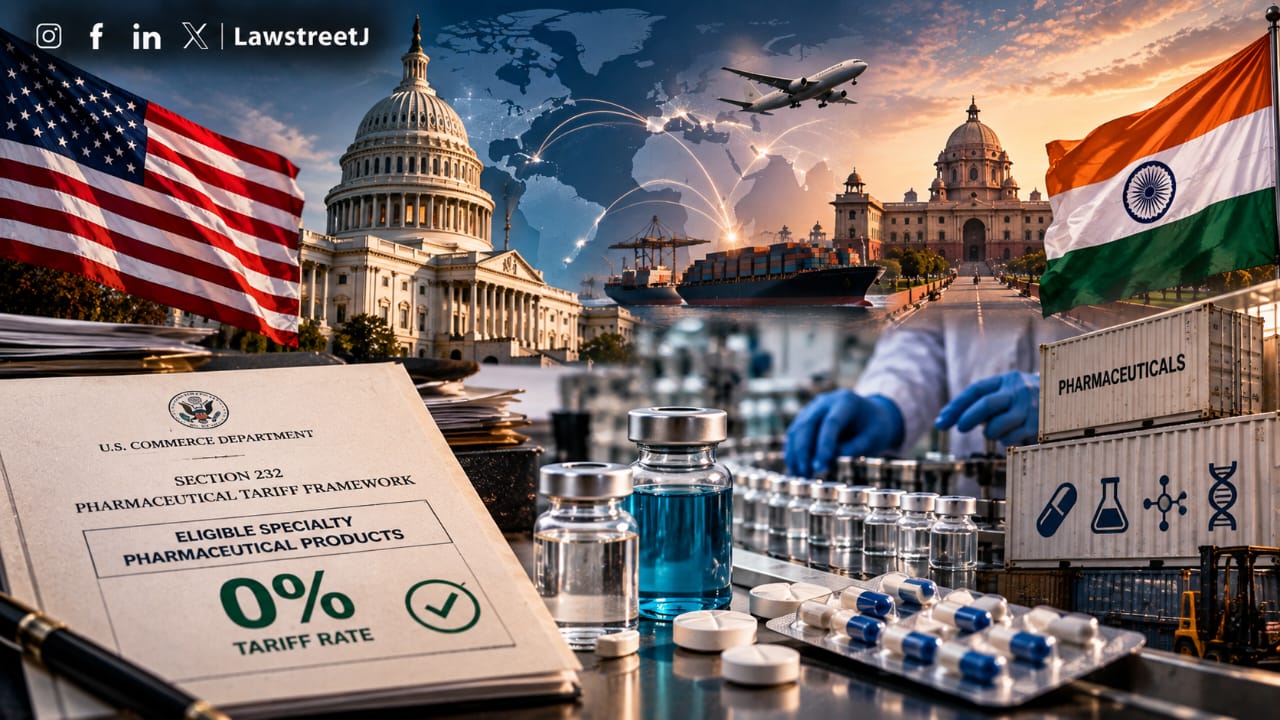
Washington, D.C.— The United States Commerce Department has confirmed that select specialty medicines and related manufacturing components originating from India and 19 other partner jurisdictions will be exempt from a sweeping 100 percent tariff on patented pharmaceuticals that took effect on September 29, 2026. The exemption list was formally published in the Federal Register, giving legal effect to a zero-duty framework for a defined category of specialty drugs even as the broader tariff regime on patented pharmaceutical products came into force.
The Underlying Tariff Order
The 100 percent tariff stems from a proclamation signed by President Donald Trump in April 2026, imposing duties on patented pharmaceutical products and associated ingredients under Section 232 of the Trade Expansion Act of 1962. Section 232 authorises the President, following an investigation by the Secretary of Commerce into the national security implications of imports, to adjust tariffs on goods found to threaten national security. According to a White House fact sheet, the Commerce Department's investigation examined the effects of pharmaceutical, pharmaceutical ingredient and related imports on national security, and the resulting tariff was framed by the administration as a measure to bolster domestic pharmaceutical manufacturing and supply chain security.
Under the original proclamation, the 100 percent tariff was scheduled to take effect 120 days after signing for larger pharmaceutical companies and 180 days for smaller companies, placing the effective date at September 29, 2026, for the broader set of affected firms. The White House has stated that the tariff has already spurred approximately $400 billion in new investment commitments from pharmaceutical companies in the United States.
The zero-duty exemption announced for India and 19 other jurisdictions covers specialty medicines and components used to treat rare diseases, along with fertility treatments, cell and gene therapies, antibody-drug conjugates, nuclear medicines based on radioactive substances, and veterinary pharmaceuticals, together with key manufacturing components used to produce these treatments. The Commerce Department has clarified that this zero percent rate applies to both finished formulations and their primary chemical components.
Separately, the Commerce Department confirmed that generic pharmaceutical products and their associated ingredients remain entirely outside the scope of the Section 232 pharmaceutical tariffs, regardless of country of origin.
Recent administrative revisions to the original proclamation have also formally updated the definition of "generic pharmaceutical articles" to explicitly include unpatented animal health products, and clarified that the category of "pharmaceutical articles" covered by the tariff strictly includes finished medications, active pharmaceutical ingredients and key starting materials. The notice additionally allows zero tariffs on items imported solely for clinical trials, research, development or other non-commercial uses.
According to the original April proclamation, countries with existing or prospective trade agreements with the United States qualify for reduced or zero tariff treatment. Pharmaceutical products from the European Union, Japan, South Korea, Switzerland and Liechtenstein are subject to a 15 percent tariff rather than the full 100 percent rate, while products from the United Kingdom are subject to a lower tariff under a separately concluded U.S.-U.K. pharmaceutical agreement. Companies that enter into most-favoured-nation pricing agreements with the U.S. Department of Health and Human Services, together with onshoring agreements with the Department of Commerce, qualify for a 0 percent tariff through January 20, 2029, while companies that enter only into onshoring agreements with the Department of Commerce face a 20 percent tariff.
Orphan drugs, animal health drugs and certain other specialty pharmaceutical products qualify for exemption where they originate from trade-deal countries or meet a defined urgent public health need, which is the category under which the exemption for India and the 19 other jurisdictions has been granted.
Implications for India
India is among the world's largest suppliers of generic medicines and active pharmaceutical ingredients to the United States. Industry analysts have noted that because the large majority of Indian pharmaceutical exports to the U.S. consist of generic drugs and active pharmaceutical ingredients rather than the branded, patented products targeted by the new tariff, the overall impact of the 100 percent levy on Indian exporters is expected to be limited. The specialty-drug exemption adds a further layer of protection for Indian-manufactured products in the specific categories it covers, including rare-disease treatments, advanced cell and gene therapies, and veterinary pharmaceuticals, along with the components used to manufacture them.
The legal foundation for the tariff and its exemptions rests in Section 232 of the Trade Expansion Act of 1962, which grants the President authority to impose tariffs or other trade restrictions on specific categories of imports following an investigation and finding by the Secretary of Commerce that such imports threaten to impair national security. This differs from tariffs imposed under other trade statutes, such as Section 301 of the Trade Act of 1974, in that Section 232 actions are formally grounded in a national security determination rather than findings of unfair trade practices.
The implementation of both the original 100 percent tariff and the subsequent exemption list has proceeded through formal publication in the Federal Register, the official journal of the United States government in which federal agency rules, proposed rules and legal notices are published to give them legal effect and public notice. The qualification of specific countries for zero-duty treatment on specialty pharmaceuticals has been tied, according to official notices, to the existence of an active or prospective trade and security framework agreement between that country and the United States.
Current Status
As of September 30, 2026, the 100 percent Section 232 tariff on specified patented pharmaceutical products and their ingredients is in effect for countries and products not covered by an exemption. India, along with 19 other partner jurisdictions, is exempt from this tariff specifically with respect to select specialty medicines covering rare diseases, fertility treatments, cell and gene therapies, antibody-drug conjugates, nuclear medicines and veterinary pharmaceuticals, along with associated manufacturing components.
Generic pharmaceutical products and their ingredients remain entirely outside the scope of the Section 232 pharmaceutical tariff regardless of country of origin. The full list of the 19 other exempted jurisdictions, along with further technical details of the qualifying product categories, has been published by the U.S. Commerce Department in the Federal Register.


.jpeg)