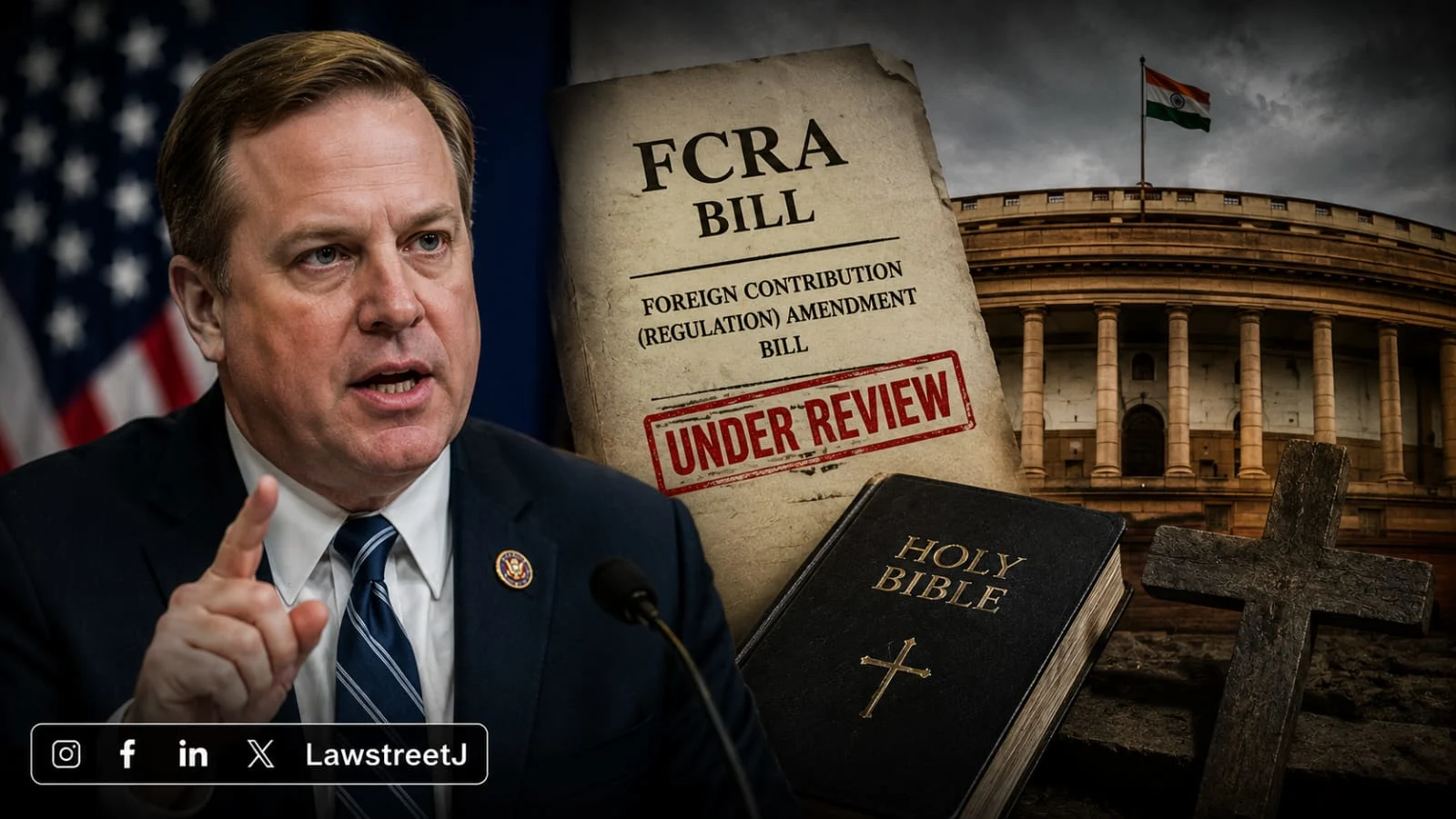

WASHINGTON D.C. / NEW DELHI: A Republican member of the United States House of Representatives has publicly called on India not to proceed with its proposed amendments to the Foreign Contribution Regulation Act, describing the legislation as a direct assault on the Christian community and warning that it could strain one of the world's most significant bilateral relationships. The statement, posted on social media platform X, represents the most pointed intervention by a sitting American lawmaker on the subject of India's domestic legislative agenda in recent memory.
Congressman Riley Moore alleged that the proposed changes to the Foreign Contribution (Regulation) Act would hand authorities the ability to assume control of churches and faith-based charitable bodies.
In his post on X, Moore wrote: "Christians have been in India since St. Thomas the Apostle traveled to the Malabar Coast just decades after the resurrection of our Lord Jesus Christ. But despite this long Christian history, India's Parliament is considering amending Foreign Contribution Regulation Amendment rules to permit government takeovers of churches and religious charities. This is a clear attack against Christians. If this bill proceeds in this way, it would be a point of major concern in our bilateral relationship with India."
Moore is a Republican lawmaker representing West Virginia's second congressional district and is a member of the House Appropriations Committee. He is a first-term Congressman and has previously led congressional action on the persecution of Christians in Nigeria, the Muslim-majority nations of the Middle East, and China. His intervention on India's FCRA legislation places New Delhi in a category of countries whose domestic religious policy has drawn formal objection from a sitting US lawmaker.
What India's FCRA Amendment Bill, 2026 Actually Proposes
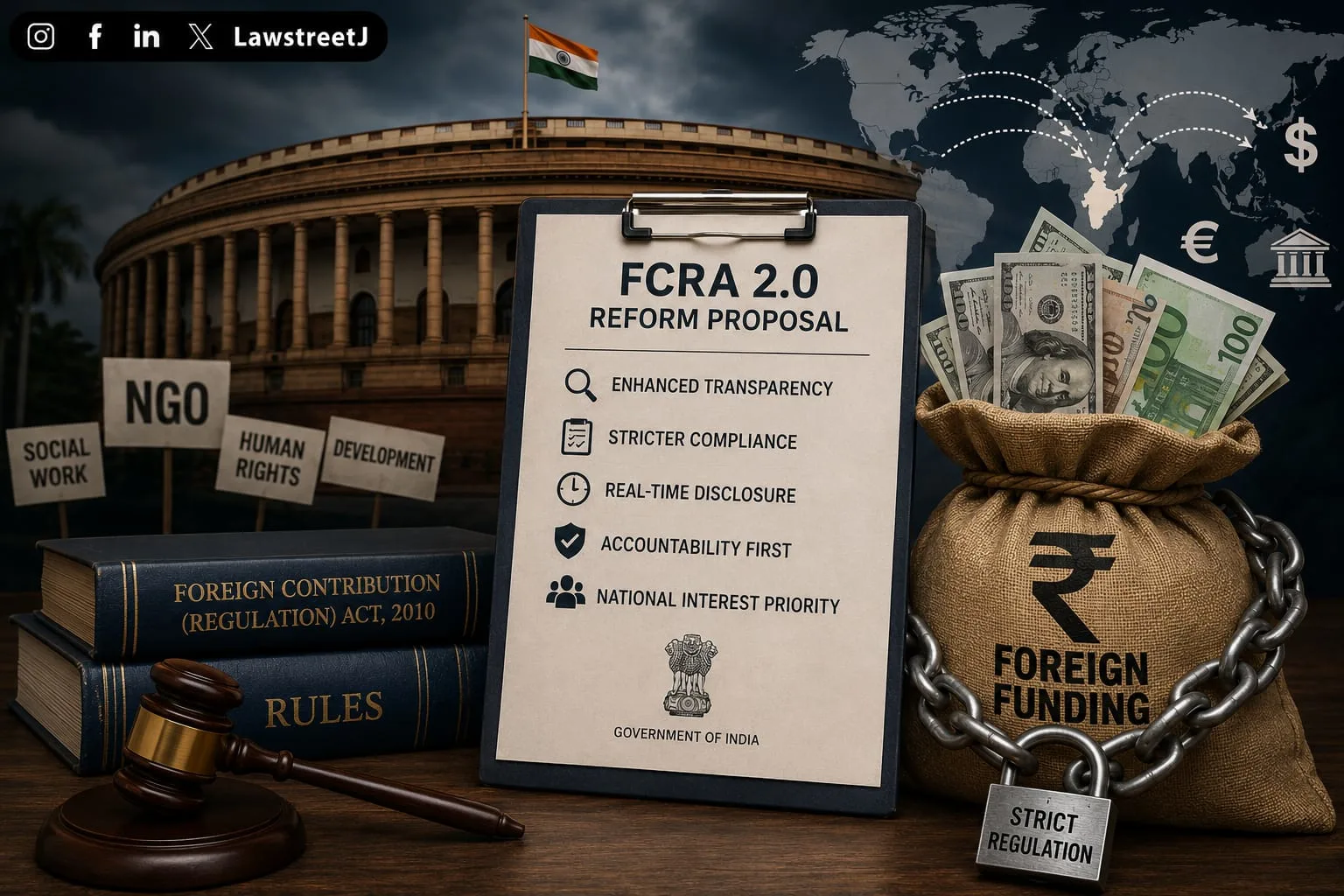
The Foreign Contribution (Regulation) Amendment Bill, 2026 was introduced in the Lok Sabha on March 25, 2026. It creates a framework for the supervision, management and disposal of foreign contributions and assets belonging to organisations whose FCRA certificate ceases to exist. This can happen if registration is cancelled, surrendered, not renewed or denied renewal.
The proposed law would allow a government-appointed Designated Authority to take control of foreign-funded assets and potentially transfer or sell those assets. Although the Indian government argues the amendment is intended to strengthen oversight of foreign contributions and prevent misuse of funds, religious freedom advocates warn that the law could further restrict the ability of religious organisations, particularly Christian ministries to operate freely in India.
The FCRA Amendment Bill 2026 also bans proselytisation from FCRA-eligible activities and reduces the maximum penalty for violations from five years to one year.
The amendment comes after years of increasing scrutiny of foreign-funded organisations in India. Throughout the years, India has introduced increasingly restrictive amendments to the FCRA. In 2020, the government banned organisations from transferring foreign funds to other NGOs, required foreign contributions to be received through a designated bank account in New Delhi, and reduced the percentage of foreign funds organisations could spend on administrative expenses.
At its core, the legislation aims to revise the existing 2010 FCRA framework, which sets the rules for how NGOs, trusts, educational bodies, religious institutions and similar entities can receive and spend money coming in from overseas. As things stand, any such organisation needs sign-off from the Ministry of Home Affairs before it can accept foreign funds, and that clearance must be renewed once every five years. As of July 15, 2026, the number of currently valid FCRA registrations stands at 14,449. A further 22,498 registrations have been revoked over time, and another 15,212 have simply run out. Foreign funds flowing into FCRA-registered bodies between 2019 and 2022 added up to Rs 55,741 crore.
The Government's Response and its Reassurances
The Indian government has not been silent on the concerns raised by churches and civil society organisations. Well before Moore's intervention, the Union government took steps through official channels to address the most pointed fears about the Bill's impact on places of worship.
The Union government sought to allay concerns among minority institutions, including Christian organisations, over the proposed Foreign Contribution (Regulation) Amendment Bill, 2026, saying that places of worship will retain their religious character even if the legislation comes into force. The Press Information Bureau, in a clarification issued on July 22, said the Designated Authority proposed under the Bill would retain the religious character of places of worship "in all cases."
According to the government, the Designated Authority would manage only assets created from foreign contributions, and only after registration has lawfully ceased. If the organisation gets its registration restored within the prescribed period, the unused funds and assets must be returned in full.
The PIB said that some cancellations or non-renewals are administrative in nature and may result from failure to file annual returns, renew registration before expiry or maintain designated bank accounts. It added that courts retain the power to review cancellation decisions. Around 16,200 associations were registered under the FCRA in 2024-25 and received approximately Rs 22,963 crore in foreign contributions.
The government has maintained that the Bill is about accountability for foreign funds flowing into India and not about targeting any religious community specifically. It has a working Lok Sabha majority and can pass the Bill if it chooses to bring it to a vote. The Rajya Sabha may see more resistance, but current parliamentary numbers suggest passage there as well.
A Growing Chorus of Domestic and International Opposition
Moore's statement did not emerge in isolation. The FCRA Amendment Bill, 2026 has generated one of the most sustained multi-front opposition campaigns of India's current Monsoon Session, involving state governments, church bodies, opposition parties, and international rights organisations.
The Bill has triggered a Kerala Assembly resolution demanding its withdrawal. The resolution concluded that the proposed amendments violate Articles 19, 20, and 25 of the Constitution, were contrary to the principles of federalism, and would place model voluntary service organisations across the country under severe strain. Kerala is home to some of India's largest FCRA-registered organisations.
The government of India re-introduced the Foreign Contribution (Regulation) Amendment Bill, 2026 on July 20, the first day of the second annual session of parliament known as the Monsoon Session. On July 23, the opposition Congress Committee in Mizoram Pradesh State, where there is a Christian majority, held demonstrations and submitted memorandums, claiming the Bill targets welfare infrastructure in the region. On July 24, church leaders met with Mizoram Chief Minister Lalduhoma to discuss the potential impact of the Bill on churches and Christian institutions.
Christians have historically had a strong presence in states such as Kerala, Mizoram, Meghalaya, Nagaland, and Manipur, where church networks run hospitals, schools, tribal welfare programmes, and rural development organisations, many of which have FCRA registrations and receive foreign funding.
The Bill has also attracted concern from Amnesty International and three UN Special Rapporteurs. Legal challenges are almost certain to follow. The constitutional questions, Article 300A and property seizure without judicial oversight, Article 25 and the proselytisation bar, Article 19(1)(c) and freedom of association are sufficiently well-founded that multiple organisations are expected to file writ petitions before the Supreme Court if the Bill becomes law.
The India-US Dimension
Moore's warning that the Bill could become a "point of major concern" in the bilateral relationship between India and the United States is significant, even if it represents the position of one lawmaker rather than the formal position of the US government or the State Department.
India-US relations have deepened considerably in recent years, with both countries engaged on trade, technology, defence, and strategic cooperation across the Indo-Pacific. A formal diplomatic friction over India's domestic religious legislation of the kind that has historically complicated US relations with countries like China, Saudi Arabia, and Nigeria would be an unusual development in the India-US relationship, which has not been publicly strained by religious freedom concerns in the same manner.
The Bill is listed for consideration and passage in the current Monsoon Session. As of the time of publication, it remains pending before the Lok Sabha. No date for its tabling for a vote has been publicly announced. The government has offered reassurances on the question of places of worship losing their religious character, but has given no indication that it intends to withdraw or substantially amend the Bill in response to domestic or international criticism.
Whether Moore's intervention translates into formal diplomatic communication between Washington and New Delhi on this specific legislative question remains to be seen.

![Former Kerala CM's Principal Secretary Granted Interim Bail on Medical Grounds by Supreme Court in FCRA Violation Case [Read Order]](/secure/uploads/2023/08/lj_9503_interim_bail_to_ex-principal_Secretary_of_Kerala_CM_M_Sivasankar.jpg)