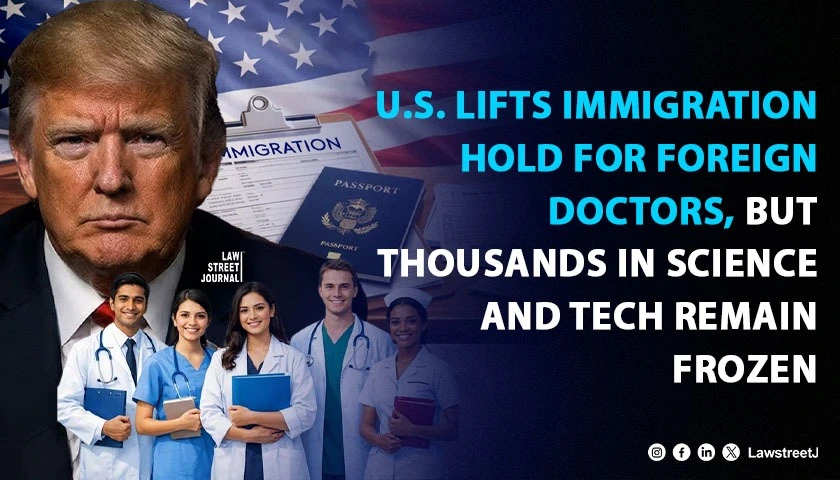
U.S. immigration officials have quietly lifted a hold on green card and visa applications for doctors from three dozen countries, in a move that offers partial relief to a segment of foreign-trained medical professionals who had been caught in a sweeping administrative freeze that began earlier this year. The exemption, however, does not extend to thousands of other skilled immigrants including scientists, researchers, and technology professionals who remain unable to work or advance their cases while the broader pause stays in place.
The clarification was posted on May 4, 2026, on a U.S. Citizenship and Immigration Services alert page, confirming that foreign medical doctors along with several other categories had been removed from the list of visa and green card cases frozen as part of an extensive national security review. The move means that thousands of physicians stuck in limbo can once again advance H-1B extensions, J-1 waiver requests, and immigrant visa petitions.
The Freeze and What It Covered
Earlier in 2026, the Trump administration halted the processing of immigration applications from nationals of several dozen countries it classified as high-risk. The pause covered a wide range of visa and green card categories, effectively stalling cases for applicants who were already legally present in the United States and in many instances actively employed.
Hospitals and residency programs had warned that the freeze risked worsening an already acute physician shortage projected to hit 86,000 doctors by 2032. Waiver sponsors in Texas, New York, and Ohio reported dozens of delayed start dates, while some rural facilities were preparing contingency plans to redirect patients.
Foreign-trained doctors disproportionately work in underserved areas, according to the National Library of Medicine. The pause had placed that coverage in serious jeopardy. Dr. Faysal Alghoula, a Libyan pulmonologist and ICU doctor who cares for roughly 1,000 patients across rural parts of Indiana, Illinois, and Kentucky, was among those directly affected. His green card renewal had been blocked since the freeze began, and his current visa is set to expire in September if his application is not decided in time. In his region, patients face a four-to-five-month wait to see a pulmonologist.
The Exemption and Its Legal Limits
The administration quietly made the exemption for medical doctors with pending visa or green card applications a step physicians organizations and immigration attorneys had sought for months. The relief, however, comes with significant uncertainty. The exemption allows cases to be reviewed, but it does not guarantee approval. It also does not address whether USCIS will be able to process applications in time to meet individual immigration deadlines.
Applicants will not receive a formal notice that their case has been unpaused; instead, movement will appear in their online case status or arrive through new biometrics or interview notices. Because USCIS has offered no premium-processing accommodation, some hospitals are fronting the $2,805 premium processing fee to accelerate time-sensitive petitions. The exemption's scope has also come into question through active litigation. Iranian Dr. Zahra Shokri Varniab, a radiology researcher in Palo Alto, California, had filed a federal lawsuit demanding a decision on her green card after her application became stuck in the freeze. A federal judge ordered immigration officials to review her case. In court filings, U.S. government lawyers wrote that her application contained inconsistencies about whether she plans to become a practicing doctor or researcher. She said she plans to do both, and has stated the exemption does not appear to apply to her since her case was already decided, and she continues to seek relief in court.
Others Still Waiting: Scientists, Tech Workers, and Families in Limbo
While doctors received targeted relief, the situation for other skilled immigrants remains unchanged. Immigrants who hold positions in science and technology said they currently cannot work because they are waiting on employment authorization documents. Some said they are running out of money for rent and groceries and worry their careers could be derailed if they are forced to leave the country. Those from Iran are especially concerned about returning home during the ongoing conflict involving U.S. and Israeli forces, and said they cannot regularly reach family due to the Iranian government's internet blackout.
With the travel-ban vetting review still in force for other nationalities, companies have been advised to anticipate continued sporadic holds and to maintain redundancy in their workforce planning. The exemption for doctors marks a narrow but notable shift in the administration's immigration posture, one that reflects the pressure brought by medical organizations, legal challenges, and documented shortages in rural healthcare. For the many others still waiting, the freeze and its consequences remain very much in place.