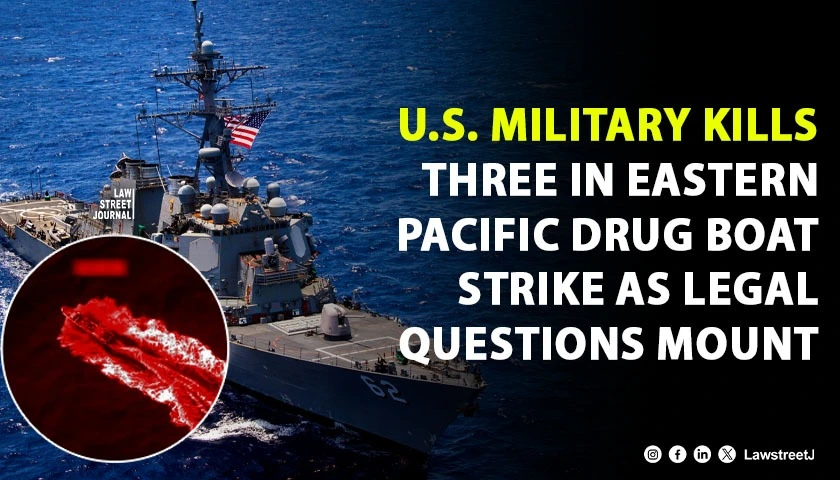
The U.S. military launched another strike on Tuesday on a vessel suspected of transporting drugs in the eastern Pacific Ocean, killing three men. The attack came a day after U.S. forces struck an alleged drug boat in the Caribbean Sea, killing two people. The two operations, carried out within 24 hours of each other, are part of a campaign that has now stretched across eight months and two ocean bodies, with no sign of slowing down. The Trump administration's campaign of destroying alleged drug-trafficking vessels in Latin American waters has persisted since early September 2025 and has killed at least 191 people in total. At least eight boat strikes took place in the Caribbean and eastern Pacific in April 2026 alone. No U.S. military personnel have been reported injured in any of the strikes.
After one of the attacks, U.S. Southern Command posted a video on its official social media account showing a boat moving swiftly in the water before an explosion left it in flames, stating it had targeted the alleged drug traffickers along known smuggling routes. However, a critical fact has remained consistent across every single operation: the U.S. military has not provided any evidence that any of the vessels were actually carrying drugs at the time they were destroyed. When pressed for details, a spokesperson for U.S. Southern Command told reporters: "For operational security reasons, we cannot discuss specific sources or methods."
The Policy Foundation: Cartels as Terrorists
The legal and policy architecture behind the strikes traces back to the very first day of President Trump's second term. On January 20, 2025, President Trump issued Executive Order 14157, calling for the designation of drug cartels and other foreign organizations as Foreign Terrorist Organizations or Specially Designated Global Terrorists, citing them as extraordinary threats to U.S. national security whose activities include convergence with extra-hemispheric actors, complex adaptive systems characteristic of insurgency, and infiltration into foreign governments across the Western Hemisphere.
Following through on that order, Secretary of State Marco Rubio formally designated eight entities as both Foreign Terrorist Organizations and Specially Designated Global Terrorists on February 6, 2025, with the designations taking effect on February 20, 2025. Those eight organizations are the Sinaloa Cartel, Cártel de Jalisco Nueva Generación, Cártel del Noreste, Gulf Cartel, La Nueva Familia Michoacana, Cárteles Unidos, Tren de Aragua, and Mara Salvatrucha.
President Trump has said the United States is in "armed conflict" with cartels in Latin America and has justified the attacks as a necessary escalation to stem the flow of drugs into the United States and reduce the number of fatal overdoses claiming American lives. The administration has drawn upon the terrorist designations to justify the use of military, rather than law enforcement, tools at sea.
The Legal Dispute: International Law and the Right to Life
The strikes have generated a sustained and serious legal debate among international law scholars, human rights bodies, and foreign governments. Military attacks against shipping on the high seas are in principle unlawful under international law, unless a valid legal justification can be produced. In a letter to Congress dated September 4, 2025, President Trump attempted to provide one by invoking the right to self-defence, arguing that tens of thousands of Americans have been killed because of drugs trafficking and that the strikes therefore constitute a legitimate act of self-defence.
Legal experts have directly challenged this position. Analysts argue that shipping drugs does not constitute an armed attack under the accepted definition in international law, the standard required to invoke self-defence. Drug smuggling is a matter for border control and law enforcement, and designating alleged drug cartels as terrorist organizations does not alter this legal position. Furthermore, even where targeted vessels were unregistered or not flying a flag, international law provides only for the right of warships to stop, board, and search suspect vessels. The permissible outcome is detention and trial, not lethal strikes.
Human Rights Watch has stated that the United States is carrying out a campaign of extrajudicial killings without any credible legal basis, noting that the U.S. government has neither identified the people killed in any of the cases nor demonstrated that those killed were engaged in conduct that could justify the use of lethal force.
On the question of criminal accountability, the International Criminal Court's territorial jurisdiction explicitly extends to crimes committed onboard vessels registered to ICC member states. If any of the ships attacked were registered to Venezuela, Ecuador, Colombia, or other member states, those countries could refer the matter to the ICC prosecutor, or the prosecutor could independently initiate an investigation into potential war crimes or crimes against humanity. Legal scholars further argue that because U.S. military units are organs of the State under the law of State responsibility, and because each strike potentially breaches the obligation under international human rights law to respect the right to life, they may constitute internationally wrongful acts for which the United States bears legal responsibility.
International Reaction and Congressional Oversight
The operations have drawn sharp responses from multiple governments. Colombian President Gustavo Petro publicly stated that the fight against drugs must be subordinated to the human rights of the Caribbean people. Mexico has opposed the strikes, called on the United States to respect international treaties, and separately announced an arrangement whereby the Mexican Navy will intercept boats near the countries' shared coastlines to prevent further lethal attacks in that area.
European Union leaders and member states, including France, have stated that they consider the boat strikes flatly illegal. In response, Secretary of State Rubio noted that since many of the drug shipments are bound for Europe, those governments should perhaps be thanking the United States. Within the United States, members of Congress have begun to question the administration about the scope of the operations and the absence of publicly articulated limits. The administration has not disclosed the criteria by which vessels are selected for lethal strikes, nor has it publicly identified any of those killed.
As of May 6, 2026, the death toll from the campaign stands at a minimum of 191 people. No independent review or accountability mechanism has been announced by the administration in connection with any of the strikes.