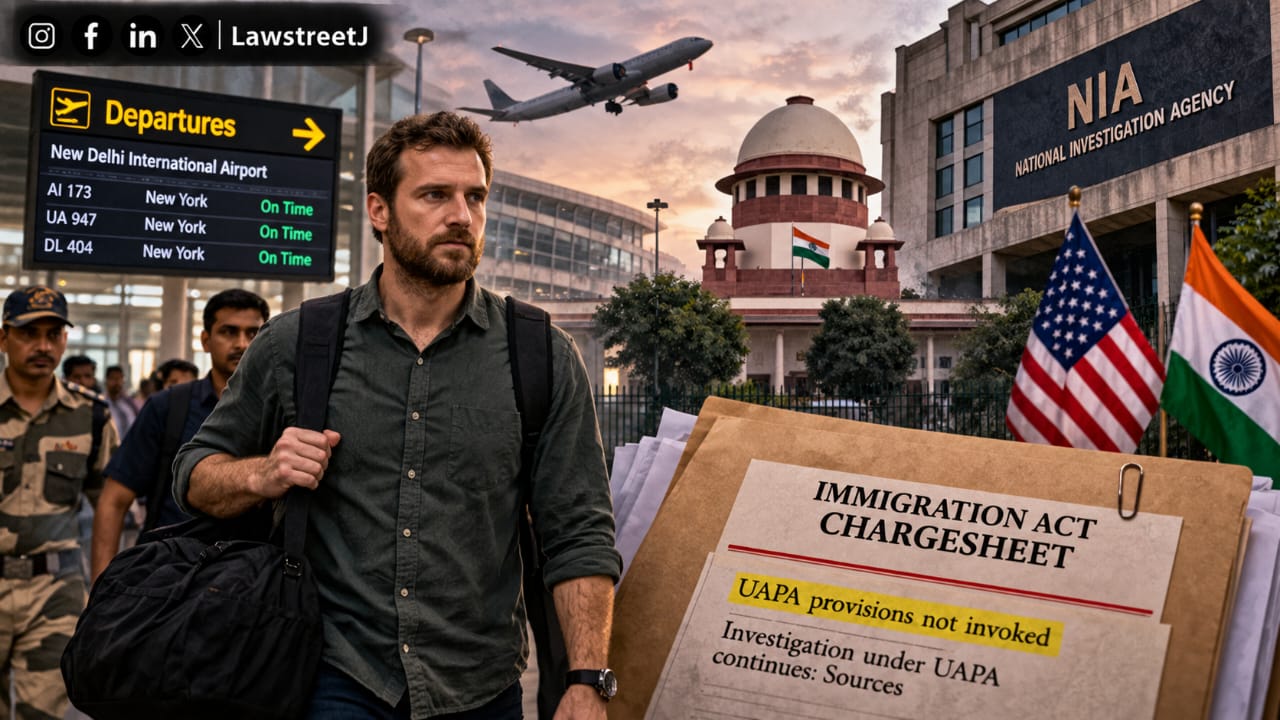

New Delhi — American national Matthew Aaron Van Dyke has returned to the United States after India's National Investigation Agency dropped terror charges against him in a case involving allegations that he and six Ukrainian nationals crossed into Myanmar to train ethnic armed groups in drone warfare. Van Dyke, who had spent over six months in Delhi's Tihar Jail, was granted bail after the NIA's chargesheet omitted charges under India's principal anti-terror law, and a special court subsequently permitted him to travel to the United States for one month pending a final hearing scheduled for October 23, 2026.
The NIA arrested Van Dyke on March 13, 2026, along with six Ukrainian nationals, in connection with alleged offences under the Unlawful Activities (Prevention) Act, 1967 (UAPA), India's principal anti-terrorism statute.
According to the agency's allegations, Van Dyke and his Ukrainian associates had entered India on valid visas before travelling to Mizoram, a northeastern Indian state bordering Myanmar that is classified as a protected area under Indian law, requiring special permits for both foreign and, in some cases, domestic travellers. The NIA alleged that the group crossed from Mizoram into Myanmar, where they conducted training sessions on two occasions for Ethnic Armed Organisations involved in Myanmar's ongoing civil conflict, and that they had imported large consignments of drones and drone components from Europe through India in connection with this activity. Investigators stated that the group's digital devices were being examined as part of the investigation. Van Dyke had, prior to his arrest, been publicly associated with foreign volunteer activity connected to conflicts in Libya and Ukraine.
The Chargesheet and Dropped UAPA Charges
On September 8, 2026, roughly 180 days into Van Dyke's custody, the NIA filed a chargesheet before the special court that did not invoke the UAPA. Instead, the agency charged Van Dyke and the six Ukrainian nationals only under Sections 21 and 23 of the Immigration and Foreigners Act, 2025, provisions concerning illegal entry, movement and stay in India. The NIA clarified at the time that the omission of UAPA provisions from the current chargesheet did not mean the terror investigation had been dropped or closed, stating that its investigation into possible terror-related offences remained open and that a supplementary chargesheet could follow. The agency's Special Public Prosecutor, Rahul Tyagi, reiterated in court that the investigation regarding the terror-charge aspect of the case was still underway.
Van Dyke's legal team argued that since the NIA had failed to establish UAPA charges against him even after 180 days of incarceration, the statutory default-bail provisions applicable upon expiry of this investigative period entitled him to release.
Special NIA Judge Prashant Sharma of Delhi's Rouse Avenue Court granted Van Dyke default bail on a Rs 1 lakh bond with an equal surety amount, with reports placing the specific date of this bail order as September 18, 2026, while a subsequent statement from Van Dyke's associated organisation, Sons of Liberty International, described him as having been "granted automatic bail from Tihar Jail on September 25, 2026." Van Dyke additionally paid Rs 5.5 lakh in compounding charges to the Foreigners Regional Registration Office (FRRO) in connection with the Immigration and Foreigners Act offences.
Following his bail, Van Dyke's legal team sought the court's permission for him to travel to the United States to reunite with his family. The court reserved its order on this application on September 23, before subsequently granting Van Dyke, along with the six Ukrainian co-accused, permission to visit their respective home countries for a period of 30 days, pending a final hearing in the case scheduled for October 23, 2026. Van Dyke has since travelled back to the United States.
In a statement dated October 11, 2026, shared on Van Dyke's X account, Sons of Liberty International, an organisation with which he is reportedly associated, confirmed the sequence of events and expressed hope that the matter would be "resolved quickly" and the case "officially closed." The organisation thanked supporters who had signed a petition, donated to a legal fundraiser, and sent messages of support on Van Dyke's behalf, and requested continued contributions to an online fundraiser to help cover what it described as final legal expenses.
India's Official Position
Earlier in the proceedings, when asked about the NIA's decision to omit UAPA charges from its chargesheet against Van Dyke, Ministry of External Affairs spokesperson Randhir Jaiswal stated that the matter was sub judice, and that the case against Van Dyke and the Ukrainian nationals would proceed as per the directives of the court.
Van Dyke's family had earlier sought urgent diplomatic intervention from the United States government, alleging that he had been denied basic detainee rights and held in solitary confinement at Tihar Jail during the early stages of his detention, allegations that have not been independently confirmed by Indian authorities.
The default bail granted to Van Dyke arises from a statutory safeguard against prolonged pre-chargesheet detention. Under the Code of Criminal Procedure framework applicable at the time of his arrest (since succeeded by the Bharatiya Nagarik Suraksha Sanhita, 2023, for cases registered after its commencement), Section 167(2) entitles an accused person to default, or "statutory," bail if the investigating agency fails to file a chargesheet within the prescribed statutory period, which for UAPA cases extends to a maximum of 180 days from arrest, inclusive of extensions, rather than the standard 90-day period applicable to many other offences.
Because the NIA's September 8 chargesheet, filed close to the expiry of this 180-day window, did not include UAPA charges, Van Dyke's counsel argued, and the special court accepted, that the statutory conditions triggering his entitlement to default bail had been met.
The UAPA itself, under which Van Dyke was originally arrested, is known for its stringent bail conditions under Section 43D(5), which make it considerably more difficult to secure bail once formal UAPA charges are pressed in a chargesheet. By omitting UAPA provisions from the chargesheet while reserving the right to pursue a supplementary chargesheet later, the NIA's approach allowed the case against Van Dyke to proceed, for the present, under the comparatively less stringent bail framework applicable to Immigration and Foreigners Act offences, which is governed by ordinary criminal procedure rather than the heightened threshold under UAPA Section 43D(5).
The constitutional right to personal liberty under Article 21 of the Constitution underlies the default bail framework, reflecting the principle that prolonged detention without the filing of a chargesheet establishing a prima facie case infringes upon an accused person's fundamental rights, a principle the Supreme Court has repeatedly affirmed extends to foreign nationals detained in India as much as to Indian citizens.
![Fanatics, indulging in terrorism to achieve religious supremacy, have to blame themselves: Ktka HC [Read Order]](/secure/uploads/2024/10/lj_8123_WhatsApp_Image_2024-10-03_at_2.01.10_PM.webp)
![J&K HC Denies Bail in Narco-Terror Case, Cites Links to Pakistan-Based Terrorist and Stringent Legal Barriers [Read Judgment]](/secure/uploads/2025/07/lj_6376_J_and_K_HC_Denies_Bail.webp)
![Threatening Panchayat Members via Posters Not ‘Unlawful Activity’ Under UAPA: J&K HC [Read Order]](/secure/uploads/2025/08/lj_2997_Threatening_Panchayat_Members.webp)