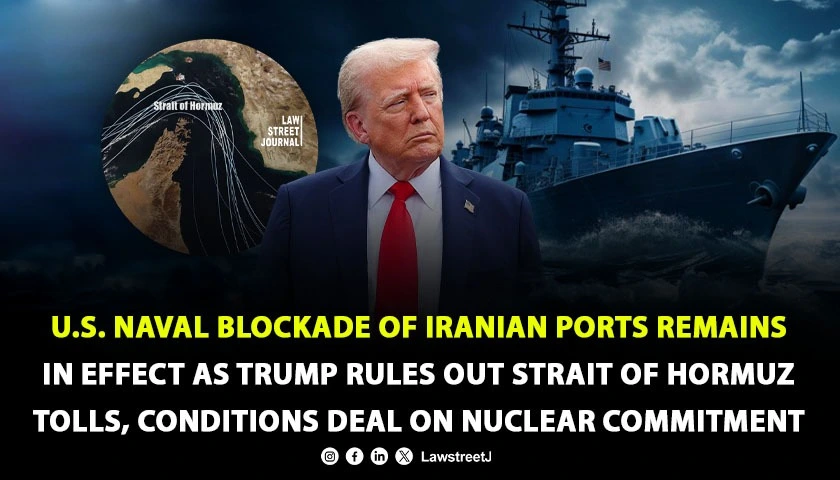
The United States naval blockade of Iranian ports is holding firm, with President Donald Trump declaring aboard Air Force One on Friday that there will be "no tolls" imposed on commercial vessels passing through the Strait of Hormuz, a direct rebuff to one of Tehran's stated demands in the ongoing conflict negotiations. Trump told reporters that negotiations on the Iran war would continue through the weekend, saying "the Iran thing is just going well." However, he made clear that the blockade is not going anywhere until a comprehensive peace agreement is reached.
The statement comes days after Iran's Foreign Minister Abbas Araghchi declared the Strait of Hormuz "completely open" for commercial vessels for the remaining period of the ceasefire, a move that sent financial markets responding sharply, stocks surged and the price of oil dropped 12% on the news. Trump welcomed the gesture but held his ground. The U.S. blockade of Iranian ports, he confirmed, "will remain in full force" until the two sides reach a peace deal.
How the Blockade Began: The Collapse in Islamabad
The sequence of events that led to the current standoff traces back to the weekend of April 12–13, when high-stakes face-to-face peace negotiations between U.S. and Iranian delegations broke down in Islamabad, Pakistan. The U.S. delegation, led by Vice President JD Vance, met with Iranian and Pakistani negotiators for more than 21 hours during the rare direct summit. The talks ultimately collapsed.
Peace talks hosted by Pakistan broke down over what the U.S. described as Iran's unwillingness to give up its efforts to obtain a nuclear weapon. Iran's own stated demands were far-reaching: Tehran's demands included control of the Strait of Hormuz, payment of war reparations, a ceasefire across the region including in Lebanon, and the release of its frozen assets abroad. Neither side found common ground.
Following the failed talks, Trump announced that the U.S. Navy would blockade "any and all Ships trying to enter, or leave, the Strait of Hormuz," with U.S. Central Command later specifying that American forces "will not impede freedom of navigation for vessels transiting the Strait of Hormuz to and from non-Iranian ports." The blockade formally took effect on Monday, April 13, at 10 a.m. Eastern Time.
The Toll Dispute and Legal Questions at Sea
At the heart of the conflict over the Strait of Hormuz lies a practice that the United States has declared unlawful. Analysts noted that Iran's Islamic Revolutionary Guard Corps imposed a de facto "toll booth" regime in the Strait, requiring vessels to submit full documentation, obtain clearance codes and accept IRGC-escorted passage through a single controlled corridor. Iran had indicated it might seek to impose a toll on all ships passing through the strait under a long-term peace deal.
A lawmaker on the Iranian parliament's National Security and Foreign Policy Committee told state media that Iran was charging some vessels up to $2 million in transit fees. Trump characterized this as "WORLD EXTORTION" and instructed the Navy to intercept ships that had already paid such fees. The U.S. military also began destroying mines Iran said it had laid throughout the Strait.
The legal classification of the blockade itself has drawn attention. Retired U.S. Admiral James Foggo said that technically speaking, a blockade of a country's ability to export goods and services is an act of war. Meanwhile, the U.S. Justice Department, through Acting Attorney General Todd Blanche, threatened to prosecute anyone who purchases sanctioned Iranian oil, saying "the Department of Justice will vigorously prosecute anyone who buys or sells sanctioned Iranian oil."
By April 16, the enforcement record showed measurable results on the water. The U.S. Navy turned back 13 ships since its blockade of Iranian ports in the Persian Gulf and the Gulf of Oman began, with Chairman of the Joint Chiefs of Staff General Dan Caine confirming that the military had not yet been required to board any vessels. The warning transmitted to approaching ships was unambiguous: "Do not attempt to breach the blockade. Vessels will be boarded for interdiction and seizure transiting to or from Iranian ports. Turn around or prepare to be boarded. If you do not comply with this blockade, we will use force."
Global Stakes: Oil, Diplomacy, and the Nuclear Question
The strategic importance of the Strait of Hormuz cannot be overstated. Nearly 20% of the global supply of oil and gas normally moves through the waterway, which is also a key passageway for fertilizer, aluminum, and helium. Oil prices surged past $100 a barrel in the days surrounding the breakdown in talks, reflecting the acute sensitivity of global markets to the standoff. On the diplomatic front, Europe has moved to carve out an independent path. French President Emmanuel Macron and British Prime Minister Keir Starmer announced they would chair a conference focused on coordinating maritime traffic in the Strait of Hormuz once the war ends, under an initiative called the "Initiative for Maritime Navigation in the Strait of Hormuz," to be held at the Élysée Palace in France. The United Kingdom separately declined to participate in the U.S. naval blockade, with a government spokesperson saying it was "urgently working with France and other partners to put together a wide coalition to protect freedom of navigation."
The nuclear question remains the central sticking point. Trump has been explicit that no deal can be concluded without Iran's commitment to forgo nuclear weapons. Vance said after the Islamabad talks that the U.S. needs a commitment that Iran will not seek to develop a nuclear weapon, adding "We haven't seen that yet. We hope that we will." Iran, for its part, has maintained that its nuclear programme serves civilian purposes and that it retains the right to enrich uranium.
As of this week, the U.S. and Iran remain engaged in talks, with Trump officials discussing details for a potential second in-person meeting with the Iranians. In-person talks could resume as early as this week, according to two people familiar with the negotiations. The human cost of the wider conflict has been significant. Iran's forensic chief confirmed that more than 3,300 people had been killed in the country since U.S.-Israeli strikes began on February 28, with more than 2,100 killed in Lebanon, 32 in Gulf states, and 23 in Israel.
As of April 18, the blockade holds, negotiations continue through intermediaries, and the ceasefire described by multiple officials as fragile remains in place. Trump, speaking to reporters, was asked how long the U.S. might wait for Iran to agree to further talks. His response was characteristic of the administration's posture throughout: "I don't care if they come back or not. If they don't come back, I'm fine."

![India reacts to US accusing Indian in foiled plot to kill Khalistan separatist [Read Unsealed Indictment]](/secure/uploads/2023/11/lj_1593_Khalistan_Row.jpg)