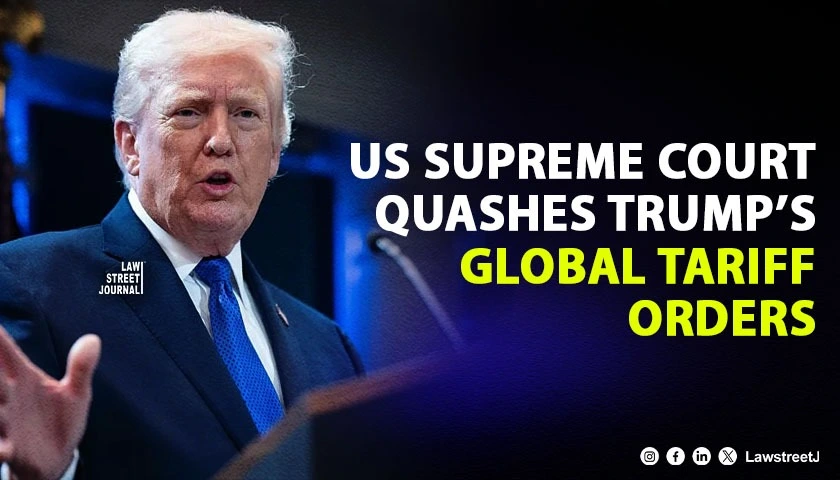
United States: The Supreme Court of the United States has held that the International Emergency Economic Powers Act (IEEPA) does not authorize the President to impose tariffs, striking down the sweeping global tariff orders issued by President Donald Trump.
Chief Justice John G. Roberts Jr. delivered the opinion on February 20, 2026, while disposing of the consolidated cases of Learning Resources, Inc., et al. v. Trump, President of the United States, et al. (No. 24-1287) and Trump, President of the United States, et al. v. V.O.S. Selections, Inc., et al. (No. 25-250).
The petitioners in Learning Resources, two small businesses, challenged the reciprocal and drug-trafficking tariffs imposed under IEEPA, arguing that the statute did not authorize such action. The plaintiffs in V.O.S. Selections, five small businesses and 12 States, raised the same challenge before the Court of International Trade.
Shortly after taking office, President Trump declared national emergencies concerning two foreign threats: the influx of illegal drugs from Canada, Mexico, and China, and large and persistent trade deficits, deeming both threats “unusual and extraordinary,” and invoked his authority under IEEPA to respond. He imposed a 25% duty on most Canadian and Mexican imports and a 10% duty on most Chinese imports to address drug trafficking. Regarding trade deficits, he imposed reciprocal tariffs of at least 10% on all imports from all trading partners, with dozens of nations facing higher rates.
The District Court for the District of Columbia denied the Government’s motion to transfer the case and granted a preliminary injunction, concluding that IEEPA did not grant the President the power to impose tariffs. The Court of International Trade granted summary judgment in favour of the plaintiffs, and the United States Court of Appeals for the Federal Circuit, sitting en banc, affirmed, concluding that IEEPA’s grant of authority to “regulate importation” did not authorize the challenged tariffs, which it described as “unbounded in scope, amount, and duration.” The Supreme Court then granted certiorari and consolidated the cases.
In its analysis, the majority emphasized that Article I, Section 8 of the Constitution vests in Congress the power to lay and collect taxes, duties, imposts, and excises. The Framers gave Congress alone access to the pockets of the people, while vesting no part of the taxing power in the Executive Branch. The Government conceded that the President enjoys no inherent authority to impose tariffs during peacetime and relied exclusively on IEEPA. It argued that the words “regulate” and “importation” in IEEPA constituted a sweeping delegation of Congress’s power to set tariff policy, authorizing the President to impose tariffs of unlimited amount and duration on any product from any country.
The majority held that IEEPA’s lengthy list of specific presidential powers contains no mention of tariffs or duties. Had Congress intended to confer the distinct and extraordinary power to impose tariffs, it would have done so expressly, as it consistently has in other tariff statutes. It further explained that the term “regulate,” as ordinarily understood, means to fix, establish, or control, and that taxation is not typically considered part of regulation. The opinion noted that no statute could be identified in which the power to “regulate” includes the power to tax, and warned that reading “regulate importation” to include taxing imports would render IEEPA partly unconstitutional, as the Constitution expressly forbids taxing exports.
Chief Justice Roberts, joined by Justices Neil Gorsuch and Amy Coney Barrett, applied the major questions doctrine, expressing reluctance to interpret ambiguous statutory text as effecting extraordinary delegations of congressional power. The majority observed that in IEEPA’s half-century of existence, no President had invoked the statute to impose tariffs. This absence of historical precedent, coupled with the breadth of authority now claimed, suggested that the tariffs extended beyond the President’s legitimate reach. It concluded that clear congressional authorization was required for such an extraordinary assertion of power, and none was present.
The opinion also rejected the Government’s argument that emergency statutes are exempt from the major questions doctrine, as well as the contention that the foreign-affairs implications of tariffs render the doctrine inapplicable.
“The Framers gave ‘Congress alone’ the power to impose tariffs during peacetime. And the foreign-affairs implications of tariffs do not make it any more likely that Congress would relinquish its tariff power through vague language, or without careful limits,” the majority stated.
Several historical arguments advanced by the Government, including reliance on the Trading with the Enemy Act and wartime precedents, were found inapposite to the question of peacetime tariff authority under IEEPA.
Justice Elena Kagan, joined by Justices Sonia Sotomayor and Ketanji Brown Jackson, agreed that IEEPA does not authorize the President to impose tariffs but concluded that invocation of the major questions doctrine was unnecessary, as ordinary tools of statutory interpretation sufficiently resolved the issue. Justice Jackson separately indicated that legislative history also confirms that Congress did not intend IEEPA to authorize the Executive to impose tariffs. Justices Gorsuch and Barrett each filed separate concurring opinions.
Justice Brett Kavanaugh, joined by Justices Clarence Thomas and Samuel Alito, dissented, arguing that the meaning of IEEPA’s language was clear by the time Congress enacted the statute, particularly in light of President Nixon’s highly publicised import duties upheld under identical language, and that the statute therefore authorized the duties at issue.
Justice Thomas filed a separate dissent, expressing the view that the power to impose duties on imports may constitutionally be delegated to the President and that the statute was consistent with separation-of-powers principles as originally understood. He observed that at the founding, power over foreign commerce was not within the core legislative power protected by the nondelegation doctrine.
Case Title: Learning Resources, Inc., et al. v. Trump, President of the United States, et al., and Trump, President of the United States, et al. v. V.O.S. Selections, Inc., et al. (Nos. 24-1287 and 25-250)