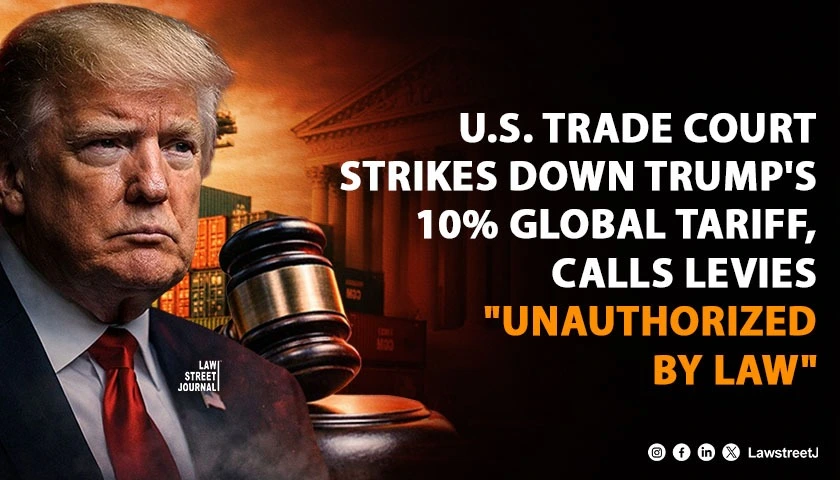
The United States Court of International Trade dealt a significant blow to President Donald Trump's trade policy on Thursday, May 7, ruling in a 2-1 decision that the administration's 10 percent global import tariff is unlawful and exceeds the powers granted to the executive branch by Congress. The split three-judge panel found the 10% global tariffs were illegal after small businesses sued, ruling that Trump overstepped the tariff power that Congress had allowed the president under the law. The tariffs are "invalid" and "unauthorized by law," the majority wrote. =
The ruling directly blocks the collection of these tariffs from three named plaintiffs: spice importer Burlap & Barrel, toy company Basic Fun!, and the state of Washington. For the wider body of importers not named in the suit, the tariffs remain in place while any appeal proceeds.
What Section 122 Says and What It Doesn't
The Supreme Court ruled in February that a broad swath of Trump's tariffs were illegal. In response, Trump swapped in new global tariffs that relied on then-untested legal authority under the Trade Act of 1974.
Trump turned to Section 122, a never-before-used provision of the Trade Act of 1974, the same day the Supreme Court struck down the bulk of his tariffs in February, imposing a 10% across-the-board surcharge set to expire July 24. The trade statute allows the president to impose a temporary tariff of as much as 15% for up to 150 days to address "large and serious" balance-of-payments deficits.
The Trump administration had argued that a serious balance-of-payments deficit existed in the form of a $1.2 trillion annual U.S. goods trade deficit and a current account deficit of 4% of GDP. The court rejected that reasoning outright. In its 53-page ruling, the court called the Section 122 tariffs "unlawful" and noted they had brought "economic harm" to the plaintiffs, adding that defendants had not explained why they should be permitted to continue the unlawful collection of such duties. The majority also addressed the core definitional problem. The court said that if the president can decide what counts as a "balance-of-payments deficit," he can always find one essentially allowing the law to be triggered at any moment. "Such an expansive reading of the statute" would give Trump unlimited tariff power that belongs to Congress.
The Plaintiffs: Small Businesses and One State
The Liberty Justice Center filed the lawsuit on behalf of Burlap & Barrel, a New York-based online spice retailer, and Basic Fun!, a Florida-based toy company, on March 9, 2026. The case centers on the fundamental constitutional dispute regarding whether the President or Congress holds the authority to impose tariffs on the American people.
The court ruled that most of the states that sued, with the exception of Washington, were not importers who had paid the Section 122 tariffs. Washington submitted evidence that it paid tariffs through the University of Washington, a public research institution. The claims of 23 of the 24 state attorneys general were dismissed, with the court ruling their harms were too indirect to establish legal standing. The court also ruled that the White House must issue refunds plus interest for all tariffs paid by the three plaintiffs.
What Comes Next: Appeals and "Plan C"
If the administration appeals, as expected, it would first turn to the U.S. Court of Appeals for the Federal Circuit in Washington, and then, potentially, the Supreme Court. Trump attributed the ruling to "two radical left judges," telling reporters: "So, nothing surprises me with the courts. Nothing surprises me."
Trade law practitioners have already flagged a likely next move. "There is already a 'plan C' in place: the Section 301 investigations that are already underway," said Tim Brightbill, co-chair of Wiley Rein's international trade practice. "The administration will appeal this decision but will continue collecting most of the 10 per cent tariffs under Section 122 until July 24, at which point we will likely have permanent Section 301 tariffs in place."
The ruling arrives a week before Trump is scheduled to discuss trade tensions with Chinese President Xi Jinping in Beijing, adding a layer of diplomatic weight to an already complex legal landscape. For American importers and businesses reliant on global supply chains, the constitutional question of who holds the power to tax goods at the border remains very much unresolved.