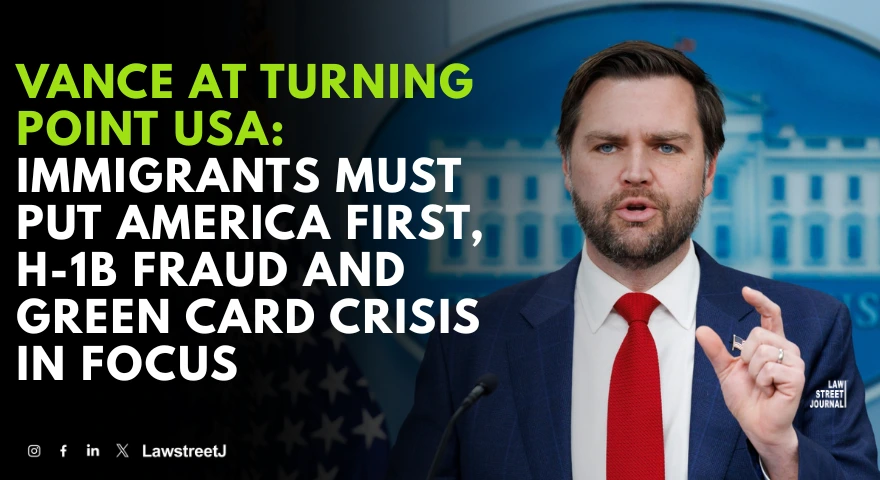
United States Vice President JD Vance took center stage Tuesday evening at Akins Ford Arena in Athens, Georgia, speaking at a Turning Point USA college tour event ahead of the 2026 midterm elections. The event was the second stop on a national Turning Point USA college tour, designed to energize college-age conservative voters before the upcoming midterm elections, held at the venue's Akins Ford Arena at the Classic Center. While the event drew both supporters and a significant number of protesters outside the arena, the Vice President's remarks on immigration, particularly his call for immigrants to place American identity above all other allegiances, dominated the national conversation by Wednesday morning.
Vance used the platform to lay out his administration's core vision of immigrant assimilation, while simultaneously acknowledging the genuine legal struggles of skilled visa holders who have spent years, in some cases decades, waiting for permanent residency in the United States.
"You Must Think of Yourself as an American"
The Vice President opened his remarks on immigration by drawing a direct and personal comparison. Vance stated that his father-in-law, who moved to the United States from India, was educated in the country, became an American citizen, and never once asked him to act in the interest of his country of origin. He framed this as the standard to which all immigrants should be held. Vance said that when someone becomes an American citizen, whether their family has nine generations of lineage in the United States or none at all, one responsibility that must be expected of citizens is that they think about the best interest of the country, not the country they came from beforehand, and not of any group they came from.
Responding to a question from a student of Indian origin who raised concerns about fraud in the H-1B visa system and noted that her parents were yet to receive their green cards, Vance said that the system only works if everybody thinks of themselves as an American. He also recalled an episode from his Senate campaign trail. Vance recounted an incident where an American of Ukrainian origin asked him to do something in support of Ukraine, to which Vance said he responded that if the person was an American, their country was the United States of America, not a place from which they had immigrated.
Vance is married to Usha Vance, who holds the distinction of being the first Indian-origin Second Lady of the United States. Her family traces its roots to Vadluru village in the state of Andhra Pradesh in India, and her parents immigrated to the United States in the 1980s.
The H-1B Visa Crisis: Fraud Concerns and Systemic Failures
The Turning Point USA event also brought renewed attention to an issue that has been building through 2025 and into 2026, widespread concern over abuse within the H-1B visa programme, alongside a staggering green card backlog that has left hundreds of thousands of skilled Indian professionals in legal uncertainty. The H-1B visa programme is widely used by United States technology firms to recruit foreign workers, with a significant number of beneficiaries being Indian professionals across sectors such as technology and healthcare. The programme has faced mounting scrutiny in recent months.
In 2026, agencies including the United States Citizenship and Immigration Services (USCIS), the Department of Homeland Security (DHS), and Immigration and Customs Enforcement (ICE) have ramped up enforcement measures. The USCIS implemented a beneficiary-based lottery system to prevent duplicate registrations from inflating the chances of selection, and Fraud Detection and National Security officers now conduct more surprise workplace inspections to confirm job legitimacy, wages, and job duties.
DHS and ICE have conducted raids on outsourcing firms, while new rules mandate higher wage proofs and limit renewals. ICE has pursued criminal cases against consultancies found running visa rackets, and petition revocations and multi-year bans have followed confirmed fraud cases. The administration has also introduced significant financial barriers to entry. Since early 2025, the administration has introduced a $100,000 fee for new H-1B petitioners and revised the lottery system to favour higher wages. The US Department of Labor has also proposed raising required wages for H-1B workers by up to 33 per cent in several cases.
The consequences for legitimate applicants have been severe. Fraud within the system slows down processing times, increases Requests for Evidence for honest applicants, damages trust between United States employers and foreign professionals, and fuels political backlash against skilled immigration.
Green Card Backlog: A Legal and Human Crisis Decades in the Making
Perhaps the most legally consequential dimension of the immigration debate is the green card backlog, which has reached proportions that immigration lawyers describe as a structural failure of current law. According to an analysis by the libertarian think tank the Cato Institute, over 400,000 Indian workers in the United States hoping for an employment-based green card face a projected 134-year wait. The United States government's annual cap of 140,000 employment-based visas and a 7 percent per-country limit have led to a backlog of 1.8 million cases, of which 1.1 million come from India. The primary legal reason for this backlog is Section 202 of the Immigration and Nationality Act, which imposes a 7 percent cap per country on employment-based green cards. This rule applies equally to all nations regardless of population or demand, which means each country receives around 25,620 employment-based green cards annually. This limit does not account for the volume of applicants from larger countries, creating a fundamental structural imbalance.
More than 90 percent of those waiting in the employment-based green card queue are Indian nationals. Reports suggest that nearly 424,000 applicants may pass away before receiving their green card. Legal experts have attributed the growing backlog to a combination of policy choices, including staff reductions ordered at the USCIS, diversion of USCIS personnel to assist ICE in enforcement efforts, and increased scrutiny of every application, all of which have slowed processing times considerably. The overall US visa backlog, as of early 2026, stands at a record 11.3 million cases, according to reporting by Business Standard.
The scale of this crisis has direct consequences for Indian professionals on H-1B visas. A single job loss can force visa holders to depart the country within 60 days, forfeiting years or decades of investment in their legal immigration process, including homes, businesses, and family roots. Long green card backlogs for Indian nationals keep many in temporary status for years, and a single job loss can threaten visa status and family plans, since employers control key filings including the H-1B petition, the immigrant petition, and the adjustment of status application. The Turning Point event in Athens was attended by hundreds of students but also drew several hundred protesters outside the Classic Center, with attendees hearing from state representatives and local political candidates who raised concerns about various aspects of the administration's policies.
As the 2026 midterm elections approach, immigration, both in its legal and enforcement dimensions, remains the defining fault line in American political debate. The Vice President's remarks in Athens reflect an administration seeking to balance a message of immigrant contribution with an unyielding demand for civic assimilation, even as the legal infrastructure meant to support lawful immigration strains under decades of unresolved statutory and administrative challenges.