

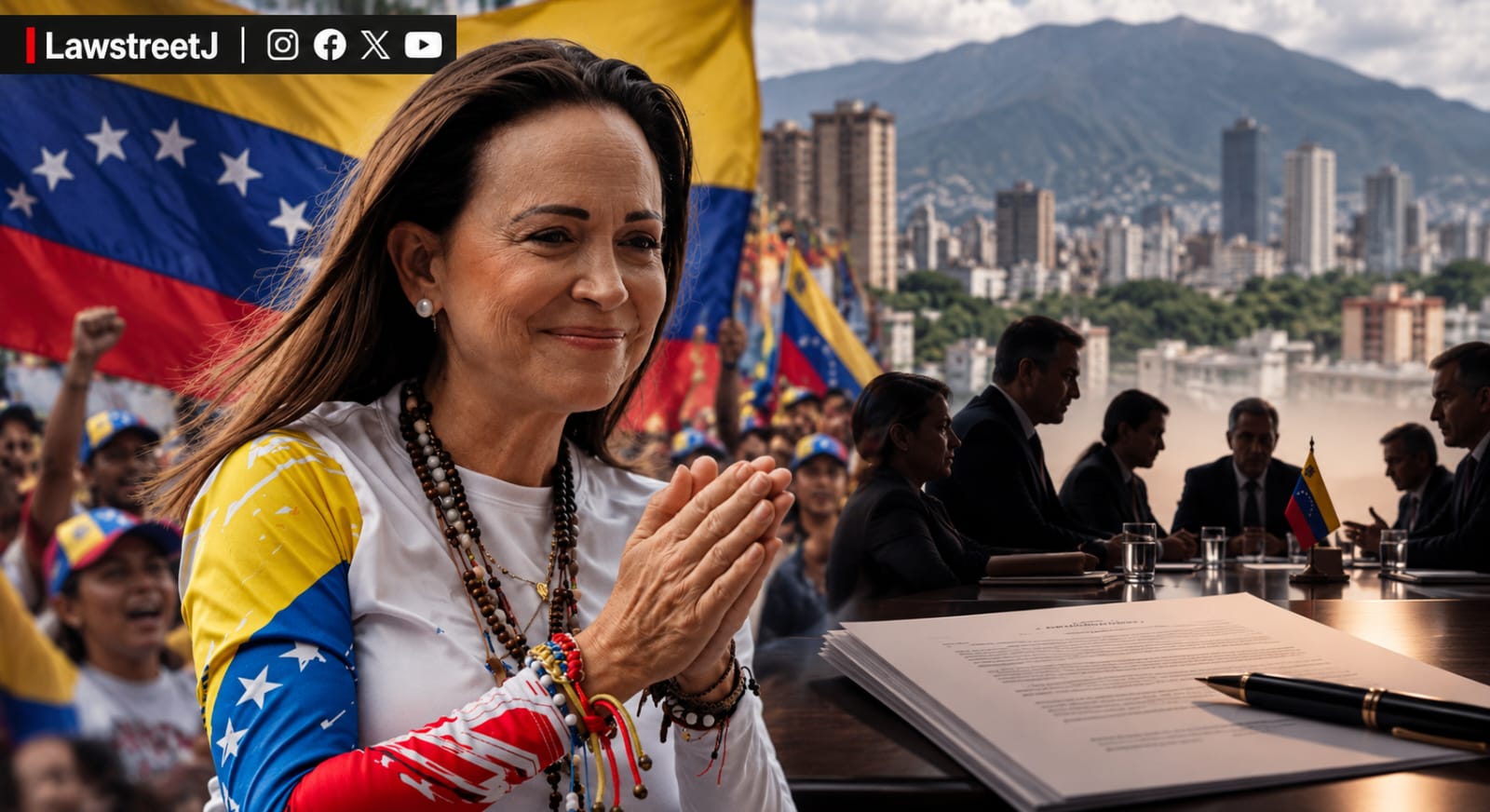
Caracas — An alliance of Venezuelan opposition parties has reaffirmed exiled Nobel Peace Prize laureate María Corina Machado as its leader, increasing pressure on Venezuela's interim authorities to allow her return to the country. The announcement, made Sunday as part of a new "Grand National Agreement," comes amid a third round of political transition talks between a faction of the opposition and the interim government, following the United States' capture and removal of longtime leader Nicolás Maduro in January 2026.
Members of the opposition's Unitary Democratic Platform (PUD) agreed to "recognize and support the leadership of Maria Corina Machado," according to the final document presented at the conclusion of a meeting held in Caracas on Sunday, October 18, 2026. Machado, currently living in exile in Panama, said in response: "We are at the beginning of a new era. We will finally make the liberal democratic republic a reality... Venezuela will be free."
The coalition's agreement calls for full freedom for political parties, the lifting of bans on candidates running for office, restrictions under which Machado herself has notably been barred from running in the past, an end to administrative proceedings targeting political organisations, and measures to protect human rights. Machado's own party, Vente Venezuela, is pushing for general elections to be held sometime next year, with a specific date yet to be set.
Maduro's Capture and the Transition
Nicolás Maduro, who had led Venezuela since 2013, was captured by the US military in January 2026 and flown to the United States to stand trial in New York. Following his removal, his deputy, Delcy Rodríguez, assumed power as interim president, governing, according to reporting, under sustained pressure from Washington to facilitate democratic reform.
Rodríguez, a longtime Maduro ally who served as his vice president, announced earlier in October 2026 that the interim government would continue releasing political prisoners detained under Maduro, describing the move as part of a "new political moment." Just prior to that announcement, the interim government freed at least four US citizens who had been detained in Venezuela, marking the first known release of American prisoners held in the country since Maduro's removal.
Machado's Position and the Ongoing Talks
Machado has not been invited to participate directly in the current round of US-backed transition talks between a faction of the opposition and the interim government, though she has stated she will not obstruct the process. Dinorah Figuera, leader of the opposition delegation involved in the negotiations, said on October 16 that she was working to ensure the talks would ultimately lead to elections. The negotiations presented to the public document described as containing 14 proposals for a democratic transition, as part of what opposition figures have termed a roadmap toward a "New Era" for the country.
Machado has separately voiced caution regarding the transition process. In prior remarks, she warned the Trump administration that interim President Delcy Rodríguez "does not represent the views of the people," asserting that Rodríguez instead represented the interests of the Russian, Chinese and Iranian governments rather than those of ordinary Venezuelans.
Machado acknowledged that the situation remained complex, with allies of the former president continuing what she described as "dirty work" even after Maduro's removal, but said she remained "profoundly confident" that an orderly transition of power would occur. Reports around the same period indicated that CIA Director John Ratcliffe had met separately with Rodríguez in Caracas as part of the broader US engagement with Venezuela's interim leadership.
Despite unresolved tensions over the shape of the transition, Machado has repeatedly thanked US President Donald Trump for what she has credited as his role in Maduro's removal, telling supporters: "I have always been grateful to the president of the United States for opening a door to progress toward freedom, democracy and true sovereignty." Trump, who met with Machado in the preceding days, has not yet formally endorsed her as Venezuela's rightful leader and has reportedly expressed uncertainty about the extent of her public support within the country, notwithstanding her prominent international profile following her 2025 Nobel Peace Prize.
María Corina Machado, a longtime Venezuelan opposition figure, was awarded the Nobel Peace Prize in 2025 for her efforts in support of democratic rights in Venezuela. She has lived in exile since 2025 and, according to reporting, has at times operated from hiding within the region before relocating to Panama.
She was previously barred from running for office in Venezuela's disputed 2024 presidential election, during which Maduro claimed victory amid widespread allegations of electoral fraud from the opposition and international observers; the opposition at the time maintained that its own candidate, Edmundo González, had won the election based on vote-tally records it said it had independently collected and published.