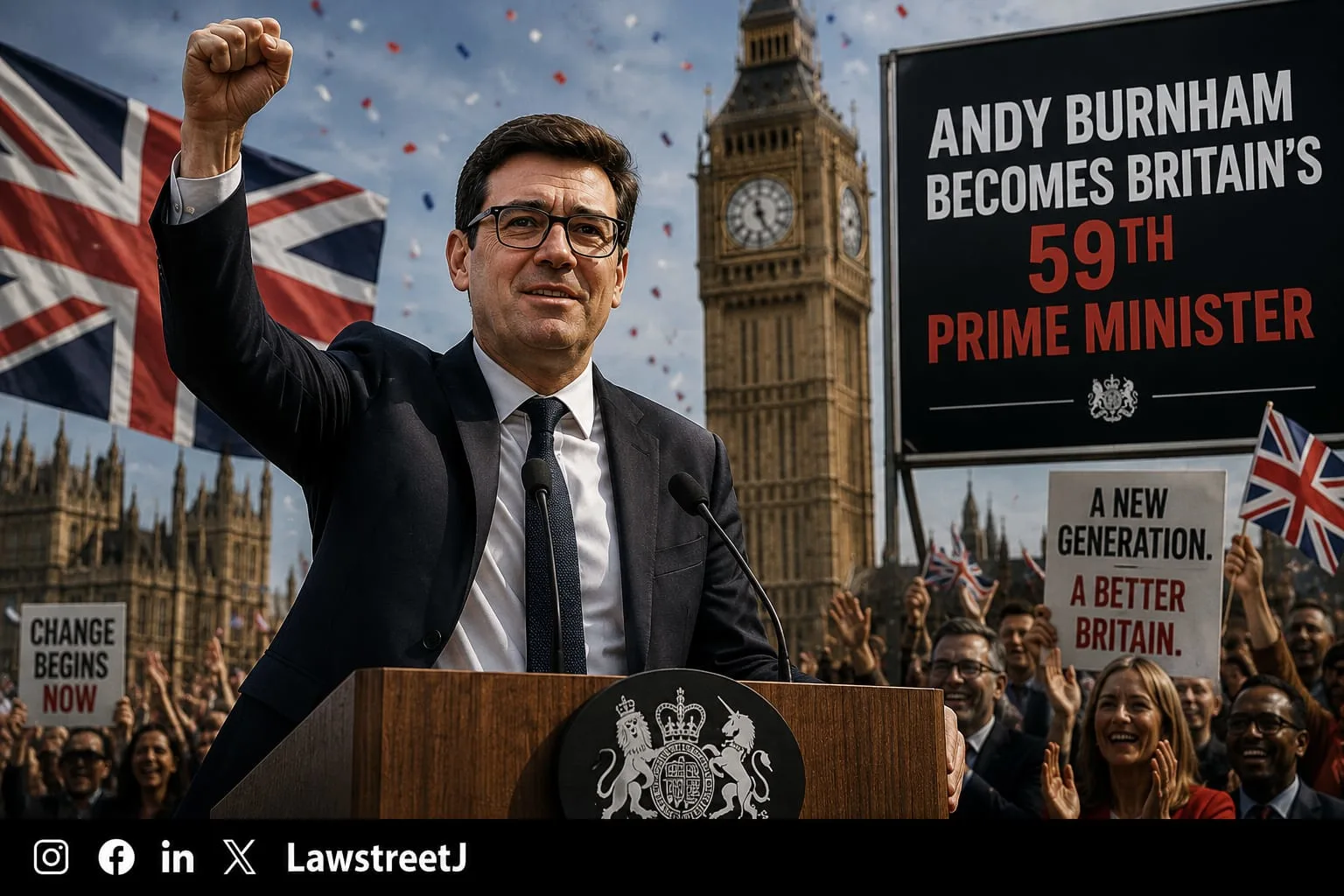
London: Andy Burnham officially became British prime minister on Monday, the country's seventh leader in 10 years, having already been elected as the leader of the Labour Party the previous week. The man from Aintree who raised his sister, ran Greater Manchester for nine years, and won back a parliamentary seat specifically designed to give him a route into this moment, stood outside 10 Downing Street in the July sunshine and told Britain it could be better.
He had been waiting for this for a very long time.
The Last Morning of the Starmer Era
The choreography of a British prime ministerial handover is one of the most practised rituals in democratic politics and by July 2026, Britain had practised it six times in ten years. Speaking outside the prime minister's official residence on Monday morning, Starmer said: "Today I am here to offer my resignation and close the book on my time as prime minister. My work is done." "I thank the British people for the opportunity to serve. I go with good grace, I go with a smile, and I go proud of everything that we have achieved."
Of his successor, the outgoing prime minister said: "I now pass the baton to Andy Burnham, I wish him every success. He has my full support."
After his address, Starmer travelled the short distance to Buckingham Palace to formally inform King Charles III of his resignation. Burnham then also travelled to the palace where the king asked him to form a government. The constitutional moment, formally known as "kissing hands," though no hand-kissing is involved, took place in a brief private audience with the King that transferred the authority of Her Majesty's Government from one Labour leader to another.
Staff clapped as new Prime Minister Andy Burnham and his wife Marie-France van Heel walked into 10 Downing Street. Burnham hugged his mother Eileen Burnham as he arrived in Downing Street.
The First Speech: "Circuit-Breaker" and a 10-Year Plan

Standing on the same patch of pavement where seven of his predecessors had addressed the country, Burnham delivered what he had promised would be a speech about stability and what it costs to lose it.
"Britain needs to show the world that we can regain our stability once again," Burnham said outside 10 Downing Street. "We have not been good enough, and we need to be better."
"We will make this moment a circuit breaker for Britain," he said. He pledged to deliver a new political and economic model and a 10-year plan, the latter a deliberate signal of ambition for a country that has changed prime ministers so frequently in the past decade that long-term planning has become almost impossible to execute.
He pledged to end the political instability that has plagued the country and promised to instigate major change, saying Britain was becoming the seventh premier in a decade.
In a clip recorded before he was officially appointed as British leader but released after his speech in Downing Street, Burnham said that among his first telephone calls internationally would be US President Donald Trump and Ukraine President Volodymyr Zelenskyy.
Who Andy Burnham Is: The Road to Downing Street
Burnham was the only candidate in a contest to become the party's new leader, securing nominations from 379 of the 403 Labour lawmakers in the House of Commons. He was confirmed as Labour leader on Friday July 17 at a special Labour conference.
Before his return to Westminster, Burnham, nicknamed Labour's "King in the North", served as the Mayor of Greater Manchester, one of the UK's largest metropolitan areas. Prior to his near-decade mayoral tenure, he was a Labour MP and held cabinet positions under prime ministers Tony Blair and Gordon Brown.
Burnham's road to Downing Street was not straightforward. In January 2026, he was blocked from contesting the Gorton and Denton by-election by Labour's National Executive Committee, a decision widely seen as an attempt by the Starmer administration to keep a potential rival out of Parliament. He eventually won the Makerfield by-election on June 18, secured his seat in the Commons, and watched Starmer resign on the same afternoon. The speed of the transition from by-election winner to Prime Minister just 32 days is without modern precedent in British political history.
He is the Member of Parliament for Makerfield. He is the 59th Prime Minister of the United Kingdom.
The Cabinet: Who Stays, Who Goes
Some of the most significant figures in former Prime Minister Keir Starmer's cabinet resigned ahead of Burnham's appointments, expected to be announced on Monday. David Lammy, who was the UK's Deputy Prime Minister and Justice Minister and who also previously served as Foreign Secretary, said that it was the "greatest privilege of his life" to serve in Starmer's government.
Several other senior Starmer-era ministers also departed, clearing the way for Burnham to shape a cabinet that reflects his own political direction rather than the Starmer government's centrist economic framework.
The prospect of Burnham, considered more left-leaning than Starmer, replacing the incumbent prime minister sent jitters through bond markets earlier in the year. Investors in UK government bonds, known as gilts, appeared to be largely supportive of Starmer and his finance minister, Rachel Reeves, remaining in their roles, due to their commitment to rein in public borrowing and spending.
Whether Burnham retains Rachel Reeves as Chancellor of the Exchequer, the single most consequential appointment signal for financial markets, was being closely watched by bond traders and currency desks on both sides of the Atlantic on Monday.
Trump's Response: "Poverty-Stricken Disaster"

The international response to Burnham's appointment began before his Downing Street speech had finished.
US President Donald Trump welcomed Burnham's plan to fast-track oil and gas exploration in the North Sea. However, in the same breath, Trump posted on Truth Social describing Britain as a "poverty-stricken disaster", a characterisation that arrived within hours of the new prime minister pledging to restore national stability.
The exchange encapsulates the challenge Burnham inherits on the foreign policy front. The UK-US relationship has been managed with considerable care by British governments of both parties for decades, and the personal chemistry between Downing Street and the White House has rarely been more unpredictable than it is in the Trump era. Burnham's call to Trump, one of his stated first diplomatic priorities will be closely watched for signals about how the "special relationship" is calibrated under new management on both sides.
What Burnham Inherits: The State of Britain in July 2026
The country Andy Burnham has been asked to govern is under considerable strain. Economically, Britain's budget deficit remains elevated, debt interest costs are at historic highs, and inflation has not fully returned to target. Politically, Reform UK under Nigel Farage, who is simultaneously fighting off a parliamentary standards investigation and a by-election he himself triggered by resigning his seat in Clacton, has been polling strongly, with the party's base energised by precisely the kind of political chaos that has produced seven prime ministers in ten years.
On foreign policy, Burnham faces an active conflict in the Persian Gulf following the resumption of US-Iran hostilities, an ongoing war in Ukraine on whose support he has already pledged to call Zelenskyy, and a UK-US trade relationship that had been in negotiation under Starmer and must now be re-anchored under a new administration.
Domestically, the National Health Service remains under sustained pressure, the planning and housing system remains a constraint on economic growth that multiple previous governments have failed to resolve, and the net zero transition, to which Burnham has made strong public commitments, requires infrastructure investment on a scale that is difficult to reconcile with the fiscal position the new Chancellor will inherit.
It might have required an act of God to keep Andy Burnham from becoming the United Kingdom's next prime minister. He is here now. What he does with the moment and whether the "circuit-breaker" holds is the question Britain will spend the next several years answering.

.webp)
![UK High Court Rejects Nirav Modi’s Application to Reopen Extradition Appeal; Holds Government of India’s Assurances Against Interrogation Comprehensive, Detailed and Reliable [Read Judgment]](/secure/uploads/2026/03/lj_7964_UK_High_Court_Rejects.webp)