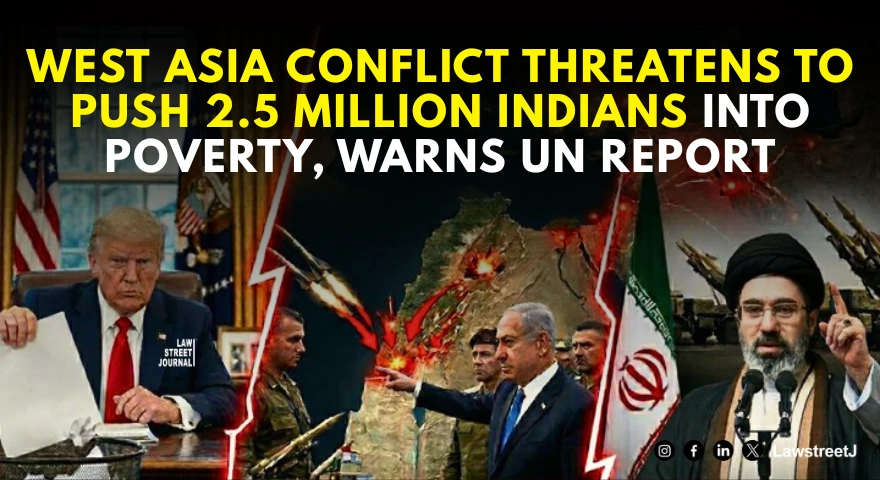
A new United Nations assessment, released on April 14, 2026, has placed India at the centre of a widening economic storm triggered by the military escalation in West Asia, one that could reverse years of hard-won progress in reducing poverty across the region. The United Nations Development Programme released a report titled Military Escalation in the Middle East: Human Development Impacts Across Asia and the Pacific on April 14, 2026. The report draws on country-level simulations and macro-economic modelling to estimate how the conflict is reshaping human welfare across 36 countries in the Asia-Pacific region. Its findings for India are stark.
According to UNDP projections, India's poverty rate is estimated to rise from 23.9 per cent to 24.2 per cent in the aftermath of the conflict, pushing approximately 2,464,698 additional people below the poverty line. The total number of people living in poverty in India post-crisis is projected to reach 354,033,698, compared to 351,569,000 before the conflict. The report models its most severe scenario as a 28-day conflict followed by an eight-month adjustment period. The findings indicate that the fallout for India goes far beyond the battlefield, touching agriculture, energy, trade, public health, and the livelihoods of millions of working families.
Globally, the UNDP estimates that 8.8 million people are at risk of falling into poverty as a direct result of the military escalation, while the Asia-Pacific region alone could face economic losses of up to USD 299 billion.
India's Deep Energy and Trade Dependency on the Region
To understand why India is so vulnerable to this distant conflict, one must look at the country's structural ties to West Asia, ties built over decades in energy, trade, and labour migration. India meets more than 90 per cent of its oil needs through imports, sourcing over 40 per cent of its crude imports and 90 per cent of its LPG imports from West Asia. This level of dependency makes India exceptionally sensitive to any disruption in regional energy flows, particularly around key maritime chokepoints like the Strait of Hormuz.
Under an adverse scenario, a 23 per cent year-on-year rise in crude prices is expected to sharply increase India's petroleum import bill, which already constitutes a substantial share of total imports. Rating agency CRISIL has warned separately that India's current account deficit could widen to around 2 per cent of GDP if the West Asia crisis prolongs, driven by a rising import bill and weakening external inflows. Beyond energy, West Asian markets account for 14 per cent of India's exports and 20.9 per cent of its imports. India's non-oil exports to the region amount to roughly USD 48 billion and include basmati rice, tea, gems and jewellery, and apparel.
The disruption to trade routes has already begun. UNDP's country-level analysis found significant supply chain impacts in 25 out of 36 countries examined, arising from freight surcharges, war-risk insurance premiums, route diversions, and delayed delivery of goods. The agriculture sector faces a particularly time-sensitive threat. The report notes that any prolonged disruption in input supply would coincide with preparations for India's Kharif cropping season, which begins in June. While urea stocks stood at 6.114 million tonnes providing a near-term buffer this may not be sufficient if disruptions persist into the planting season.
Remittances, Migrant Workers, and the Human Cost
One of the most consequential channels through which the West Asia conflict reaches ordinary Indian households is remittances. India is the world's largest recipient of remittances, and a very large share of those inflows originates from the Gulf. According to data from India's Ministry of External Affairs cited in the UNDP report, 9.37 million Indians were residing in Gulf Cooperation Council countries as of October 2024, collectively sending home approximately 38 to 40 per cent of India's total inward remittances.
Remittances from the Gulf account for nearly 3.5 per cent of India's GDP, a share that is higher than India's export earnings from the United States, which amount to roughly 2 per cent of GDP. For states like Kerala, Uttar Pradesh, and Bihar, Gulf remittances are not a supplementary income source, they are an economic lifeline embedded in the daily financial reality of millions of families. The UNDP report draws a direct line between reduced economic activity in Gulf states and food security back home in India. The report notes that food security pressures in India could be compounded by remittance losses, as reduced Gulf economic activity weakens household incomes and purchasing power. Employment risks extend well into the domestic economy as well. In India, employment risks are likely to be especially pronounced in MSME-intensive sectors that rely on imported energy and inputs or are exposed to Gulf-linked trade. This is particularly significant in a labour market where approximately 90 per cent of employment is informal.
Small firms in hospitality, food processing, construction materials, steel-based manufacturing, and gems and diamonds are among those expected to face higher input costs, supply shortages, and delayed or cancelled orders, with knock-on effects on jobs, working hours, and business continuity. The healthcare sector, too, is feeling the strain. Raw material costs for medical devices in India are expected to rise by around 50 per cent due to disruptions around the Strait of Hormuz, while wholesale prices of medicine have already risen by 10 to 15 per cent.
Human Development at Risk and the Path Forward
Beyond immediate poverty numbers, the UNDP report assesses the longer-term damage to India's human development trajectory. India is projected to experience a loss of approximately 0.03 to 0.12 years of Human Development Index progress as a result of the conflict, a setback that, while smaller than the estimated one to one-and-a-half years of HDI progress that Iran could lose, is nonetheless a reversal of hard-won gains. The UNDP has not framed this report as a counsel of despair. UN Assistant Secretary-General and UNDP Regional Director for Asia and the Pacific Kanni Wignaraja stated that the crisis also presents opportunities to accelerate long-term resilience through adaptive social protection, stronger regional value chains, and diversified energy and food systems.
To mitigate the consequences, the UNDP has proposed targeted and temporary cash transfers to support low-income and vulnerable households, an intervention that could require up to USD 6 billion, alongside temporary subsidies for electricity and basic gas consumption. The UNDP has emphasised that even with a temporary ceasefire, the crisis shifts from an acute to a prolonged stage, and the longer it persists, the higher the risk of accelerated poverty growth. In a worst-case scenario, up to 32 million people globally could fall below the poverty line.
For a country that has made significant strides in poverty reduction over the past decade, the UNDP's latest numbers are a sharp reminder that human development gains, when built on structurally vulnerable foundations, can erode quickly when geopolitical shocks arrive. The months ahead, particularly as India enters its agricultural season, will determine the true scale of the damage.

![Call for Papers: International Conference on Environment and Sustainable Development at Gauhati University in Collaboration with UNDP [Read Details]](/secure/uploads/2025/06/lj_8592_Call_for_Papers_International.webp)