New Delhi: Three days before thousands of Cockroach Janata Party supporters marched toward Parliament and clashed with Delhi Police, and two days before the CJP march was even publicly confirmed as going ahead despite a police ban, the United States Embassy in New Delhi published a formal Demonstration Alert for American citizens. The alert, dated July 17, 2026 and posted on the official Embassy website in.usembassy.gov, is verified and publicly accessible. It has since become the subject of heated political debate about what it means that the Embassy knew what was coming and whether that knowledge implies foreign involvement in the protests.
This article sets out what the alert actually says, how US embassies issue such alerts, what the political argument being made around it is, and what the facts support and do not support.
What the Alert Actually Said: The Full Text

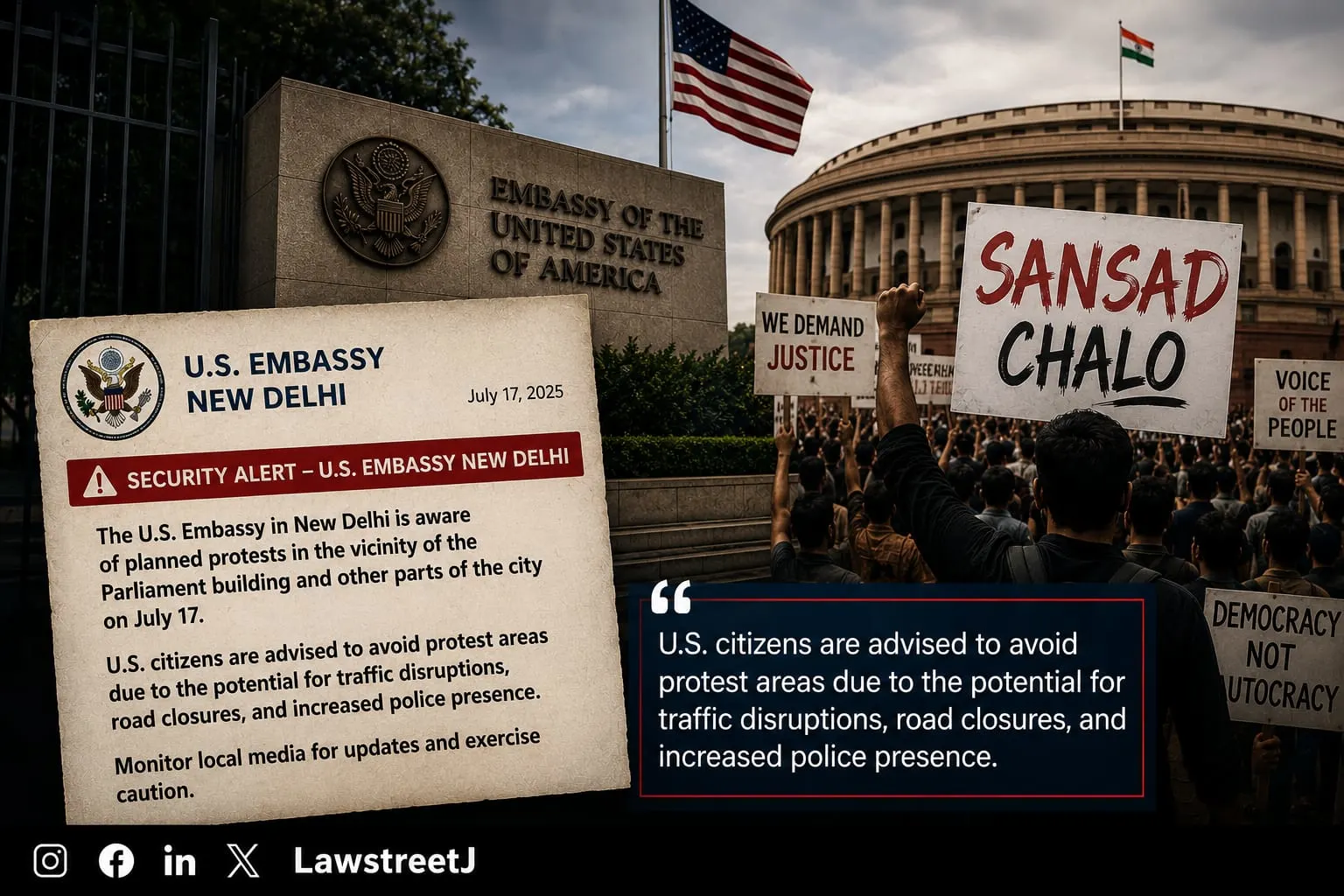
The July 17 Demonstration Alert issued by the US Embassy New Delhi advised American citizens to exercise caution due to expected large crowds and potential disruptions in Central Delhi on July 20 and 21. It specifically highlighted three locations and two dates.
On July 20, the opening day of the Monsoon Session of Parliament, the alert warned of large crowds expected to gather around Jantar Mantar and Parliament House, coinciding with the commencement of the session and the expected gathering of large crowds of politicians and activists. It noted that Delhi Police were expected to implement strict security measures and traffic management throughout Central Delhi.
On July 21, the alert warned of a separate protest at Kisan Ghat, where an alliance of approximately 250 national farmer organisations was expected to assemble, with participants arriving in New Delhi on motorcycles.
The alert advised US citizens to avoid crowds, monitor local media, plan for travel delays due to road closures and traffic diversions, and maintain a low profile while moving around the city. It did not predict violence. It did not describe the protests as dangerous. It characterised them as events likely to cause disruption.
The alert is categorically a routine consular notification, the US Embassy stated that US government personnel were advised to exercise caution, avoid affected areas where possible, and plan for travel delays accordingly.
How US Embassies Issue Demonstration Alerts: The Standard Practice
The debate over the July 17 alert has largely ignored the well-established and entirely routine nature of US Embassy demonstration alerts as a category of consular communication. These alerts have been issued by US embassies worldwide for decades, and India is not an exception. The US Embassy in New Delhi issued an identical class of advisory in July 2021, when the Samyukta Kisan Morcha was holding its Kisan Parliament at Jantar Mantar during the Monsoon Session of that year. That alert named Parliament and Jantar Mantar as the relevant locations, exactly as the July 2026 alert does.
US embassies have a legal and institutional obligation to inform American citizens, tourists, business travellers, students, diplomats, journalists, of any anticipated disruption to normal public movement in the cities where they are located. The State Department's worldwide caution system, the Smart Traveller Enrollment Programme, and the individual Embassy alert mechanisms all serve this function. Embassies gather this information from publicly available sources, news reports, social media, official police announcements, and standard diplomatic observation of the political calendar.
By July 17, the following information was already publicly available through Indian media and social media: the CJP had been protesting at Jantar Mantar since June 6; Sonam Wangchuk had been on hunger strike since June 28; the CJP had announced a "Sansad Chalo" march on July 20 coinciding with the Monsoon Session's opening day; and Delhi Police had publicly stated they would not grant permission for the march and had issued warnings. The farmers' alliance had separately announced their July 21 Kisan Ghat assembly through press releases circulated to media. None of the information in the Embassy's alert was secret, classified, or unknown to anyone following Indian news media.
The Embassy alert drew on these publicly available facts to do exactly what it is designed to do: warn American citizens in advance about anticipated disruptions to their movement. Describing this as evidence of "foreknowledge" attributable to foreign involvement misunderstands how consular alerts work.
The Political Argument: What Is Being Claimed and By Whom
This argument has been amplified by Republic World and has circulated across nationalist social media communities. It draws on a broader political narrative that has been circulated by government-aligned commentators since the CJP protests began,, namely, that a movement that began as a student agitation over a paper leak has been infiltrated or guided by external forces hostile to India's stability.
The Ministry of External Affairs has not made any statement endorsing or investigating the Embassy alert as evidence of foreign involvement. The Ministry of Home Affairs has not issued any public security assessment linking the CJP protests to external direction. No intelligence agency has made a public statement on the subject. The Indian government's official position, as stated by various ministers, is that the protests are an internal matter being handled through law enforcement and dialogue.
The claim that the Embassy alert constitutes evidence of foreign involvement in the protests contains a logical error that should be stated plainly. The alert was issued because the protests were already publicly announced and widely reported, not because the Embassy had access to information unavailable to anyone reading a newspaper. Demonstrating that the Embassy knew what was in the news three days before it happened is not evidence of involvement in the events being reported.
What the Debate Reveals: Larger Anxieties About India's Protest Ecosystem
While the specific conspiracy claim is not supported by the available facts, the debate around the Embassy alert does reveal something real about the current political climate surrounding the NEET protests and the CJP movement more broadly.
The attempt to link the protests to external forces follows a pattern that has been observed in India's political discourse during multiple large-scale domestic agitations. During the 2020-2021 farmers' protests, similar claims were made about foreign involvement based on tweets by international figures and foreign government statements. During the 2019-2020 CAA protests, claims about external funding and direction were circulated by government-aligned media. In each case, the government eventually engaged with the core demands being made through dialogue, through legislation, or through withdrawal of the contested policy rather than treating the movement as primarily a foreign-sponsored operation.
The July 20 CJP march was driven by 2.27 million students whose examinations were cancelled, a 21-day hunger strike by one of India's most respected public figures, and a demand for ministerial accountability that has been consistent and specific from the movement's beginning on June 6. Whether foreign embassies issued routine travel alerts about the day's expected disruptions is a separate question from whether those underlying grievances are legitimate and the conflation of the two serves neither accurate analysis nor the public interest.
What Came After July 20: The Protests Continue
Sonam Wangchuk's fast continued into July 21. Doctors reported low blood sugar despite stable vitals. Delhi High Court refused an urgent PIL hearing on alleged CJP protest crackdown, stating: "Don't drag the court into all this." CJP founder Abhijeet Dipke set a new condition: the government must come to Jantar Mantar to speak with CJP directly.
The farmers' alliance, as separately flagged in the Embassy's alert, did assemble at Kisan Ghat on July 21 as planned, a protest against the proposed India-US trade deal, specifically the agriculture chapters that farmer organisations allege would disadvantage Indian growers. That protest proceeded without the same level of police confrontation as the July 20 CJP march.
The Embassy alert, in retrospect, accurately described what happened on both days. That it did so three days in advance reflects the effectiveness of reading publicly available information, not the existence of a foreign hand in India's domestic protest movements.