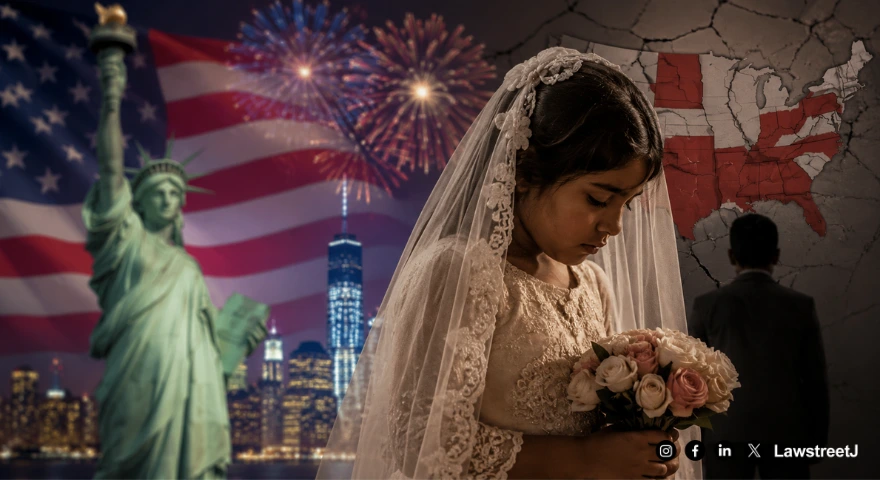
When Sara Tasneem started high school in Colorado, she was planning her future. She participated in JROTC, attended basketball games, had a boyfriend her own age, and dreamed of joining the Air Force and then going to law school. She was fifteen. She had no reason to believe that within months, her life would be unrecognisable.
During a visit to her father in Mountain View, California, she was introduced over coffee to a man she had never met. By that evening, she had been married to him in a spiritual ceremony in a hotel room in Los Angeles. Six months later, the marriage was made legal in Nevada. She had not consented. She had not been consulted. Her father, who belonged to a strict religious sect, had decided she had broken the group's rules by having a boyfriend her own age, and marriage to a stranger nearly twice her age was the consequence.
"Abuse was normalized for me at a young age, which was why it was so hard to recognize it," Tasneem said in a statement published by the AHA Foundation. "Instead, I blamed myself for many years until I started going to therapy and began to understand the abuse I had been exposed to."
She spent seven years in that marriage before she found the strength to leave. She eventually returned to school, earned her bachelor's degree, and built a new life. She also found a cause. For the past nine years, Sara Tasneem has been one of the most prominent voices in America calling for a nationwide ban on child marriage and as the United States celebrates the 250th anniversary of its independence this week, the numbers tell a story that is difficult to reconcile with the country's self-image as a beacon of human rights.
The Legal Reality: 33 States Still Allow Child Marriage
As of May 2026, only 17 of the 50 United States have completely banned child marriage by setting the minimum marriage age at 18 with no exceptions whatsoever. The remaining 33 states still permit marriage below the age of 18 under varying conditions, most commonly with parental consent, a court order, or both.
The 17 states with complete bans are Connecticut, Delaware, Massachusetts, Minnesota, New Jersey, New York, Pennsylvania, Vermont, Michigan, Rhode Island, Washington, Virginia, New Hampshire, Maine, Oregon, Missouri, and Oklahoma, the most recent of which, Oklahoma, banned the practice in May 2026 when Senate Bill 504 was signed into law. Three US states, California, Mississippi, and New Mexico, set no minimum age for marriage at all. In those states, a child of any age can be legally married with parental consent and a judge's approval.
Child marriage was legal in all 50 states until 2018. It was Delaware that made history as the first state to enact a complete ban, followed by New Jersey in the same year. The pace of reform has since accelerated, but the gap between the 17 states that have acted and the 33 that have not is vast, both geographically and in terms of the number of children it leaves exposed.
Between 2000 and 2021, approximately 315,000 children as young as 10 were legally married in the United States, according to research published by Unchained At Last. Of those, 86 percent were girls, with most wed to adult men. The annual number has declined significantly from roughly 32,600 in 2000 to approximately 1,700 in 2021, but the decline is not projected to reach zero without legislative intervention, according to advocates.
Why Child Marriage Is Still Legal: The Loopholes That Survive Every Reform
The persistence of child marriage in the United States is not an accident of political inaction alone. It is the product of a specific set of legal structures, loopholes that have survived repeated reform efforts and that activists describe as the hidden architecture of a practice most Americans assume does not exist in their country.
The most common loophole is parental consent. In most of the 33 states where child marriage remains legal, a minor can marry with the written consent of one or both parents, regardless of the minor's own wishes. This is precisely what happened to Sara Tasneem, her father consented on her behalf, and the law did not require anyone to ask her.
The second loophole is judicial approval. In many states, a judge may authorise a marriage involving a minor after reviewing the circumstances. Advocates argue this process is largely unworkable as a safeguard, since minors typically cannot afford legal representation, are often brought to court by the same parents who are arranging or permitting the marriage, and are not provided with independent legal counsel to represent their interests.
The third loophole is the pregnancy exception. Arkansas, Maryland, New Mexico, and Oklahoma have allowed legal exceptions to the minimum marriage age when a girl is pregnant or has already given birth to the prospective spouse's child. Advocates describe this provision as treating pregnancy, which in many cases may itself be evidence of statutory rape as a justification for marriage rather than as a potential sign of abuse.
Critically, marriage in most US states legally emancipates a minor, granting them the ability to sign contracts, lease property, and make their own medical decisions. But it simultaneously strips them of access to the legal protections available to other children including, in many states, the right to file for divorce. A minor who is married cannot in most states file for divorce, seek a domestic violence restraining order, or access a domestic violence shelter without their parents' consent. They are legally bound but legally powerless.
The Statutory Rape Problem
One of the most troubling dimensions of child marriage law and one that Sara Tasneem has spoken about extensively is its interaction with statutory rape law. In most states, child marriage serves as a legal defence to statutory rape charges. This means that an adult who marries a minor with parental consent cannot be prosecuted for having sexual relations with that minor, even if the minor is years below the age of consent.
The US State Department has officially classified child marriage as a human rights abuse. The United Nations Human Rights Committee, which monitors compliance with the International Covenant on Civil and Political Rights to which the United States is a signatory raised concern as recently as 2023 that child marriage remains legal in the majority of US states and urged Washington to set 18 as the universal minimum with no exceptions. The federal government has no minimum marriage age of its own and has not legislated one.
There are also federal loopholes with significant consequences. US federal law sets no minimum age for foreign spousal or fiancé visas, allowing an adult US citizen to use the immigration system to bring a foreign child spouse into the country. Under the US military code, marriage can still serve as a defence against charges of sexual assault of minors, a provision that Equality Now has described as suggesting the US government condones the practice.
Sara Tasneem's Fight: Nine Years in the Legislature
Since 2017, when she returned to school and began researching child marriage as part of her academic coursework, Sara Tasneem has been at the forefront of the legislative campaign to end the practice in California, one of the three states with no minimum marriage age at all.
She has testified before the California legislature, participated in protests outside lawmakers' offices, including a demonstration at which survivors dressed in wedding gowns with chains around their wrists and worked alongside Unchained At Last, the Tahirih Justice Center, and other advocacy organisations. She has appeared in the documentary "Knots: A Forced Marriage Story" and has spoken at state legislatures across the country.
Assembly Bill 2924, California's most recent attempt to ban child marriage by setting the minimum age at 18 with no exceptions, was introduced by Assemblymember Cottie Petrie-Norris and has been supported by Tasneem and Unchained At Last. The bill has faced opposition from multiple directions, including from the ACLU California Action and Planned Parenthood Affiliates of Northern California, which have argued that banning marriage under 18 without exceptions could drive abusive relationships underground and limit the rights of those under 18 who willingly want to marry. Anti-child-marriage activists have firmly rejected that framing. Tasneem's position has been consistent: "I want to protect the people with the smallest voice in this process, and that's the minor. Nobody looks out for them, not their parents, not the law, not lawyers, not politicians."
As of the time of writing, California remains one of three states in the country with no minimum marriage age.
250 Years and 33 States: The Gap Between Promise and Law
As the United States marks the 250th anniversary of its declaration that all are created equal and endowed with unalienable rights, the gap between that founding promise and the legal reality facing hundreds of thousands of American children who may be forced into marriage without their consent is one that advocates like Sara Tasneem have spent years trying to make visible.
Fraidy Reiss, founder of Unchained At Last, who was herself forced into a marriage at 19 and has driven the legislative campaign for bans across multiple states, describes the challenge plainly: "For some reason, most Americans do not realise that these abuses are happening. Most Americans agree that forced marriage and child marriage are terrible and heartbreaking. They imagine this happening on the other side of the world, and I wish there was something we could do to show them it's happening here, too, largely because we have outdated, archaic, and dangerous laws that need to be updated."
Sara Tasneem was a teenager in a California hotel room when those laws failed her. She is now in her forties, still fighting the same fight, still walking into the same legislative chambers, still telling the same story because in 33 states, the law has not yet changed enough to mean that another fifteen-year-old girl could not face exactly what she faced.



.jpeg)