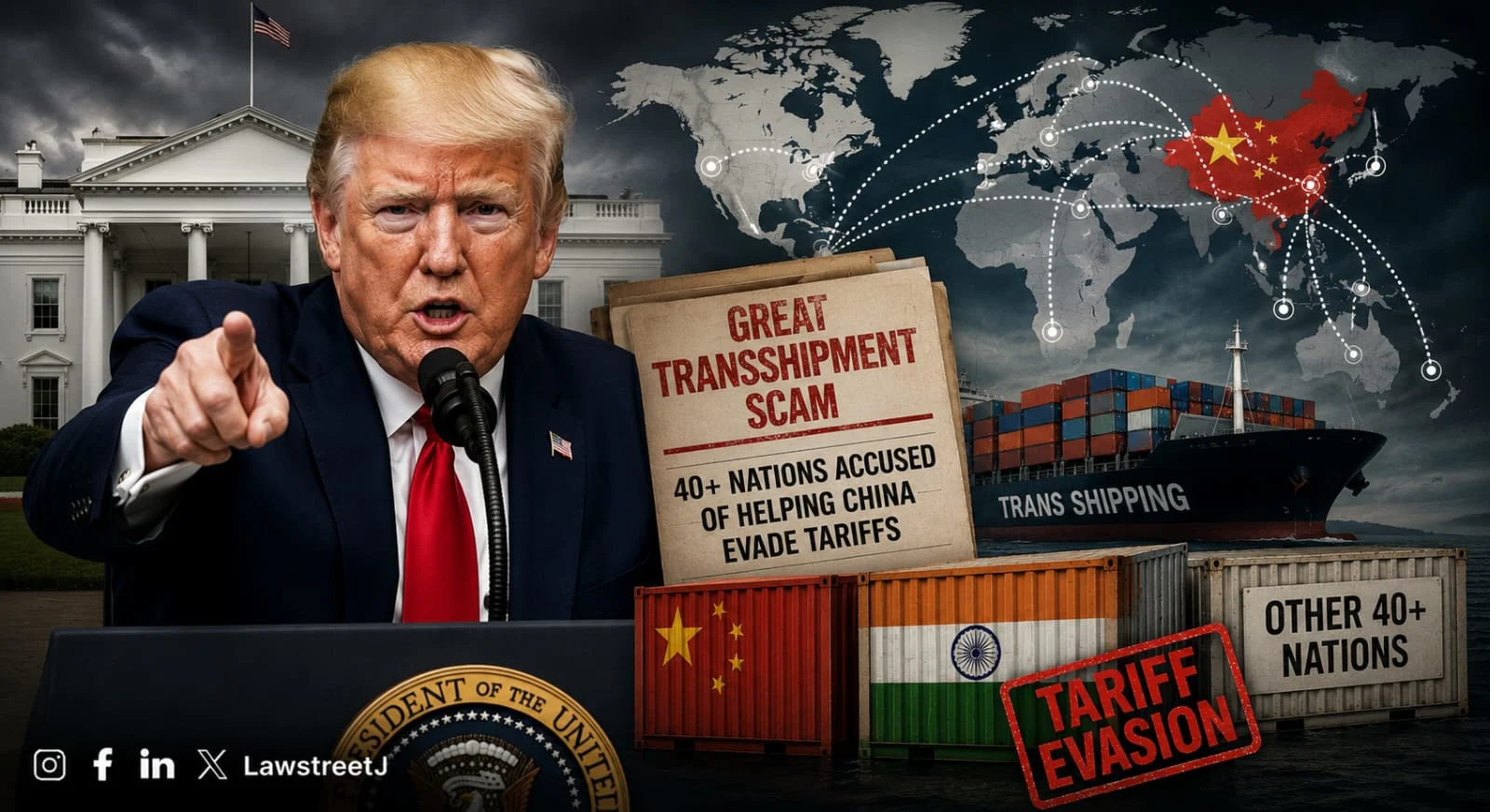
WASHINGTON D.C. — The White House released a report on Thursday that accused more than 40 countries including some of Washington's closest trading partners of participating in what it called a global "Shadow Transshipment Network" through which Chinese exporters are bypassing steep US tariffs by routing goods through third-party nations. India, which has been in active trade negotiations with the United States, was explicitly named by senior trade adviser Peter Navarro and placed in the highest-risk tier of the report's classification system.
In a report titled "The Great Transshipment Scam," Peter Navarro, Counsellor to the President for Trade and Manufacturing, told reporters: "For years, the great transshipment scam has let Communist China launder its exports through more than 40 countries."
The allegations were detailed in a White House report titled "The Great Transshipment Scam," released by the Office of Trade and Manufacturing Policy. According to the report, the network includes more than 40 countries, among them some of Washington's largest trading partners, including India, Canada, Mexico, the European Union, Japan and South Korea.
The report reads: "The message to the world is simple. The age of untraceable illegal transshipment is over. What once seemed like quiet paperwork manoeuvres relabelling, repackaging, re-invoicing has become a matter of economic sovereignty and national will."
How the Scam Works and How Long It Has Been Running
The mechanism the White House report describes is not a new one. US trade adviser Peter Navarro said Chinese exporters have for years used third countries to disguise the origin of goods and gain access to the American market while avoiding tariffs imposed on Chinese products. The transshipments became more prevalent after 2018, when the Trump administration imposed Section 301 tariffs on China to counter "unfair trade practices."
The US alleges that Chinese goods are routed through intermediary countries where they may undergo limited processing, assembly, repackaging or relabelling before being exported to the US. Exporters were able to disguise where a product came from by repackaging or relabelling the goods and performing limited assembly in another country before sending the product to the US.
The mechanics of the scheme, as described in the report, involve a range of practices from straightforward relabelling that changes a product's stated country of origin, to more elaborate minimal processing that is designed to meet the technical threshold for a different country-of-origin classification. The goal in each case is the same: to present a Chinese-made product to US Customs as a product of Vietnam, India, Mexico, or another country that faces a substantially lower tariff rate than China currently does.
The report argues the named countries have a financial incentive to allow the practice because transshipment generates fees, jobs, and tax revenue. This framing is significant, it shifts the characterisation from one of active fraud to one of systemic incentive alignment, where third countries benefit from hosting the transshipment infrastructure even without directly conspiring to evade US law.
The Financial Scale: Up to $303 Billion, $75 Billion Central Estimate
The White House report does not offer a single definitive figure for the scale of the transshipment scheme, reflecting the methodological difficulty of measuring trade that is, by design, obscured from official view.
The White House report estimates that the value of goods involved in illegal transshipment could range from $40 billion to as much as $303 billion annually, depending on the methodology used. A central estimate puts the figure at around $75 billion, with the US potentially losing $19 billion to $26 billion in tariff revenue every year.
The report claims roughly $75 billion in goods were improperly transshipped between February 2025 and February 2026. That figure translates into an estimated $19 billion to $34 billion in lost US tariff revenue over the same period.
A separate analysis from the Commerce Department estimated that about $67 billion in goods were transshipped from China through Mexico, India and Vietnam last year, resulting in roughly $28 billion in lost tariff revenue.
The range between the low estimate of $40 billion and the high estimate of $303 billion reflects the fact that the US does not have direct visibility into a supply chain that is specifically structured to avoid detection. The report's methodology involves inference from trade data anomalies, sudden surges in exports from specific third countries in product categories where China has historically dominated, shipment routing patterns that do not reflect the most efficient logistics paths, and ownership structures that link exporters in third countries to Chinese parent companies.
Three Tiers: Where India Sits and What It Means
The report does not treat all 40-plus accused countries equally. It introduces a three-tier classification system that places different countries in different categories based on their scale, their economic integration with China, and the nature of the transshipment risk they present.
The report categorises the 40-plus nations into three tiers. India is placed in Tier 1 ("Diversified Scale Leaders") alongside major economies like Canada, the European Union, Israel, Japan, Mexico, South Korea, and Taiwan, described as large industrial bases where transshipment risks are embedded within legitimate trade.
Tier 2 ("Significant Economic Integration with China") includes Brazil, Indonesia, Malaysia, Thailand, Turkey, and Vietnam, while Tier 3 ("Small, Opportunistic Targets") includes Bangladesh, Cambodia, the Philippines, Singapore, Sri Lanka, and the UAE.
India's placement in Tier 1 is the most consequential element of the report for New Delhi's trade relationship with Washington. Tier 1 countries are not being accused of intentional fraud or of actively running transshipment operations. They are, however, being identified as countries where the scale of legitimate trade with China creates conditions in which transshipment can be embedded and is difficult to detect and prevent.
The practical consequence of the Tier 1 classification is that India will face increased US Customs scrutiny of its exports to the United States, particularly in product categories where Chinese manufacturing dominance is well established. Electronics, solar panels, steel products, chemicals, and textile components are among the sectors where transshipment risks have historically been most acute.
Navarro Names India Directly and Issues a Warning
Beyond the report's tier classification, senior trade adviser Peter Navarro addressed India by name during his Thursday briefing, delivering a message that was both a characterisation of the problem and an explicit warning about what the administration intends to do about it.
Senior trade adviser Peter Navarro explicitly named India during a briefing, warning that as the US imposes higher tariffs, it would deter countries like India and Vietnam attempting transshipment. "This is about the 40-plus countries that are enabling the transshipping, and as we impose higher tariffs on other countries, India, Vietnam, down the line, they're going to try this transshipment too. Our message is simply that the way to pay less is not to cheat; it is to stop dumping, respect intellectual property, drop your barriers to American goods and move towards reciprocity."
"Our warning to the lower tariff countries facilitating and enabling the transshipping is this: preferential access to the American market is not a license to launder somebody else's exports," said Navarro.
Navarro's framing, positioning India's current relatively lower tariff rate as a privilege that could be revoked if India is found to be facilitating Chinese transshipment, is a direct trade pressure tool. India has been in protracted negotiations with the United States over a bilateral trade deal throughout 2025 and 2026. The release of a report naming India as a Tier 1 transshipment risk, during those negotiations, changes the leverage dynamics of those talks and gives the US administration a publicly documented basis for demanding stronger origin verification requirements and greater cooperation on customs enforcement from New Delhi.
"Detective Border": The AI System That Will Hunt Transshipment
The report is not merely an accusation. It comes with an operational response, a planned AI-powered enforcement system that the Trump administration says will fundamentally change the US government's ability to detect and penalise transshipment.
Navarro announced that the US will use an AI-enabled system called "Detective Border" to identify transshipped goods reaching American shores. The "Detective Border" would support US Customs and Border Protection by integrating shipment data, routing histories, product classifications, ownership relationships, production-capacity indicators, anomaly detection, computer vision, and other analytical tools.
"The objective is to improve CBP's ability to distinguish legitimate nearshoring and foreign investment from illegal pass-through trade, identify high-risk shipments, and convert analytical findings into interdiction, duty collection, penalties, and exclusion," the report said.
The "Detective Border" system represents a significant technological escalation in US customs enforcement. Traditional US Customs and Border Protection enforcement has relied heavily on physical inspection of declared shipments and review of paper documentation, processes that are slow, resource-intensive, and relatively easy to circumvent through careful documentation. An AI system that can analyse shipping route histories, product classification patterns, ownership structures across corporate networks, and production capacity data from multiple countries simultaneously creates a fundamentally different enforcement environment.
The report frames the AI system as a tool for distinguishing legitimate economic activity, genuine nearshoring, where companies have actually relocated production to third countries from fraudulent transshipment where production remains in China and only the routing and labelling changes. That distinction is one that requires exactly the kind of multi-variable pattern analysis that AI systems are well suited to perform.
What This Means for India-US Trade Relations
The timing of the "Great Transshipment Scam" report released in the middle of ongoing India-US trade negotiations, is a factor that New Delhi's trade negotiators will need to navigate carefully.
India has been working to reduce trade friction with the United States, with discussions focused on market access, tariff rates, and trade deficit reduction. The report introduces a new element into those discussions: the explicit US allegation that India's trade infrastructure is being used by Chinese exporters to circumvent American tariffs, whether or not Indian companies themselves are directly involved in the evasion.
The Tier 1 classification does not require India to accept guilt for intentional transshipment facilitation. What it does require is that India demonstrate, to the US government's satisfaction, that its customs and origin verification systems are adequate to prevent Chinese goods from being laundered through Indian supply chains. Failing to provide that demonstration or being found to fall short carries the implied threat of higher tariffs or other trade measures.
India's official response to the report had not been issued as of the time of publication. The report itself is the opening of a conversation that India's trade ministry will need to respond to as the US-India trade negotiations continue.


.jpeg)