

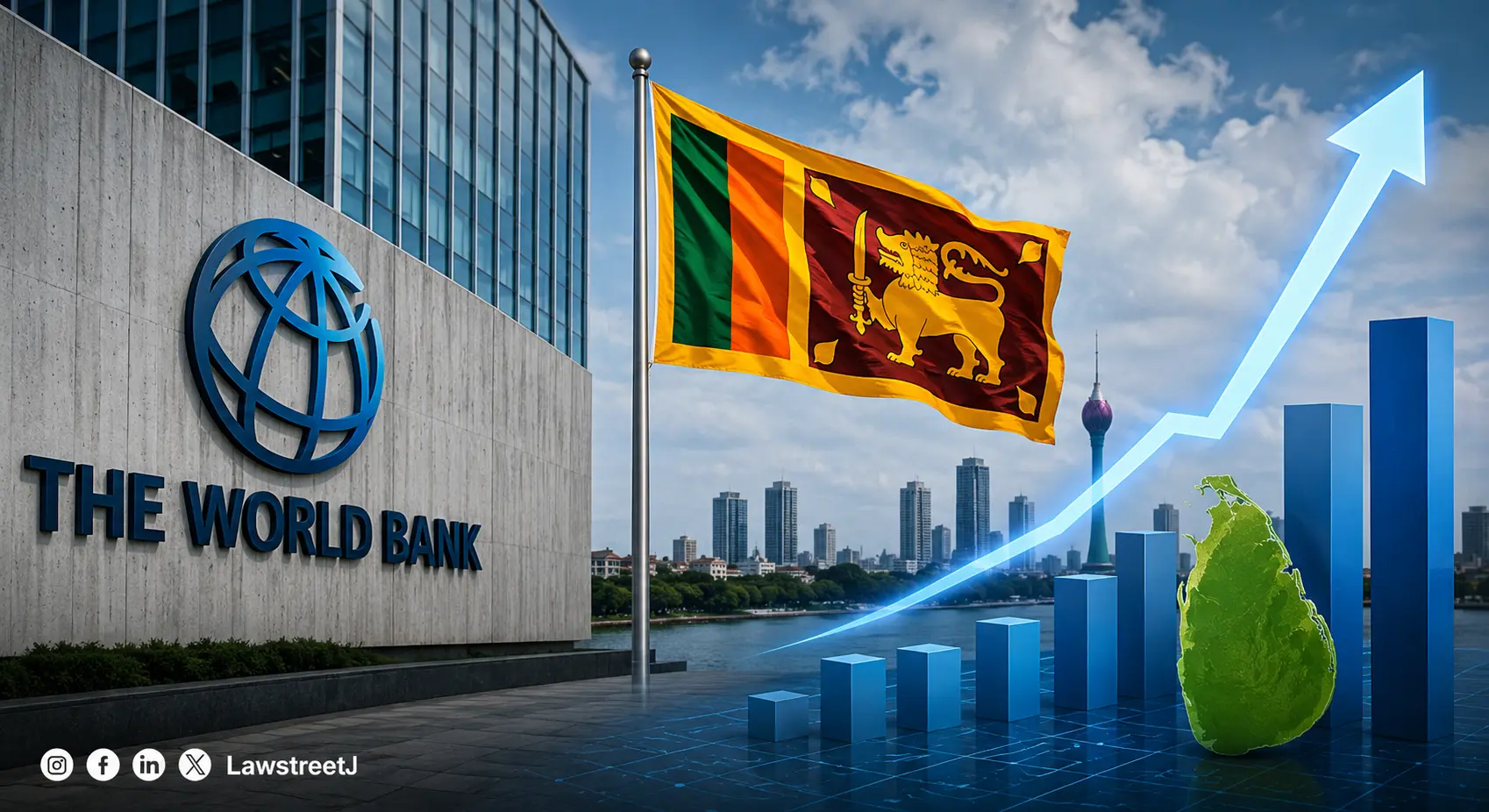
Three years after one of the most dramatic economic collapses in South Asian history, fuel shortages, medicine scarcities, mass public protests, a defaulted sovereign debt, and a president who fled the country, Sri Lanka has been officially reclassified as an upper-middle-income economy by the World Bank. The announcement, made on July 1, 2026, as part of the World Bank Group's annual country income classification update, marks what the institution itself described as "a story of recovery" and what Sri Lankans living through the aftermath of the 2022 crisis will understand to be one of the most consequential economic turnarounds in the country's post-independence history.
According to the latest country income classifications released by the World Bank Group on July 1, 2026, Sri Lanka has been upgraded from a Lower-Middle-Income Country to an Upper-Middle-Income Country. The updated classification covers 218 economies.
The classification will remain valid until the end of June 2027, when the World Bank will reassess all economies based on the following year's Gross National Income per capita data.
The Road Back: From Default to Recovery
To understand the weight of this reclassification, it is necessary to recall where Sri Lanka stood in 2022. Sri Lanka officially declared an economic emergency in 2022, triggering widespread public unrest and the resignation of then-President Gotabaya Rajapaksa. The country subsequently entered into a bailout programme with the International Monetary Fund and undertook a series of painful but necessary fiscal reforms, including tax increases, subsidy reductions, and restructuring of its foreign debt obligations.
The crisis had deep structural roots. Decades of fiscal mismanagement, a catastrophic and abrupt ban on chemical fertilisers in 2021 that devastated agricultural output, a collapse in tourism revenue during the COVID-19 pandemic, and ballooning foreign debt obligations had left the government with insufficient foreign exchange reserves to pay for essential imports. By April 2022, Sri Lanka had defaulted on its external debt for the first time in its history as a sovereign nation, a moment that sent shockwaves through credit markets and triggered an IMF intervention that came with stringent conditions attached.
The World Bank said Sri Lanka's real GDP grew by 5 percent in 2025. "Sri Lanka is a story of recovery. Just three years after a severe economic crisis brought the country to the brink of collapse in 2022, real GDP grew by 5 percent in 2025, driven by a rebound across industries and growth in financial and tourism services. The reclassification is a marker of resilience, though the country only narrowly crossed the threshold," it said.
What the World Bank's Income Classification System Means
The World Bank updates its income classifications on July 1 each year through its Development Data Group, using gross national income per capita estimates from the previous calendar year. Economies are grouped as low-income, lower-middle-income, upper-middle-income, or high-income. The thresholds are adjusted annually for inflation using the Special Drawing Rights deflator, a weighted average of the GDP deflators of China, Japan, the United Kingdom, the United States, and the Euro Area, to keep income classification thresholds fixed in real terms over time.
The classification carries both symbolic and practical significance. Among the key implications of this status change are greater credibility with international investors and financial institutions, potential changes to the terms and conditions of future development financing, recognition of the country's progress in stabilising its macroeconomic fundamentals, and improved standing in global economic rankings and assessments.
The classification also influences eligibility for concessional financing. Countries in higher income brackets typically face less favourable borrowing terms from development institutions, meaning Sri Lanka's upgrade could, paradoxically, make some forms of concessional lending from multilateral development banks more expensive or less accessible going forward, a transition that the government will need to plan for carefully.
Sri Lanka first entered the upper-middle-income category in 2019 before falling back to lower-middle-income status as economic growth slowed and income levels deteriorated. Tuesday's reclassification therefore represents a return to a status the country had achieved before and then lost, rather than an entirely new milestone.
Sri Lanka Was Not Alone: The July 2026 Reclassifications
This year, none of the countries assessed moved down. Five moved from lower-middle to upper-middle income: Jordan, Micronesia, the Philippines, Sri Lanka, and Viet Nam. One moved from low to lower-middle income: Togo. They reached the same thresholds through very different paths.
The World Bank's own assessment of those different trajectories is instructive. Viet Nam tells a story of growth. Powered by an export-led model, the country saw exports surge by more than 15 percent in both 2024 and 2025, with its GDP growing at 7 percent and 8 percent respectively. GNI expanded at an average of 10 percent annually between 2021 and 2025, one of the strongest sustained runs in the region. The Philippines achieved its reclassification through broad-based expansion. GDP grew at an average of 5.8 percent per year over five years, reflecting gains across all major industries, not a single sector boom, but an economy-wide shift.
Jordan's reclassification followed a comprehensive revision of its national accounts, which revealed that its economy was nearly 10 percent larger than previously estimated. Micronesia recorded modest but steady post-pandemic growth. Togo, meanwhile, moved into the lower-middle-income category largely as a result of revised population estimates, together with economic growth and exchange-rate movements.
Sri Lanka's path, recovery after crisis, driven by a rebound in industry, financial services, and tourism is qualitatively distinct from the growth-led trajectories of Vietnam and the Philippines. That distinction matters for how durable the upgrade proves to be.
A Narrow Crossing: What the Numbers Actually Show
The World Bank's own language about Sri Lanka's reclassification is carefully measured. The World Bank said Sri Lanka only narrowly exceeded the upper-middle income threshold. Maintaining this status will depend on sustained economic growth, stronger exports, continued investment and ongoing economic reforms.
That qualifier, "only narrowly" is significant. It means Sri Lanka is not comfortably ensconced in the upper-middle-income bracket but sitting at its lower boundary, making the country vulnerable to reclassification downward again if growth falters, exports disappoint, or external shocks materialise.
While the upgrade is widely regarded as positive news, economists and policymakers are likely to caution that the reclassification does not mean the hardships faced by ordinary Sri Lankans are over. The cost of living remains elevated, and the full benefits of economic stabilisation have yet to be felt equally across all segments of society.
Economists warn the upgrade does not resolve ongoing challenges including high debt, inflation, and structural vulnerabilities. Sri Lanka continues to operate under its IMF Extended Fund Facility and has not yet fully exited the debt restructuring process that was initiated following the 2022 default. Foreign exchange reserves, while significantly improved from their crisis-era lows, remain below the levels considered adequate for a country of Sri Lanka's import dependency and debt service obligations.
The IMF itself has clarified that it places its trust in Sri Lanka's domestic institutions when assessing the country's progress under its programme, a statement that acknowledges the ongoing nature of the reform process rather than declaring it complete.
What Comes Next: The Test of Durability
Businesses and policymakers will now watch whether the economy can maintain this momentum and remain above the upper-middle income threshold in future assessments. The factors that will determine whether Sri Lanka consolidates its upper-middle-income status or falls back again are well understood: sustained GDP growth above the 4 to 5 percent range, continued progress on fiscal consolidation and debt reduction, diversification of export earnings beyond garments and tourism, and the maintenance of macroeconomic stability in an external environment that remains uncertain.
President Anura Kumara Dissanayake, whose administration took office in late 2024 on a platform of systemic economic reform and anti-corruption, has presided over the initial phase of Sri Lanka's recovery and will now face the harder task of making that recovery durable. The World Bank's upgrade provides his government with a significant political and diplomatic asset, but it also raises the bar that Sri Lanka must now consistently clear to maintain the designation.
For a country that four years ago could not afford to import petrol, the return to upper-middle-income status is a genuine and measurable achievement. Whether it is the beginning of a sustained new chapter or a fragile moment of recovery that could reverse under pressure is the question that Sri Lanka's economic managers, its creditors, and its 22 million people will be watching closely over the coming years.