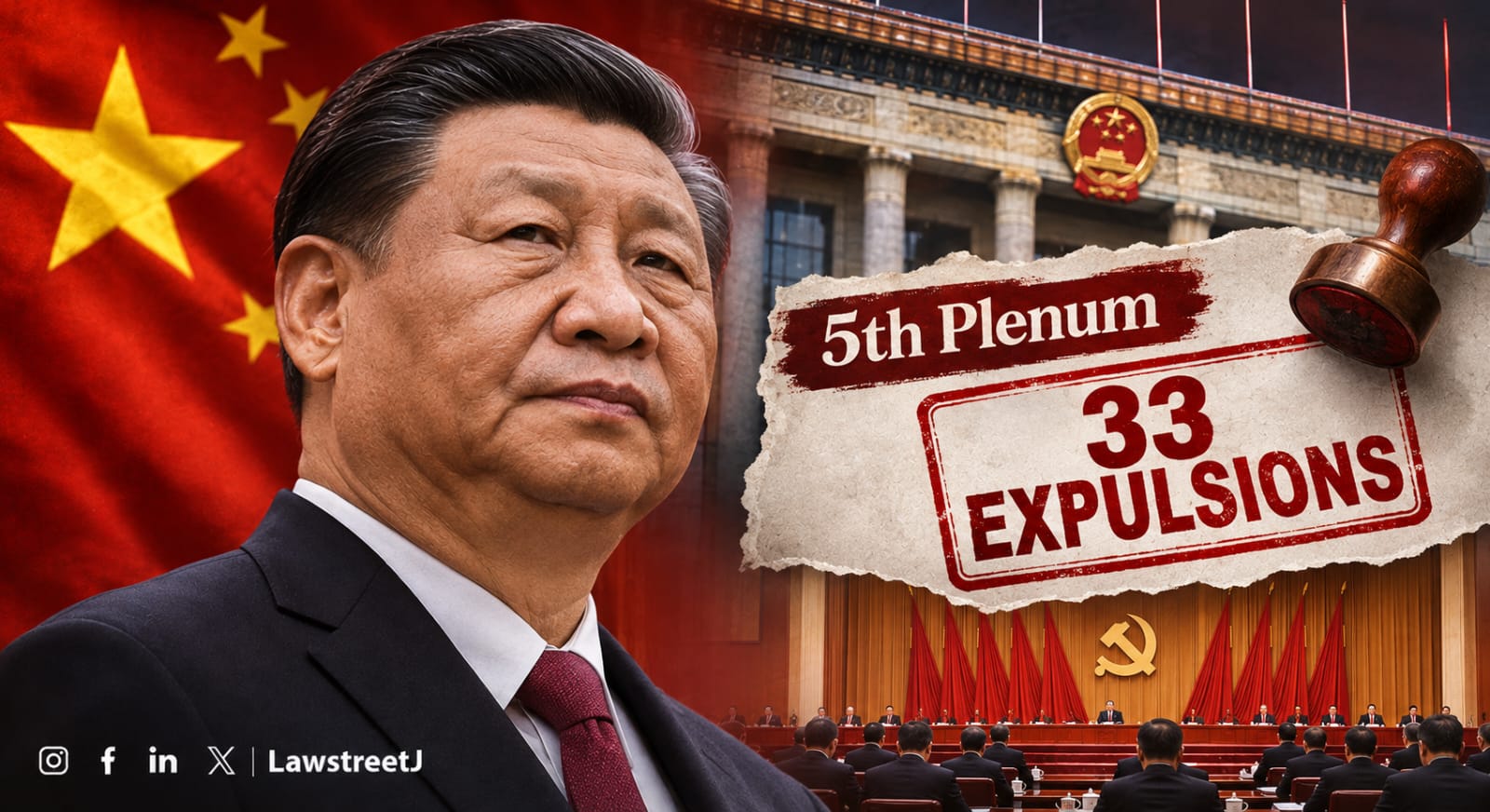
Beijing — China's Communist Party (CCP) concluded its Fifth Plenum on Thursday, October 29, 2026, confirming the expulsion of a record 33 members of its Central Committee, including 16 senior military officers, in a sign that President Xi Jinping's anti-corruption campaign, now in its 14th year, is far from over. The outcome has left the Central Military Commission with only two of its seven seats occupied and renewed questions about military leadership and succession ahead of the party's 2027 Congress.
The Plenum
The fifth plenary session of the 20th Central Committee met behind closed doors in Beijing from October 26 to 29, 2026. According to official reporting, the session was attended by 162 full members and 117 alternate members, a total of 279, down from the 376 members originally installed at the 2022 Party Congress. Attendance fell below 300 for the first time in Xi's 14-year leadership.
The Central Committee communiqué confirmed that 33 members and alternate members had been expelled from the party. According to analysis of the announcement, 24 were full members and nine were alternates. Sixteen of the 33 were military officers. The communiqué said those removed had committed "serious disciplinary and legal violations," language routinely used in announcements of this kind under Xi's anti-corruption apparatus.
Among the high-profile figures confirmed as expelled were Ma Xingrui, a former Politburo member and former Xinjiang party chief, former top generals Zhang Youxia and Liu Zhenli and Liu Jianchao, a prominent former diplomat.
The plenum also confirmed the removal from the Central Committee of two successive directors of the Central Military Commission's General Office, Lieutenant Generals Zhong Shaojun and Fang Yongxiang. Zhang Zhongyang, a former general manager of the China Aerospace Science and Technology Corporation and an alternate Central Committee member, was among those named in the disciplinary action, reflecting how the campaign has widened beyond the armed forces to defence industry and corporate leadership.
The Hollowed-Out Military Leadership
The expulsions have left China's top military body severely depleted. The seven-member Central Military Commission (CMC), the body that directs the People's Liberation Army, now has only two active members, Xi Jinping and Vice-Chairman Zhang Shengmin, who was elevated to the Politburo at this plenum. No replacements were named for the five vacant seats. The Politburo, which normally has 25 members, now has 22.
An analysis cited in reporting on the plenum, from the Asia Society Policy Institute, found that of 44 uniformed officers elected as full Central Committee members in 2022, only two, Zhang Shengmin and Defence Minister Dong Jun, have neither been purged nor disappeared.
Xi's signature anti-corruption drive, aimed at what the party calls "tigers and flies," meaning both senior officials and low-level functionaries, has punished at least 7.9 million CCP members and officials since it began in 2012. Reporting on the plenum noted that 51 Central Committee members have now been removed during Xi's third term alone, compared with 35 during his first term and five during his second. The plenum's communiqué also formally recognised "Xi Jinping Thought on Party Building" as a new addition to party doctrine, described as providing "fundamental guidance" for strengthening the party.
The plenum emphasised accelerating the modernisation of the People's Liberation Army and continuing the party's work on Taiwan. However, analysts cited in coverage have raised the question of whether the strengthening of political loyalty comes at the cost of military effectiveness, given the extent of the turnover in senior command.
The meeting also comes ahead of the 21st Party Congress in 2027, at which Xi is widely expected to seek an unprecedented fourth term as the CCP's general secretary, with no clear successor identified and no new appointments to the top bodies announced at the plenum to settle succession questions.
Legal and Institutional Framework
Expulsion from the Chinese Communist Party is a party disciplinary measure decided under the party's own constitution and regulations, enforced principally by the Central Commission for Discipline Inspection, rather than a criminal conviction issued by a court. Party expulsion frequently precedes, though it is legally distinct from, criminal proceedings handled through China's state legal system, in which the National Supervisory Commission, established in 2018 and operating alongside the party's discipline body, investigates alleged corruption among public officials.
The Central Committee is the party's main decision-making body between National Congresses, formally elected by the Party Congress for a five-year term, and is empowered under the party constitution to confirm the removal of its own members at plenary sessions.
The Central Military Commission exists in two formal guises that are in practice staffed by the same individuals: a party CMC, answerable to the Communist Party, and a state CMC under China's constitution, which commands the armed forces. Xi chairs both. Constitutionally, a 2018 amendment removed the two-term limit on the office of PRC president, though the party's top post of general secretary has never carried a formal term limit, informal norms of retirement ages and succession that prevailed before Xi have been eroded during his tenure.