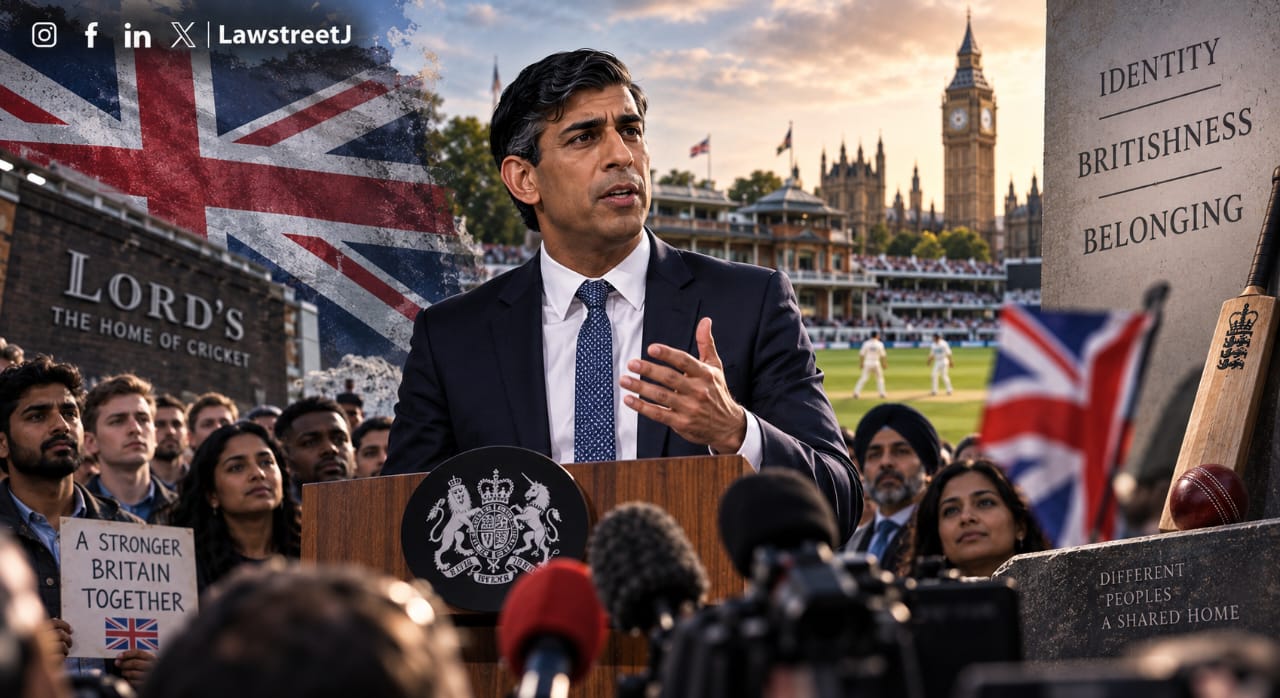
LONDON — Rishi Sunak has picked a fight with an idea he says he ran into personally, the notion that no matter how British someone acts, looks like the wrong colour to actually belong.
Britain's former prime minister used his regular column in The Sunday Times, published this past weekend, to lay out a warning about where he thinks the country's conversation on identity is heading. The piece built on a lecture he had delivered days earlier, on September 17, at Lord's Cricket Ground, where he gave the Marylebone Cricket Club's Cowdrey Lecture, an annual address that typically uses cricket as a lens for talking about something bigger than the sport itself.
Sunak, the first person of Indian heritage to hold the office of British prime minister, has been out of Downing Street since losing the July 2024 general election to Keir Starmer. He's now a backbench Conservative MP for Richmond, at 46 years old, and this column marks one of his more pointed public reflections since leaving office on how his own background shaped, and complicated, his time in politics.
The "Reverse Tebbit Test"
The phrase doing most of the work in Sunak's argument is one he's coined himself, riffing off something that's been part of British political vocabulary since 1990. Back then, Conservative MP Norman Tebbit suggested a simple test for whether immigrants had truly integrated into British life, which cricket team did they cheer for? If a British Asian cricket fan in England supported India or Pakistan over England, Tebbit argued, that was a sign of a failure to properly integrate. It became known, somewhat infamously, as the Tebbit test.
Sunak says he passed that test without even trying. "Ten-year-old me passed the test without even knowing about it," he wrote, recalling growing up in Southampton with a passion for cricket that had nothing to do with proving his Britishness and everything to do with just loving the game. But he argues something has shifted since Tebbit's era, and not for the better. "But the Englishness argument was stranger still," Sunak wrote. "Call it the reverse Tebbit test. If you're not white, it no longer matters who you support at the cricket, because you can never be English."
That's the crux of his warning, where the original Tebbit test was at least, in Sunak's telling, something a person could pass through genuine allegiance and integration, the version he says he's now encountering offers no way to pass at all if your skin isn't white. Support England all you want, love the culture, embrace the values, it doesn't matter. The disqualification, in this reading, is automatic and permanent.
"Brown Hindu" and the Question of Whether He Could Be English
Sunak didn't leave this abstract. He connected it directly to his own experience after leaving Downing Street, describing a debate that broke out over whether he could really be considered English at all, given that he is, in his own words, a "brown Hindu." That specific framing, pairing his skin colour with his religion as the disqualifying combination, is what he says triggered the broader reflection captured in his column.
He didn't stop at the identity debate either. Sunak also recalled an unsettling moment during the 2024 election campaign, when he saw footage of someone directing a racial slur at him. What struck him about the incident, he said, wasn't just the slur itself but how out of step it felt with the rest of his political career, this kind of overt abuse, he noted, had not been a defining feature of his time in public life up to that point. Its appearance during the campaign seemed to land as confirmation of the broader shift he was describing, that questions about his belonging were becoming sharper and more explicit as his profile grew.
A Warning About People Being "Marked Down" for Where They Started
Beyond his own experience, Sunak used the column to make a broader argument about how Britain treats people more generally on questions of belonging, extending the concern past his own case to newer migrants across the country. He warned against a situation where "people who live here, who feel British, who embrace our culture and embody our values, who strive to be the best members of society they can be, are marked down" simply because they arrived in the country more recently than others.
That line captures the core distinction Sunak is trying to draw throughout the piece. He's not arguing against having standards for integration, he explicitly frames himself as someone who supports a "radical reduction in immigration and a far more robust approach to integration." What he's objecting to is a different, separate standard that he believes is creeping in alongside those legitimate integration debates, one based on appearance rather than actual behaviour, values or contribution to society. In his view, conflating the two, treating skin colour as a proxy for genuine belonging, is where the real danger lies.
It's worth noting that Sunak didn't arrive at this argument through a straightforward political speech, he built it around cricket specifically, and that choice of vehicle matters to understanding the piece.
His Cowdrey Lecture at Lord's was fundamentally about cricket's place in British life, and he used the sport as evidence for a more optimistic counter-argument running alongside his warning, that sport, cricket in particular, can play what he called "a small but significant role in encouraging integration."
That framing gives the piece a somewhat two-sided character. On one hand, there's the warning about a "reverse Tebbit test" that no non-white Briton can pass. On the other, there's a genuine, personal appeal to cricket, and by extension shared cultural experiences more broadly, as one of the few spaces where that kind of exclusionary logic can actually be overcome. Sunak described growing up near the Dell and Hampshire's County Ground in Southampton, where his father ran a GP surgery, and said those weekend trips to watch cricket left him with a lasting belief that sport "opens a window onto who we are" as a country.
Islamism, Immigration and a "Democratic Achievement" Under Strain
Sunak's column wasn't confined to questions of race and belonging alone. He situated his concerns within a broader diagnosis of British society under pressure, writing plainly, "I worry that Britain's great democratic achievement is coming under strain." He pointed to what he described as two distinct sources of that strain, challenges posed by Islamism, which he linked to the aftermath of the October 7, 2023, attack in Israel and the reactions it provoked in Britain, and separately, challenges he attributed to what he called the failure of recent governments, including his own, to adequately control immigration.
He was careful to draw a line between these concerns and the racial identity argument at the heart of his piece, insisting it was "entirely possible" to hold both positions simultaneously, favouring tighter immigration controls and stronger integration expectations, while also firmly rejecting any framework that would disqualify people from being considered British purely on the basis of their race. Addressing immigration policy directly, he also referenced his own record in office, recalling his government's push to deport certain migrants to Rwanda as part of a broader effort to deter illegal immigration during his premiership.
The response to Sunak's column has been notable largely for how directly it has reopened a public conversation about race, religion and Britishness, one that Sunak himself has now placed squarely back in the headlines through his own account of what he experienced in office and after leaving it.
As the first politician of Indian heritage to occupy 10 Downing Street, his reflections carry a particular weight simply by virtue of who is making the argument, someone who held the country's highest political office while facing, by his own account, exactly the kind of scrutiny over belonging that he's now warning other non-white Britons might face regardless of how they live their lives or what they contribute to the country.