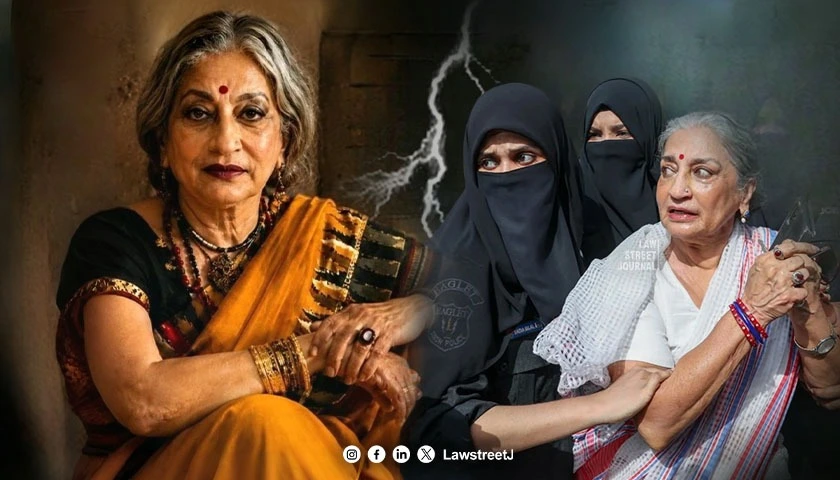
One week ago, a photograph taken by Reuters photographer Akhtar Soomro outside the Karachi Press Club stopped Pakistan in its tracks. It showed a 75-year-old woman, composed, upright, and defiant surrounded by veiled female police officers who had just pulled her from her car. The woman was Sheema Kermani, classical dancer, founder of the feminist cultural group Tehrik-e-Niswan, recipient of Pakistan's Pride of Performance award, and one of the country's most recognized human rights voices. That image, and the events that unfolded in the days that followed, set off a chain of legal consequences, institutional responses, and public debate that is still very much alive today.
What Happened on May 5: The Detention Outside Karachi Press Club
The organisers of the Aurat March had arrived at the Karachi Press Club on the afternoon of May 5 for a scheduled press conference. They were prevented from entering by police, who arrested Kermani and other organisers from right outside the press club gate. Besides Kermani, Moneeza Ahmed, transgender activist Shahzadi Rai, and several volunteers were detained. Kermani's car remained parked directly in front of the gates as she was pulled out and taken away in a police vehicle.
Speaking after the events, Kermani described what she experienced inside her car. She said male policemen forcefully struck her vehicle, forced the back door open, and sat inside an act she described as itself illegal, in contrast to what she was arrested for: attending a pre-arranged press conference. Police stated that a heavy contingent had been deployed outside the press club due to concerns over a possible breach of peace. Seven activists in total were detained. Their release came shortly after Sindh Home Minister Ziaul Hasan Lanjar ordered south zone police to free them. The activists were held at Aram Bagh police station for approximately one hour before being released. They returned to the Karachi Press Club chanting slogans.
This was not the first time Kermani had faced such action outside the same venue. Rights journalist Alifya Sohail documented that Kermani was similarly stopped the previous year before an Aurat March press conference on the enforced disappearances of Baloch women, and that in January 2026, she was physically prevented from attending a protest related to the imprisonment of two activists.
The Legal Response: Three Officers Suspended, Inquiry Ordered
The institutional response came within 24 hours of the detentions. The Sindh government suspended three police officers over the alleged use of force and unlawful detention of the activists. The action was taken on the directives of Home Minister Ziaul Hasan Lanjar after an inquiry was conducted. The inquiry found that South police carried out the operation without obtaining prior approval from senior authorities. It also examined video footage of the arrests. Following the findings, Saddar DSP Nasir Afridi, Women Police Station SHO Hina Mughal, and Artillery Maidan SHO Nadeem Haider were suspended from service.
Sindh Home Minister Lanjar stated that there is a zero-tolerance policy against misuse of authority and that respect for women and protection of their rights would be ensured at all costs. He personally contacted Kermani, expressed his regrets, and assured her that the requirements of justice would be fulfilled.
Legal analysts and commentators noted that even under Section 144 restrictions, holding a press conference within the Karachi Press Club does not constitute unlawful assembly. Yet police impeded access, detained activists, and reportedly used physical force against women demanding nothing beyond constitutionally protected rights. The formal inquiry ordered by the Additional Inspector General of Karachi, Azad Khan, remains ongoing. No criminal charges have been filed against any of the detained activists.
The NOC Dispute: 28 Conditions and What They Said
Behind the confrontation at the press club lay a dispute that had been building for weeks. For the eighth consecutive year, Aurat March organisers faced delays and intimidation over the issuance of a no-objection certificate for their annual event, with authorities still having not granted permission just days before the scheduled march.
When the NOC was eventually issued by the Sindh government for a gathering at Sea View, Karachi, it came attached with 28 conditions. Among those conditions was a ban on what authorities described as objectionable clothing, a prohibition on the promotion of LGBTQ content, and restrictions on anti-state and anti-religious slogans, banners, and speeches. The requirement that organisers provide a full list of volunteers was also included, which Aurat March Karachi condemned as an attempt to widen the net of state surveillance over civil society movements, calling it a violation of privacy rights.
The Human Rights Commission of Pakistan condemned the detentions and stated that the incident was not an isolated overreach but part of a broader pattern of the systematic denial of public space to citizens seeking to articulate their rights. The HRCP noted that the rights to peaceful assembly and freedom of expression are constitutionally guaranteed.
May 10: The March Happened Anyway
Despite the arrests, the suspensions, the week of legal uncertainty, and the 28 state-imposed conditions, the Aurat March took place on May 10, 2026, at Sea View, Karachi, the date it had been scheduled for all along.
Hundreds gathered at Clifton's Beach View Park for the annual march. Despite the restrictions, significant issues were raised, including the right to bodily autonomy. The march also highlighted the case of Shanti, a 19-year-old newlywed from Lyari who died from injuries after her husband allegedly subjected her to severe violence just two days after their wedding. Speaking from the main stage, Kermani addressed the crowd. "At first we thought: should we not do the march? Then we thought, why not? It is our right," she said. Referencing the mounting restrictions placed on the gathering, she declared that the movement would continue regardless of pressure. "For eight years of struggle, where we have reached today, we will keep going forward. We will not stop. Just like our slogan says: the march will continue."
One male participant at the march cited violence statistics discussed at the event, noting that more than 7,500 women had been killed in the preceding four years, including around 1,500 in what were classified as honour killings, and that harassment, workplace abuse, and domestic violence figures remained widespread but socially normalised.
Where Things Stand Today- May 12, 2026
As of today, three police officials remain suspended pending a transparent inquiry led by Additional IG Azad Khan. The arrests exposed how quickly women's voices can still be treated as disruptive when they demand space in public and political life. The swift suspensions and public backlash also showed how dramatically the conversation around women's rights in Pakistan has evolved, where incidents that may once have passed quietly now trigger nationwide outrage and scrutiny.
Since Aurat March first emerged in 2018, the movement has evolved from a relatively small feminist gathering into one of Pakistan's most visible civil rights platforms. The 2026 edition added another chapter to that history, one that began with a 75-year-old woman being pulled from her car and ended, one week later, with that same woman standing on a stage by the sea telling hundreds of people that the march would not stop.
The inquiry into police conduct is ongoing. The constitutional questions it has raised are not.