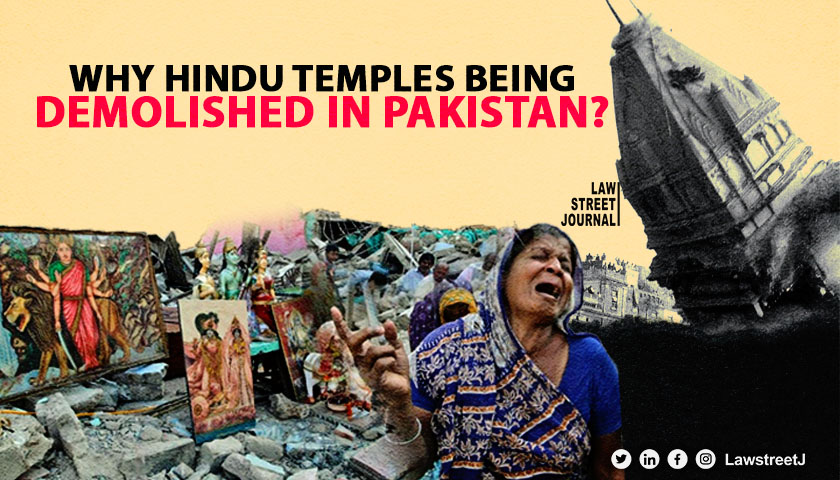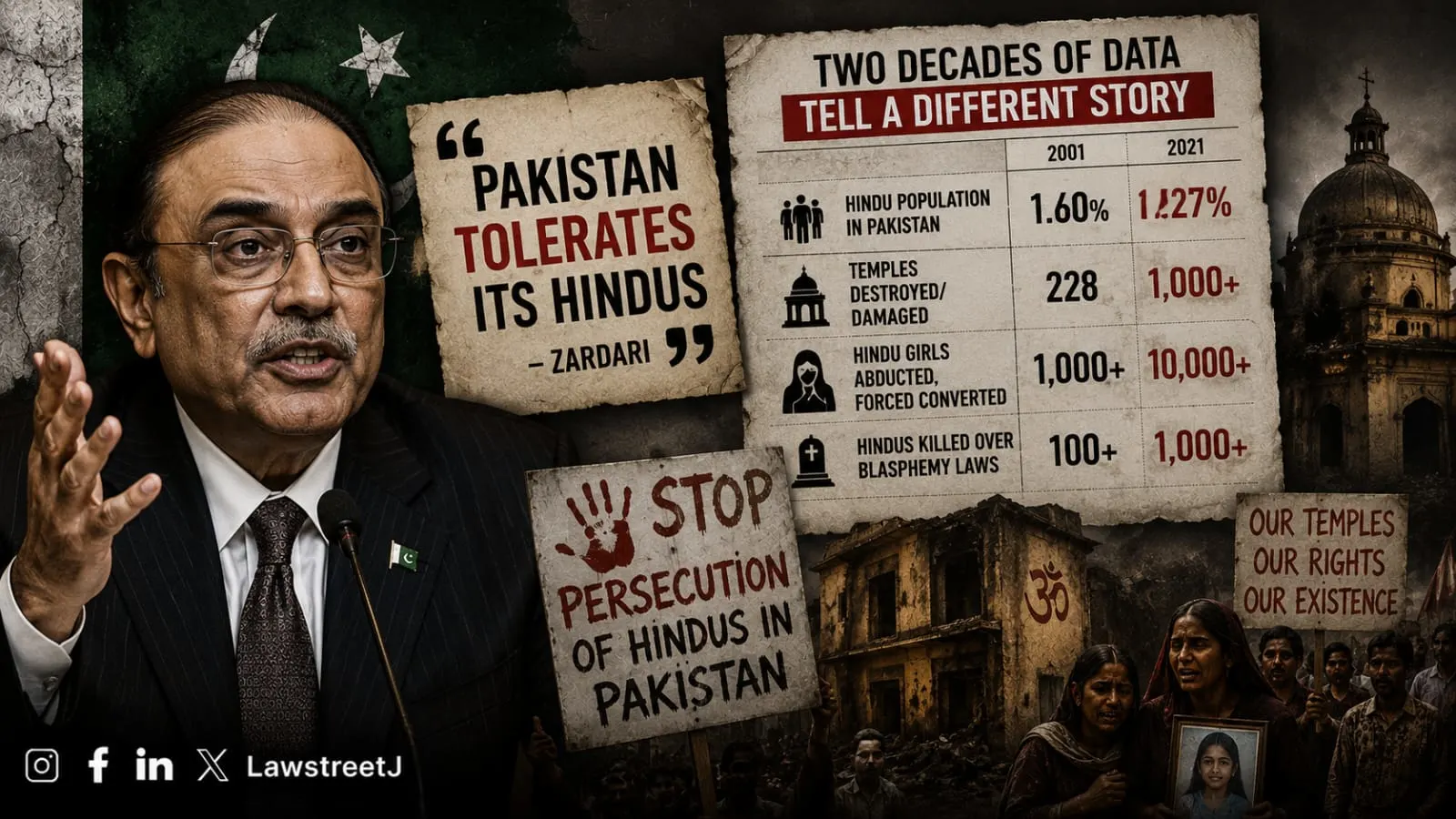
ISLAMABAD — A single word in a speech delivered on Pakistan's 78th Independence Day has cut through the ceremonial rhetoric and placed Pakistan's treatment of its religious minorities squarely in international focus. Pakistan President Asif Ali Zardari, speaking at an Independence Day gathering in Islamabad on August 14, used the word "tolerate" to describe the Muslim majority's relationship with the country's Hindu population and the choice of that word has since sparked a wave of scrutiny that the speech's broader context has done little to contain.
Speaking at an Independence Day gathering on August 14, Zardari said: "The Indians believe in Akhand Bharat. But we are Muslims. They are not. But we are Muslims of the mindset that tolerates. We have a 4% Hindu population in Pakistan. They are as free as anywhere else. They would rather be with us than India."
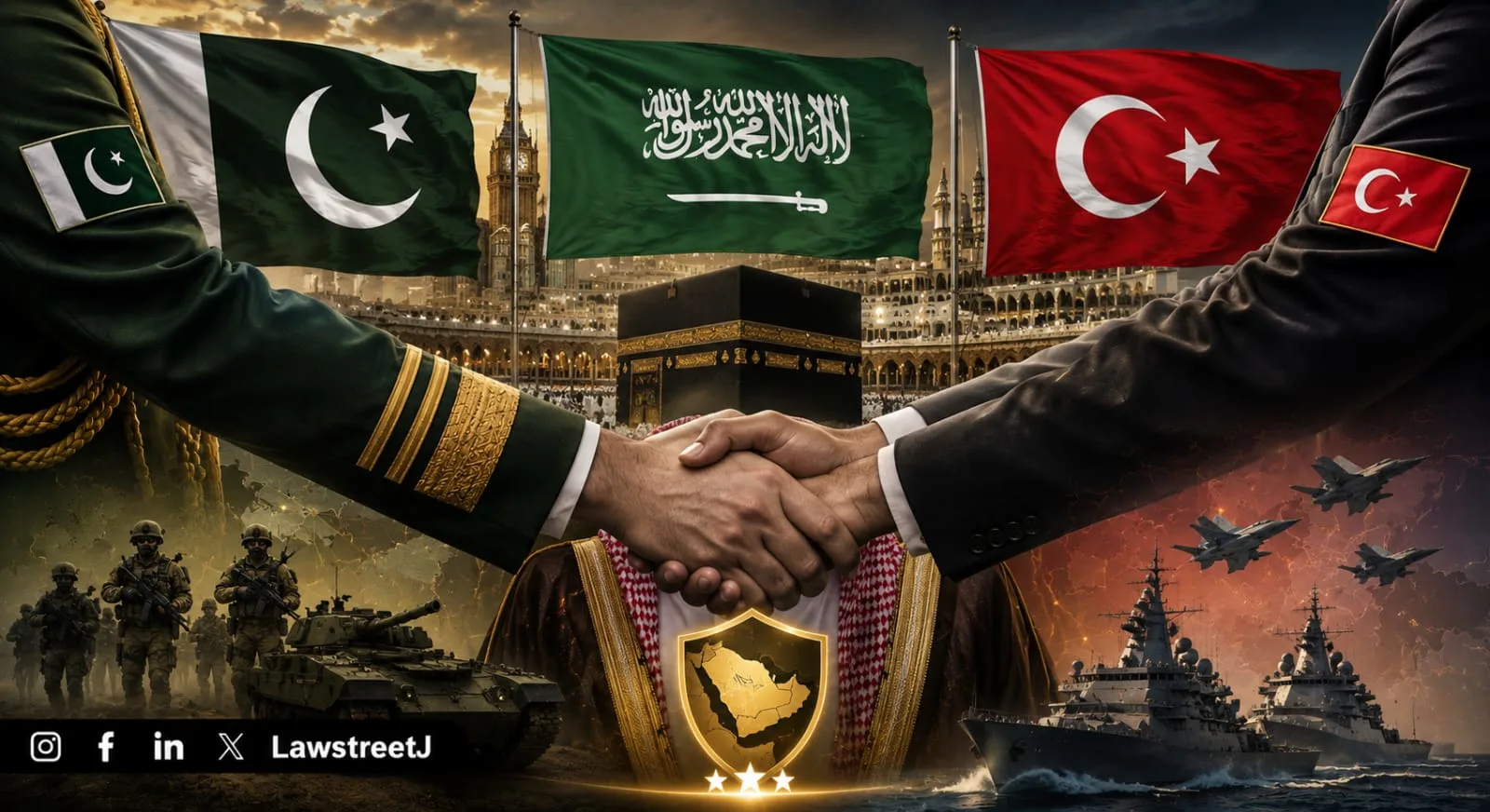
The remarks came while Zardari was discussing Pakistan's relationship with India, the role of the armed forces and the wider geopolitical situation in the region. He also highlighted Pakistan's recent trilateral defence agreement with Saudi Arabia and Turkiye, describing it as evidence of the country's growing regional role.
But it was the word “tolerate” not the geopolitics that defined the news cycle that followed.
The Word That Sparked the Controversy
The controversy that erupted around Zardari's remarks is not simply a matter of poor word choice. It reflects a substantive question about whether the Pakistani state's relationship with its Hindu minority is one of equal citizenship, as guaranteed by Pakistan's constitution or one of sufferance, in which a religious majority permits a smaller community to exist within certain boundaries, subject to conditions it has not set and cannot remove.
Referring to the country's Hindu population, Zardari said Pakistan and its Muslim majority "tolerate" the 3-4 per cent Hindu population. In the widely circulated video, Zardari claimed that India had a different outlook and alleged that its people believe in Akhand Bharat.
The distinction between "tolerating" a minority and guaranteeing their equal rights under law is not semantic. It is constitutional and political. Pakistan's constitution, like India's, formally guarantees equality of citizenship irrespective of religion, and formally protects religious freedom. The framing of tolerance as a virtue extended by the majority to the minority reverses this constitutional relationship, implicitly treating minority status as a privilege granted by the majority rather than a right guaranteed by the state. The language of tolerance, in this context, positions the majority as the giver and the minority as the receiver an asymmetry of power that sits uneasily alongside the formal guarantee of equal citizenship.
The Data Problem: Zardari's 4% Figure Does Not Match Pakistan's Own Census
Beyond the language, there is a factual discrepancy between Zardari's claim and Pakistan's own official data.
Zardari's claim that the 4% Hindu population prefers Pakistan over India is contradicted by a Pew report stating it is 2.1%.
According to Pakistan's 2023 census, Hindus form 2.17% of Pakistan's population, or over 5.2 million Pakistanis. The breakdown across provinces is stark in its geographic concentration, Sindh accounts for 4,901,107 Hindus at 8.81% of the province's population, while Punjab counts 249,716 Hindus at just 0.2%, Balochistan 59,107 at 0.41%, and Khyber Pakhtunkhwa only 6,104 at 0.02%.
The overstatement of the Hindu population, Zardari's 4% against the census's 2.17%, is itself telling in the context of Pakistan's minority history. At Partition in 1947, non-Muslims made up over 20% of West Pakistan's population, whereas today the Hindu minority sits at around 4%. While this figure of approximately 4% cited in some estimates reflects different methodologies, all independent data sources place the current Hindu population well below the share it held in 1947, a demographic decline that the official census figure of 2.17% makes more pronounced.
The seven-decade trajectory is unambiguous: a community that comprised more than one in five people at the founding of the state now comprises roughly one in fifty. That trajectory regardless of how the current figure is precisely calculated is not the profile of a community that has been "as free as anywhere else."
Javed Akhtar and K P Fabian: Two Pointed Responses
The response to Zardari's remarks came quickly from two very different voices one a celebrated Indian lyricist known for his public commentary, the other a former senior Indian diplomat.
Lyricist and screenwriter Javed Akhtar hit out at Pakistan President Asif Ali Zardari over his remarks that Muslims in Pakistan "tolerate" the country's Hindu population. Taking a dig at Zardari, Akhtar said the Pakistani leader had always been insensitive to anything "which is less than 10 per cent". In a post on X, Akhtar took a swipe at the Pakistani president's reputation as "Mr 10 per cent", a nickname linked to corruption allegations against him. "Mr Zardari of Pakistan, who had come into the limelight after Benazeer Bhutto had married, says that they tolerate the 3-4 percent Hindu population in their country. I understand Mr Zardari you have always being insensitive to all under the sun, which is less than 10 per cent," Javed Akhtar said.
Former diplomat K P Fabian told ANI: "Pakistan was formed on the basis of religion. World history is the World Court of Judgment which in 1971 pronounced its judgment." Fabian's reference to 1971 is a pointed one, the creation of Bangladesh through the liberation war was a moment in which the contradictions of Pakistan's founding as a state defined by religion, rather than by civic equality, found their most catastrophic expression.
The Documented Reality: Forced Conversions, Blasphemy Laws, and a Pattern of Targeted Violence
The scrutiny triggered by Zardari's remarks is sharpened by a documented record of what Pakistan's Hindu and other religious minorities have actually experienced.
A report published in the US-based Global Strat View in April 2026 found that Pakistan has witnessed a consistent exodus of minority populations, including Christians, Hindus, and other communities, which reflects a broader pattern of fear and insecurity. Since 1947, religious minorities have faced persistent atrocities across the country, including social prejudice, institutional discrimination and targeted violence. Forced conversions, underage marriages, and inconsistent legal protections make minority girls question whether the constitution truly safeguards their rights. Several incidents of communal violence across Pakistan demonstrated a disturbing pattern of delayed or incomplete accountability.
The forced conversion of Hindu and Christian girls, a documented and recurring practice in Pakistan, particularly in Sindh has been the subject of sustained reporting by Pakistani civil society organisations and international human rights bodies. Girls as young as twelve have been documented as being taken from their families, converted to Islam, and married to adult men, with the legal system in many cases failing to intervene effectively or returning the girls to their alleged captors rather than their families.
Pakistan's blasphemy laws particularly Section 295-C of the Pakistan Penal Code, which carries the death penalty for blasphemy against the Prophet, have been used disproportionately against religious minorities, including Hindus and Christians. Accusations under the blasphemy law have triggered mob violence, burned homes and businesses, and in some cases resulted in the extra-judicial killing of accused individuals. The US Commission on International Religious Freedom has designated Pakistan as a Country of Particular Concern for religious freedom violations.
India's Ministry of External Affairs has addressed Pakistan's minority record directly in previous formal exchanges. MEA Spokesperson Randhir Jaiswal said: "Pakistan's horrific and systemic victimisation of minorities of various faiths is a well established fact. No amount of finger pointing will obfuscate it."
What "Tolerance" Actually Costs: The Pakistan Muslim-Hindu Interface
The deeper issue raised by Zardari's choice of language is not unique to Pakistan, it is a challenge that all multi-religious societies face in articulating the relationship between a majority community and minority communities. The distinction between tolerance and equal citizenship is one that has been debated in political philosophy for centuries.
John Locke, who wrote the foundational text on religious toleration in the 17th century, distinguished between toleration, which he conceived as a practical restraint on persecution and full equality of civic standing. In Locke's framework, toleration was a step toward coexistence, not its destination. The destination was equality under law.
What Zardari's remarks suggest, though he may not have intended this reading, is that Pakistan's majority-minority relationship has remained at Locke's first step rather than reaching his destination. A president's description of his own country's minority community as a group that is "tolerated" rather than fully equal is not the language of a state that has completed its constitutional commitment to equal citizenship.
The Pakistani state's formal constitutional guarantee of minority rights and the evident gap between those guarantees and the documented reality of minority life in Pakistan is the uncomfortable space that Zardari's Independence Day speech has forced back into view.