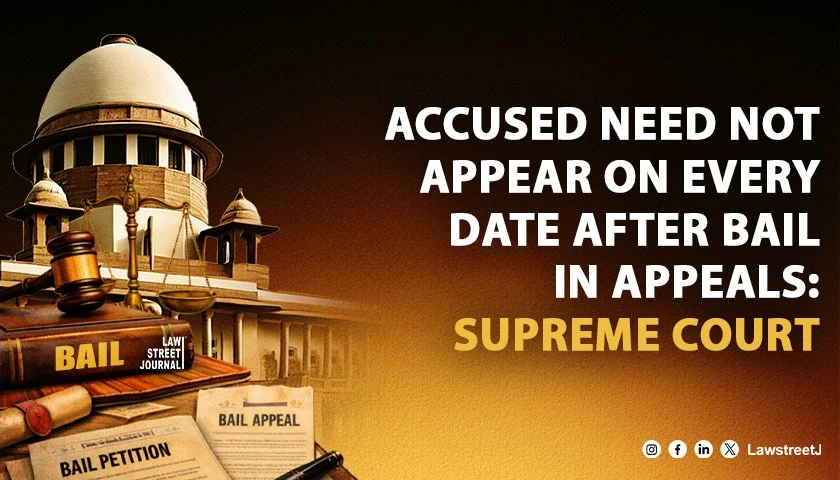
New Delhi: The Supreme Court of India has ruled that accused persons cannot be required to appear before appellate or revisional courts on every date of hearing once their sentence has been suspended and bail has been granted.
The Bench of Justices Aravind Kumar and Prasanna B. Varale delivered the decision while hearing an appeal arising from proceedings in which the appellant had been taken into custody after a Non-Bailable Warrant was issued for changing counsel multiple times.
The case originated from proceedings under Section 138 of the Negotiable Instruments Act, 1881, involving dishonoured cheques worth ₹12,00,240. The appellant had been convicted and released on bail with suspension of sentence in 2017; however, the bail was later cancelled by the appellate court, which also issued an NBW against her.
The Court noted that in Haryana, there exists a practice of requiring accused persons to appear before appellate courts on all hearing dates even after suspension of sentence and grant of bail. This practice, as explained by the State’s counsel, stems from Form No. 45 (Bond and Bail-Bond for Attendance) in Schedule II of the Code of Criminal Procedure, 1973, under which the accused executes a bond undertaking to attend court.
The Supreme Court found this practice both burdensome and unnecessary. It observed that once an appellate or revisional court has satisfied itself of the need to suspend the sentence and has granted bail, insisting on the accused’s appearance on every date—especially when appeals often remain pending for months or years and are adjourned for various reasons—serves no meaningful purpose.
The Court emphasized that if an appeal or revision is ultimately dismissed, the legal consequences would automatically follow, and the jurisdictional magistrate would be fully empowered to secure the accused’s presence in accordance with law.
Expressing strong disapproval of the appellate court’s conduct, the Supreme Court described it as “appalling and shocking” that the court had insisted on the appellant’s presence on every hearing date despite having already suspended the sentence. The Court observed that the appropriate course would have been either to appoint an amicus curiae and decide the appeal on merits, or to grant the accused an opportunity to make alternative arrangements if counsel was unavailable.
Accordingly, the Supreme Court directed that a copy of its order be placed before the Chief Justice of the Punjab and Haryana High Court for circulation to the district judiciary through an appropriate circular.
The Court also granted bail to the appellant till the disposal of the pending appeal and directed that the appeal be decided expeditiously, preferably within three months.
Case Title: Meenakshi v. State of Haryana & Another