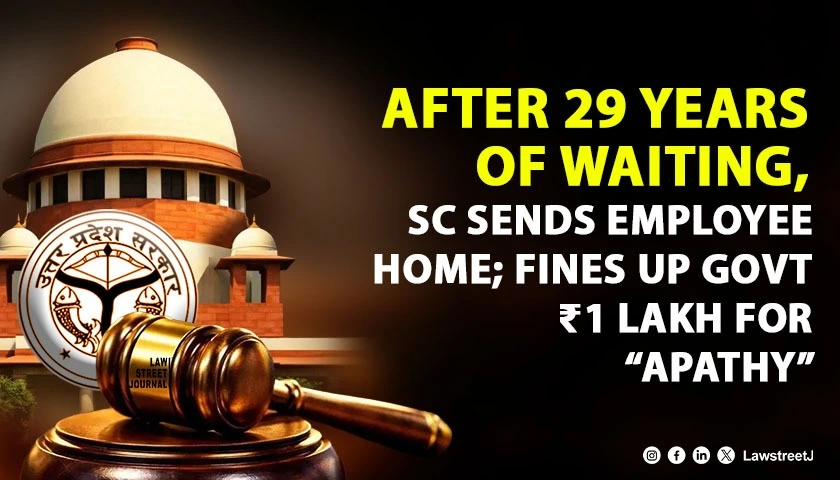
New Delhi: A man who had cleared a government exam in 1995, opted for a hill posting, and spent decades fighting bureaucratic indifference has finally secured cadre reallocation to Uttarakhand—with the Court calling the State’s conduct “nothing other than apathy.”
In a judgment that reads as much as a rebuke as a legal ruling, the Supreme Court of India on Tuesday directed the State of Uttar Pradesh to immediately reallocate a government employee to the Uttarakhand cadre—the posting he had originally opted for when he appeared for an examination over three decades ago.
Justice Sanjay Karol, writing for the bench, did not mince words. From the moment the High Court of Allahabad cleared his path to appointment in 2004, Rajendra Singh Bora should have been settled into his chosen posting. Instead, the State filed appeals, delayed the process, and ultimately ignored three written representations submitted by the appellant between May and October 2012. The formal appointment eventually came in 2011—fourteen years after the notional date—and even then, in the wrong State.
“This is in no way, shape, or form anything other than apathy on the part of the State.”
Bora cleared the Combined Lower Subordinate Service Examination conducted by the Uttar Pradesh Subordinate Services Selection Commission in 1995, scoring 672 out of 900. He had applied for the post of Sub-Deputy Inspector of Schools with a preference for the hill area of Uttar Pradesh. His application was initially rejected on what would prove to be a hollow technicality: he had brought his B.Ed. marksheet to the interview rather than submitting it with his original application. Candidates who scored below him were appointed in his place.
His first writ petition, filed in 1997, was allowed in 2004. The High Court found that Condition No. 7 of the advertisement, which required applicants to annex their B.Ed. marksheets, did not state that applications without the document would be rejected. The production of the marksheet at the interview stage was an admitted fact. Keeping in mind the remote area from which the appellant hailed, the Court declined to adopt a “hyper-technical view.”
The State of Uttar Pradesh appealed—and lost in 2009. Bora finally joined service in Kashi Ram Nagar, Uttar Pradesh, in July 2011. By that time, the reorganisation of Uttar Pradesh had already created the new State of Uttarakhand in 2000, meaning the hill area for which he had originally opted now lay in a different State entirely.
When Bora sought reallocation to Uttarakhand through the writ petition that ultimately reached the Supreme Court, the Allahabad High Court dismissed his claim on the ground that once he was allotted to the Uttar Pradesh service, no question arose of transfer to Uttaranchal/Uttarakhand.
The Supreme Court found this reasoning legally unsound, drawing a sharp distinction between two concepts the High Court had apparently conflated.
A change of posting within the same cadre leaves service identity, seniority, and conditions unchanged.
A shift from one cadre to another, however, constitutes a structural change affecting seniority, promotion, and applicable service rules.
The Court’s articulation now stands as an authoritative restatement of this distinction for service law purposes: a transfer is “an incident of service, routinely exercised by the administration for functional, administrative, or public interest considerations,” while a change of cadre “alters the very framework within which the employee’s service is regulated.”
Justice Karol set out three separate bases on which the reallocation was justified, each described as independently sufficient.
The first is that the DoPT’s cadre allocation policy, which governs the distribution of employees between successor States following reorganisation, prioritises allocation by option exercised, then by domicile, and only lastly by juniority in reverse order. Bora had exercised his option for the hill cadre from the outset. He is also a resident of present-day Uttarakhand. On both counts, his claim stood squarely satisfied.
The second ground concerns the distortion caused by the delays themselves. If Bora’s appointment had not been derailed by the initial rejection, he would have been posted in the hill area of Uttar Pradesh. With the reorganisation of 2000, that posting would automatically have translated into service under the successor State of Uttarakhand. The delays imposed by bureaucratic error effectively denied him a right he should never have had to litigate.
The third ground is humanitarian in nature. Bora’s son has been certified as cognitively challenged, with little or no scope for improvement. The DoPT’s exceptions to its standard allocation criteria include, significantly, “mental illness—self or family,” which qualifies for allocation based on the employee’s original option when indoor treatment of at least three months is involved. The Court found this exception applicable.
“The entire time that being close to family would have been a great source of support in raising his son, he has spent away from family.”
The judgment does not stop at Bora’s individual case. The Court expressly noted its concern that the facts before it are unlikely to be unique, observing that there are “many other cases where, on account of long pendency of service disputes, the party in question would be approaching superannuation.” It requested the Chief Justice of the Allahabad High Court to ascertain the number of such long-pending service matters and to distribute them across benches for expeditious disposal.
The arithmetic in the judgment is stark. From the date of his notional appointment in June 1997 to the date of this ruling in April 2026, twenty-nine years elapsed. Even discounting the initial litigation period and counting only from the High Court’s 2004 ruling in his favour, twenty-two years passed before he obtained what he had sought from the very beginning.
The Supreme Court set aside the impugned Allahabad High Court order and directed the Chief Secretary of Uttar Pradesh to forthwith facilitate Bora’s reallocation to the Uttarakhand cadre, with full protection of seniority and all relevant service benefits. A copy of the judgment was directed to be sent to the Chief Secretary of Uttarakhand for follow-up action. Costs of ₹1,00,000 were imposed on the State of Uttar Pradesh, payable to the appellant within four weeks.
2026 INSC 404; Civil Appeal arising from SLP (C) No. 29304 of 2018
Decided: April 22, 2026
Bench: Justices Karol & Kotiswar Singh, JJ.
Parties: Rajendra Singh Bora v. Union of India & State of U.P.