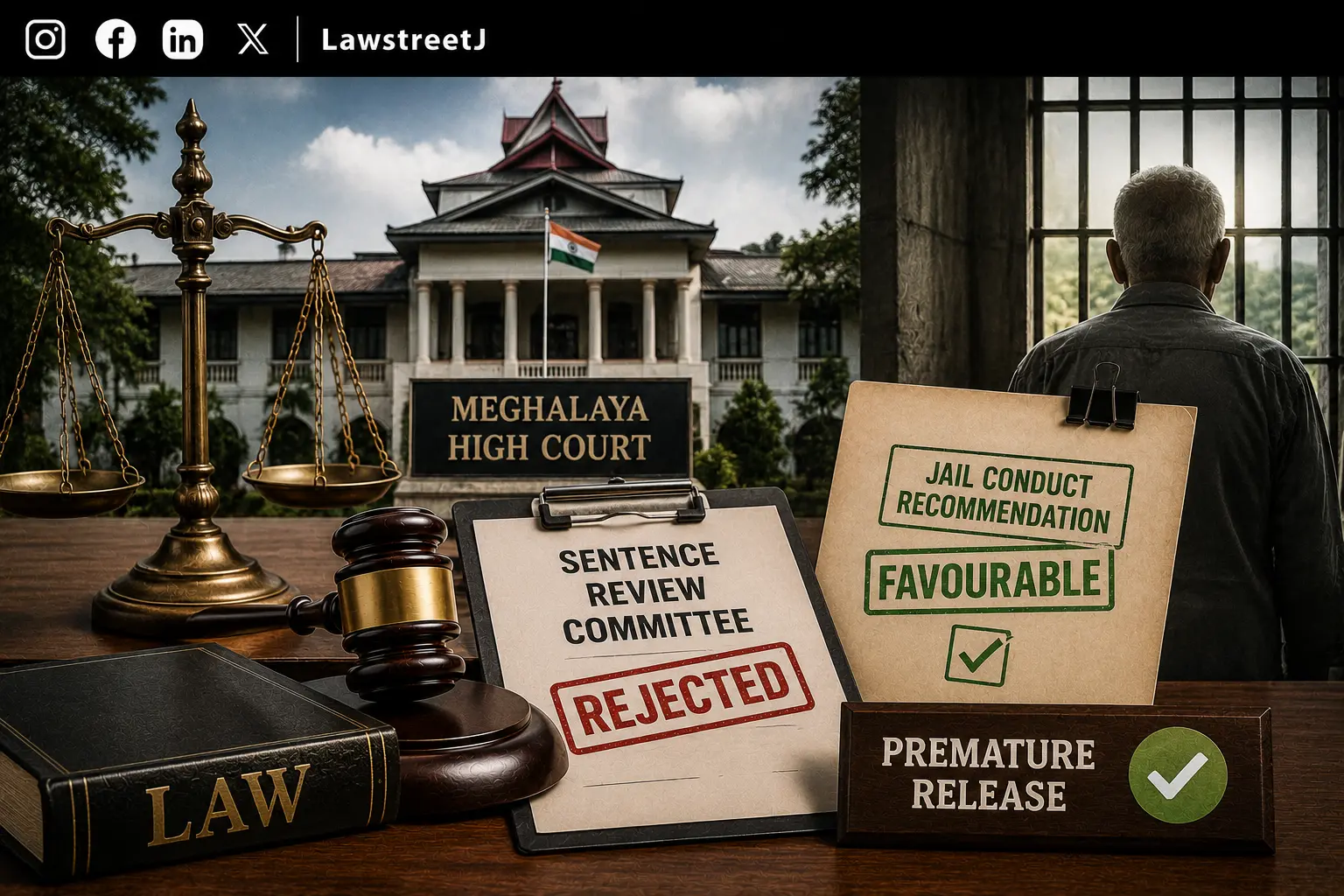
The Meghalaya High Court has quashed a Sentence Review Committee's rejection of a life convict's application for premature release, holding that age and physical fitness cannot be the sole grounds for denying remission, and that a favourable jail conduct recommendation cannot be ignored without reasons.
Court Sets Aside Rejection, Remits Matter For Reconsideration
Justice B. Bhattacharjee allowed a writ petition filed by Suraj Gupta, a life convict currently lodged at the District Prison and Correctional Home, Shillong, challenging the Sentence Review Committee's decision rejecting his application for remission of sentence. The Court set aside the impugned decision and remitted the matter back to the Committee for reconsideration within 30 days, in light of its observations and the relevant Supreme Court precedents and the State's Remission Policy.
Background: Convict Had Served Over 19 Years In Jail
The petitioner was convicted by the Adhoc Judge, Fast Track Court, West Garo Hills District, Tura, under Sections 302 and 364-A IPC and sentenced to life imprisonment, along with a separate conviction under Section 201 IPC carrying seven years' rigorous imprisonment. His conviction and sentence were upheld by the High Court in 2019. He had been in custody since 2006, initially at Tura and later transferred to Shillong, and had served 19 years, 7 months and 18 days in prison as on the date his remission application was considered.
Petitioner Argued Rejection Was Mechanical And Ignored Favourable Recommendation
Counsel for the petitioner submitted that the Sentence Review Committee had mechanically rejected the remission prayer solely on the ground that the petitioner was 40 years old, physically fit, and that his potential to commit further crime could not be ruled out, without any material basis for this apprehension. It was further argued that a favourable recommendation from the Superintendent of the District Prison and Correctional Home, Shillong, regarding the petitioner's conduct, had been ignored without any reason. Reliance was placed on Satish @ Sabbe v. State of Uttar Pradesh, Zahid Hussain v. State of West Bengal, and Laxman Naskar v. Union of India, to argue that any assessment of a convict's likelihood of reoffending must be based on antecedents and jail conduct rather than age alone.
State Defended Rejection, Cited Gravity Of Crime
The State's counsel countered that the rejection was not based solely on age, but also on the gruesome nature of the offence — the kidnapping and murder of a nine-year-old boy for ransom — which had shaken society. Reliance was placed on clauses 7 and 10 of the Remission Policy, 2026, and on the decisions in Ranjan v. Home Department of Tamil Nadu, Bilkis Yakub Rasool v. Union of India, and Mafabhai Motibhai Sagar v. State of Gujarat, to argue that remission was not a matter of right and that the Committee's decision suffered from no illegality.
Court Finds Committee's Reasoning Flawed
Examining the impugned decision, the Court found that the Committee's conclusion that the petitioner's "potential to commit further crime in future cannot be ruled out" was largely influenced by his age and physical fitness, with no other supporting reason, even though the Superintendent's recommendation regarding his good conduct, maturity and role in maintaining peace and harmony during incarceration had been favourable and was left unaddressed.
Relying on the Supreme Court's holdings in Zahid Hussain and Satish @ Sabbe, the Court reiterated that the conduct of a convict while in jail is an important factor in assessing whether the potential to reoffend persists, and that age alone, or the gravity of the original offence alone, cannot be the sole basis for refusing premature release. The Court held that while remission remains a matter of discretion for the competent authority and not a right, such discretion cannot be exercised arbitrarily, and antecedents and jail conduct must be given due weightage.
Committee Directed To Reconsider Within 30 Days
Finding that the Sentence Review Committee had failed to assign any reason for disregarding the Superintendent's favourable recommendation, the Court held the impugned decision unsustainable in law, set it aside, and directed the Committee to reconsider the petitioner's application for premature release within 30 days of receiving the judgment.
Case Title: Shri Suraj Gupta v. State of Meghalaya & Ors. Case No.: W.P. (Crl.) No. 5 of 2026 Citation: 2026:MLHC:735 Court: High Court of Meghalaya at Shillong Bench: Justice B. Bhattacharjee Judgment Date: July 16, 2026 Counsel for Petitioner: Ms. S. Nongsiej, Advocate Counsel for Respondents: Mr. N. D. Chullai, Additional Advocate General, with Ms. R. Colney, Advocate