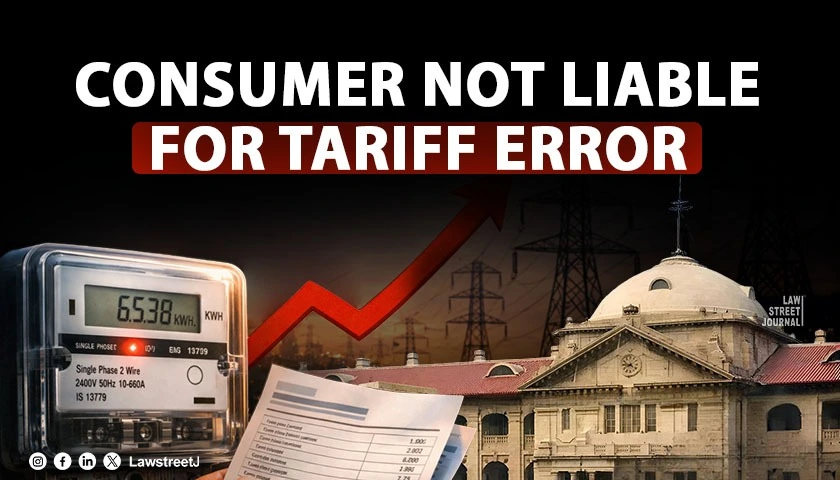
Prayagraj: The Allahabad High Court on May 6, 2026 allowed a writ petition filed by a commercial electricity consumer against whom the supply company had raised a retrospective demand of over Rs. 62 lakhs, nearly two years after the consumer had regularly paid consumption charges, on the ground that the company had made a billing error while applying the applicable tariff rate, in the matter of M/S Om Food Manufacturing Center v. State of U.P. and 2 Others, Writ-C No. 12303 of 2026. A division bench of Justices Arindam Sinha and Satya Veer Singh (per Arindam Sinha J.) held that while a supply company may raise a subsequent demand upon discovery of a bona fide billing mistake, it is barred from using disconnection as a coercive tool for recovery, and must instead resort to a civil remedy to recover the disputed amount.
The petitioner, M/S Om Food Manufacturing Center, held a commercial electricity connection. On an application for enhancement of load, the connection was upgraded to 140 KV on July 14, 2023. Following the enhancement, the petitioner regularly paid its electricity consumption bills. After a lapse of approximately two years, the supply company issued a notice on July 1, 2025, alleging that there had been a mistake in applying the applicable tariff rate for electricity charges, and raised a demand of Rs. 54,14,196.88. A subsequent notice dated October 24, 2025 revised the demand further upward to Rs. 62,03,152. The threat of disconnection was held out in the event of non-payment.
The petitioner challenged the demand before the Allahabad High Court, contending that the increase of load and installation of the meter were entirely within the supply company’s control, that there was no allegation of theft whatsoever, and that any mistake in billing was entirely of the supply company’s own making. The petitioner argued that being penalised by way of threatened disconnection for the company’s internal error was impermissible in law.
The central question before the Court was whether a licensee supply company, having raised incorrect bills over a sustained period due to its own mistake in applying the tariff rate, is entitled to subsequently raise a backdated additional demand, and further, whether it can enforce recovery of that demand by threatening to disconnect the electricity supply under Section 56 of the Electricity Act, 2003.
Legal Framework and Precedents Discussed
Section 56 of the Electricity Act, 2003:
The Court reproduced Section 56 in full. Sub-section (1) permits a licensee to cut off electricity supply after giving fifteen clear days’ written notice, where a consumer neglects to pay charges. Sub-section (2), however, bars recovery of any sum due from a consumer after the expiry of two years from the date on which the sum first became due, unless it has been continuously shown as recoverable as arrears. The Court noted that no other statutory provision was pointed out by the supply company to justify the retrospective demand beyond this section.
Assistant Engineer, Ajmer Vidyut Vitran Nigam Ltd. v. Rahamatullah Khan, (2020) 4 SCC 650:
The supply company’s counsel relied on this Supreme Court decision in support of the additional demand. The Court extracted the relevant paragraph, which holds that while Section 56(2) does not preclude a licensee from raising an additional or supplementary demand after the expiry of the two-year limitation period in cases of mistake or bona fide error, it equally does not empower the licensee to resort to the coercive measure of disconnection for recovery of such additional demand. The Court in Rahamatullah Khan further held, applying Section 17(1)(c) of the Limitation Act, 1963, that limitation in cases of mistake runs from the date of discovery of the mistake.
M/s Prem Cottex v. Uttar Haryana Bijli Vitran Nigam Ltd., (2021) 20 SCC 200:
The supply company’s counsel sought to distinguish Rahamatullah Khan by relying on a subsequent Supreme Court decision in Prem Cottex. The Court examined paragraph 18 of Prem Cottex, which noted that the Court in Rahamatullah Khan had prevented disconnection while giving the licensee liberty to take any other remedy available in law. The Allahabad High Court rejected the attempt to use Prem Cottex to dilute Rahamatullah Khan, holding that Rahamatullah Khan was not overruled in Prem Cottex; on the contrary, distinguishing it on facts only further strengthened its status as binding precedent on the law declared.
The Court held that the demand notices issued by the supply company suffered from serious infirmities. The initial notice of July 1, 2025 spoke only of a mistake being detected, without any statement that it was a bona fide error, thereby presenting the petitioner with an allegation of discovery without any opportunity to test its correctness. The Court further found that the bill contained various items of charge and entries, including for rebate, without particulars, rendering the demand opaque and incapable of verification.
The Court also held that once a demand is made upon discovery of a mistake, the supply company cannot progressively revise it upward. The fact that the demand had been increased from Rs. 54,14,196.88 to Rs. 62,03,152 between the two notices was found to be impermissible. There cannot be an upward revision in the demand after it is initially made.
On the central legal question, the Court affirmed the position in Rahamatullah Khan and held that since the supply company could not resort to coercive recovery measures, it must seek recovery through civil proceedings on the principal sum and may claim interest on that sum in such proceedings. The Court accordingly directed the supply company to present a proper accounting of the discovered mistake with correct calculation and applicable rebate for payment within the prescribed time, and held that in the event of non-payment, the supply company’s only recourse is civil proceedings, not disconnection.
The writ petition was allowed and disposed of. The Court directed the supply company to furnish a proper and particularised calculation of the demand with applicable rebate for payment within the prescribed period, and held that any recovery must thereafter be pursued through civil remedy alone. The threat of disconnection for enforcement of the disputed demand was found to be impermissible in law.
Case Details:
M/S Om Food Manufacturing Center v. State of U.P. and 2 Others, Writ-C No. 12303 of 2026, High Court of Judicature at Allahabad. Before Justices Arindam Sinha and Satya Veer Singh. Decided on May 6, 2026. Advocate Kumar Ankit Srivastava appeared for the petitioner; Advocate Piyush Shukla (Standing Counsel) appeared for the State; Advocate Udit Chandra appeared for respondent Nos. 2 and 3 (the supply company).

!["No Loudspeakers For Azan, No Fundamental Right To Create Noise," Says Allahabad HC To Two Mosques [Read Judgment]](/secure/uploads/2020/01/lj_4995_Allahabad_HC_AZAN.jpg)