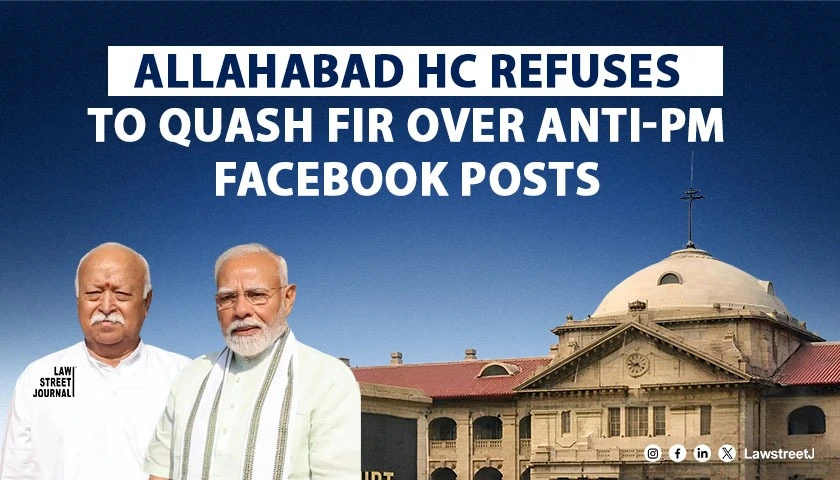
Prayagraj: The Allahabad High Court has dismissed an application seeking to quash criminal proceedings against two persons accused of posting anti-national content and objectionable remarks against the Prime Minister on Facebook, holding that the allegations are corroborated by material collected during the investigation and that no case for interference under Section 528 of the Bharatiya Nagarik Suraksha Sanhita is made out.
Justice Saurabh Srivastava, dismissing the application on 29.04.2026, held that the inherent powers under Section 528 BNSS are to be exercised sparingly and with caution, and that the assertions of false implication raised by the applicants are factual issues requiring proper adjudication by the trial court based on evidence.
The applicants, Jubair Ansari and another, sought to quash the entire proceedings in Criminal Case No. 12299 of 2025 arising out of Case Crime No. 78 of 2025 registered at Police Station Anapara, District Sonbhadra, under Sections 353(2), 196(1)(a), 3(5), 352 and 351(2) of the Bharatiya Nyaya Sanhita. They also sought to quash the charge sheet dated 13.05.2025 and the cognizance and summoning order dated 15.11.2025 passed by the Additional Civil Judge (J.D.) Court No. 3, Sonbhadra.
The FIR alleged that the applicants and a co-accused had posted anti-national content and objectionable posts against the Prime Minister of India with derogatory remarks, which were alleged to have been shared or circulated from the Facebook ID of a Pakistani YouTuber. The FIR further alleged that the Facebook accounts of the accused persons contained posts that were anti-national and directed against the Prime Minister and the Rashtriya Swayamsevak Sangh. Following a detailed investigation, a charge sheet was submitted on 13.05.2025, upon which cognizance was taken by the learned Chief Judicial Magistrate, Sonbhadra, through the impugned order dated 15.11.2025.
Sri Deepak Kumar Singh, learned counsel for the applicants, contended that the FIR did not mention any specific date and time of the alleged incident and that it was lodged with mala fide intention and ulterior motive. He argued that the allegations in the FIR were vague and without substantial evidence, and that the Magistrate had passed the summoning order in a mechanical manner without application of judicial mind, making the entire proceedings liable to be quashed. He further contended that the allegations were based solely on a Facebook post.
The learned Additional Government Advocate for the State opposed the application, submitting that the arguments raised by the applicants were matters of trial involving appreciation of evidence and could not be adjudicated at this stage, and that no interference was required.
The Court observed that social media has become a platform where people freely express their views and opinions, but that the line is sometimes crossed when content is posted without understanding the consequences. It noted that while social media serves as a useful medium for the exchange of views, it is also susceptible to misuse where comments hurt the sentiments of others and trigger disharmony on a large scale.
The Court referred to the Supreme Court’s judgment in Shreya Singhal v. Union of India, wherein Section 66A of the Information Technology Act, 2000 was declared unconstitutional on the ground that it was vague, overbroad, and violated Articles 14, 19(1)(a) and 21 of the Constitution, having been widely misused to arrest persons for posting critical comments about social, political issues, and political leaders on social networking sites. The Court noted that the Supreme Court had, however, upheld the validity of Section 69B of the Act and the 2011 guidelines permitting the government to block websites whose content had the potential to create communal disturbance, social disorder, or affect India’s relationship with other countries.
On the applicability of Section 196(1)(a) of the BNS, the Court held that the provision is attracted when content deliberately promotes enmity, hatred, or ill-will between different groups based on religion, race, place of birth, residence, language, caste, or community. It noted that the key aspects attracting the provision include deliberate intent to create disharmony, targeting a specific group rather than merely criticising a policy or the government, and content likely to provoke breach of peace. It further noted that the test applied by courts is whether a reasonable, strong-minded, firm, and courageous person would be swayed by the post to commit disorder.
The Court found that the conduct of the applicants in posting the content amounted to a deliberate and malicious attempt to promote disharmony and outrage sentiments. It observed that the allegations levelled against the applicants were corroborated by evidence collected during the investigation, which was sufficient prima facie to satisfy the concerned court to take cognizance of the offence.
On the standard applicable at the stage of summoning, the Court placed reliance on the Supreme Court’s decisions in S.W. Palanitkar and Others v. State of Bihar and Another (2002) 1 SCC 241 and Nupur Talwar v. Central Bureau of Investigation and Another (2012) 11 SCC 465, holding that the test at the stage of issuing process is whether there is sufficient ground for proceeding and not whether there is sufficient ground for conviction, and that the material before the Magistrate need only be sufficient for proceeding against the accused and not sufficient to prove and establish guilt.
The Court held that it could not be said at this stage that no offence is made out against the applicants, that the inherent powers under Section 528 BNSS are to be exercised sparingly and with caution primarily to prevent abuse of process or to secure the ends of justice, and that no sufficient grounds had been made out to invoke the extraordinary jurisdiction of the Court. Finding no infirmity in the summoning order dated 15.11.2025, the Court dismissed the application.
Case Details
- Case Title: Jubair Ansari and Another v. State of U.P. and Another
- Case Number: Application U/S 528 BNSS No. 12863 of 2026 (2026:AHC:99795)
- Court: High Court of Judicature at Allahabad, Court No. 77
- Judge: Hon’ble Justice Saurabh Srivastava
- Date of Order: 29.04.2026
Appearances:
- For the Applicants: Sri Deepak Kumar Singh, Sri Shishir Kumar Singh, Sri Vinanjay Kumar Patel, Advocates
- For the State: Learned Additional Government Advocate

!["No Loudspeakers For Azan, No Fundamental Right To Create Noise," Says Allahabad HC To Two Mosques [Read Judgment]](/secure/uploads/2020/01/lj_4995_Allahabad_HC_AZAN.jpg)