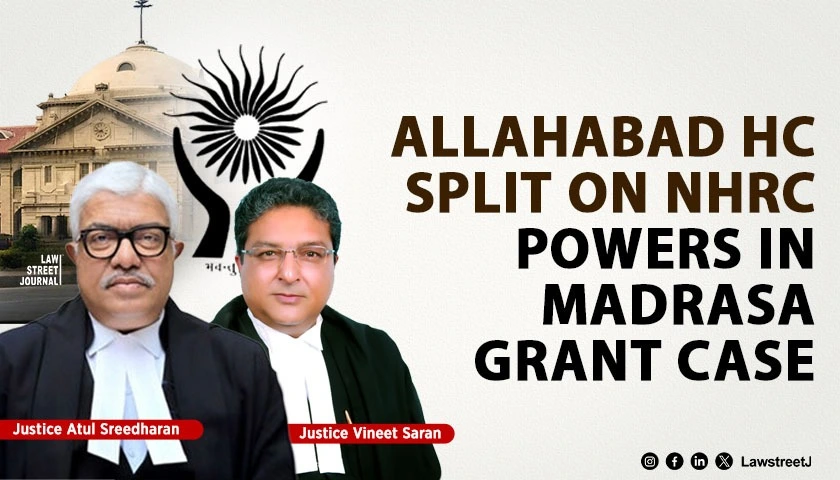
Prayagraj: A Division Bench of the Allahabad High Court, on April 27, 2026, delivered a split verdict in a writ petition challenging orders passed by the National Human Rights Commission (NHRC) in a matter relating to alleged irregularities in government grants to madrasas in Uttar Pradesh, with the two judges differing on the observations made regarding the NHRC’s jurisdiction and conduct.
While Justice Atul Sreedharan questioned whether the NHRC had the jurisdiction to entertain the complaint and made observations on the Commission’s selective exercise of suo motu cognizance, Justice Vivek Saran differed, holding that adverse observations ought not to have been made in the absence of the parties.
The Bench comprised Justice Atul Sreedharan and Justice Vivek Saran. The writ petition, Writ-C No. 32051 of 2025, was filed by Teachers Association Madaris Arabia and two others against the National Human Rights Commission and eight others.
Both judges were in agreement on granting the adjournment sought by the petitioner’s counsel. However, Justice Sreedharan’s order contained observations on the merits of the NHRC’s jurisdiction and conduct, with which Justice Saran expressly differed.
The matter arises from a complaint filed before the NHRC alleging that 588 madrasas in Uttar Pradesh are operating in collusion with officers of the Minority Welfare Department of the Government of Uttar Pradesh. The complainant alleged that these madrasas receive government grants while not meeting prescribed standards, employ illiterate teachers, and lack basic educational infrastructure, including buildings, furniture, and hostels. It was further alleged that unqualified teachers were recruited through bribes and commissions paid to state authorities.
The NHRC, by order dated February 28, 2025, transmitted the complaint to the Director General, Economic Offences Wing, Government of Uttar Pradesh, directing him to look into the allegations and submit an action taken report within four weeks. A copy of the complaint was also forwarded with directions to take appropriate action.
Justice Sreedharan’s Order:
On the date of hearing, counsel for the petitioner sought an adjournment on the ground that the arguing counsel was not available. This was opposed by the State, which submitted that the matter involved crores of rupees and that the NHRC had already been directed to inquire and submit a report.
Justice Sreedharan, upon examining the NHRC’s order dated February 28, 2025, expressed prima facie astonishment at the directions issued by the Commission.
He noted that the powers of the NHRC arise from the Protection of Human Rights Act, 1993, under which Section 2(1)(d) defines human rights as “the rights relating to life, liberty, equality, and dignity of the individual guaranteed by the Constitution or embodied in international covenants, and enforceable by courts in India.”
Justice Sreedharan held that the NHRC and State Human Rights Commissions are empowered to take cognizance only of human rights violations as defined under the Act, and that these commissions are not tribunals under the law that can try cases. He observed that while a Human Rights Commission may itself become a complainant before a court of competent jurisdiction or have an FIR registered where a victim is unable to do so, the Court had a prima facie doubt as to whether the Commission could direct officers of the executive to act in a particular manner in cases where human rights are not involved.
He further observed that the matter was of a kind that ought to have been agitated before the High Court under Article 226 by way of a PIL, and that Human Rights Commissions appeared to be dabbling in matters that prima facie did not concern them.
He noted that the Court was not aware of the NHRC taking suo motu cognizance in situations where vigilantes take the law into their own hands and harass ordinary citizens, or where individuals are targeted on account of their relationships with persons of different communities, or where even having a cup of coffee in a public place with a person of another religion becomes a fearful act. He further observed that members of the Muslim community are, at times, attacked and even lynched, and that no instance had been placed before the Court of either the State or National Human Rights Commission taking suo motu cognizance in such cases.
Notwithstanding these observations, Justice Sreedharan granted the adjournment, rejected the State’s objection, issued notice to the NHRC directing it to appear through counsel and file a response, directed steps to be taken within three days, and connected the matter with Writ-C No. 15360 of 2026. The cases were listed for May 11, 2026, on which date the Court stated it would consider and pass final orders after hearing all parties. The interim order granted earlier was directed to continue until the next date.
Justice Saran’s Dissent:
Justice Vivek Saran, in a separate order on the same date, recorded that Justice Sreedharan’s order was dictated at the stage of a mentioning for adjournment, when the petitioner was not arguing the case and the NHRC had no representation before the Court. The only party opposing the adjournment was the State.
Justice Saran held that if any order touching upon the merits of the case or the role of the NHRC was to be passed, all concerned parties ought to have been heard first. While acknowledging that a writ court may pass orders even in the absence of a party, he observed that, given the definite observations made in paragraphs 6 and 7 of Justice Sreedharan’s order, it would have been appropriate for all parties to be properly represented. He held that, in the absence of the parties, no adverse observations were warranted.
Justice Saran expressly stated that he does not agree with the observations made in paragraphs 6 and 7 of Justice Sreedharan’s order and recorded his dissent on that aspect, while agreeing with the grant of adjournment.
Operative Directions:
Both judges agreed on the following directions:
- The adjournment sought by the petitioner’s counsel was granted
- The matter is connected with Writ-C No. 15360 of 2026
- The case is listed for May 11, 2026
- The interim order granted earlier shall continue until the next date
Case Details:
- Court: High Court of Judicature at Allahabad, Court No. 2
- Case: Writ-C No. 32051 of 2025; connected with Writ-C No. 15360 of 2026
- Case Title: Teachers Association Madaris Arabia and 2 Others v. National Human Rights Commission and 8 Others
- Bench: Justice Atul Sreedharan and Justice Vivek Saran
- Date of Order: April 27, 2026
- Next Date: May 11, 2026
- Counsel for Petitioners: Hritudhwaj Pratap Sahi, Mohammad Ali Ausaf, Prashant Shukla (Senior Advocate)
- Counsel for Respondents: C.S.C., Pranav Mishra

!["No Loudspeakers For Azan, No Fundamental Right To Create Noise," Says Allahabad HC To Two Mosques [Read Judgment]](/secure/uploads/2020/01/lj_4995_Allahabad_HC_AZAN.jpg)