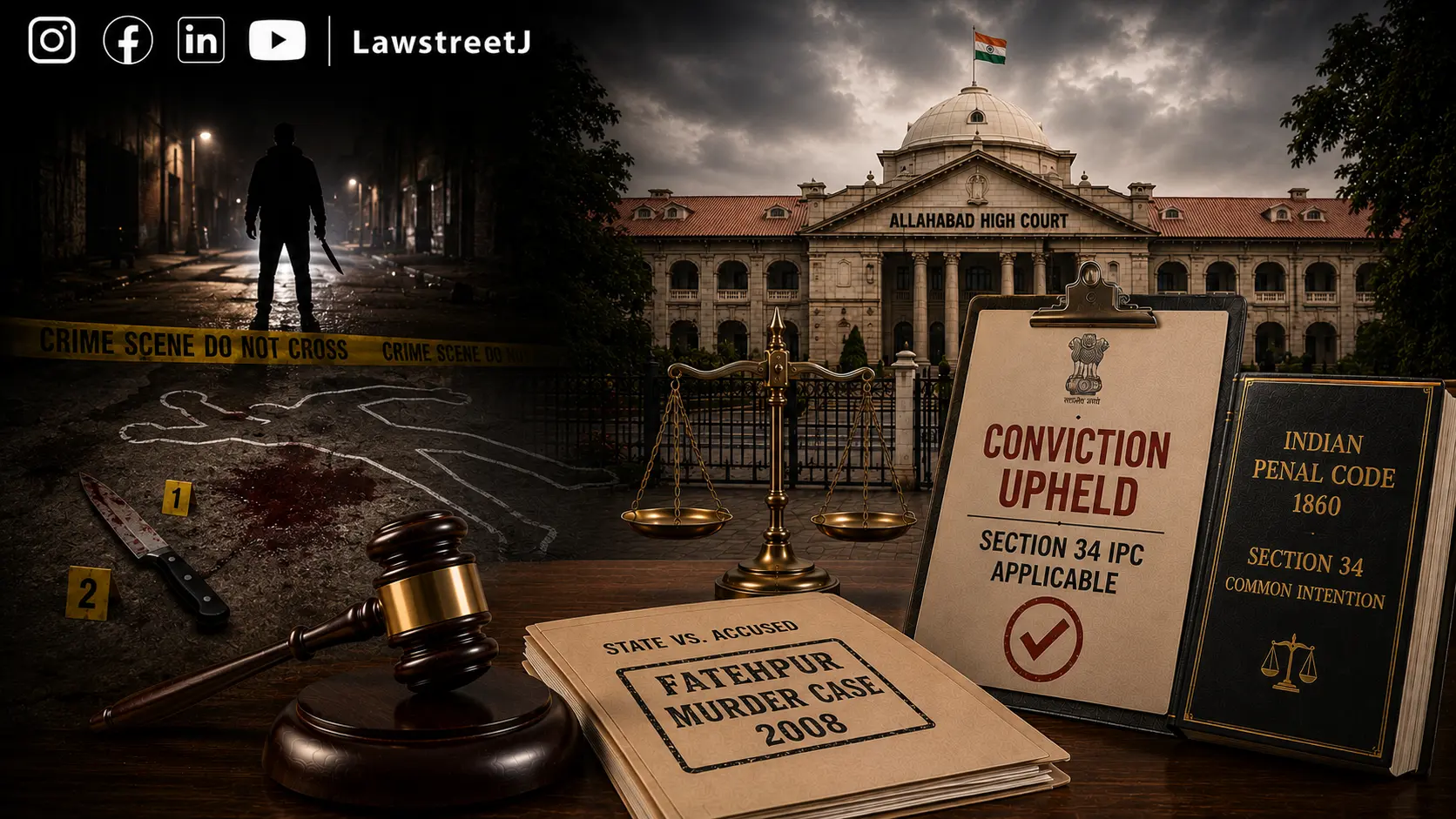
Allahabad: The High Court of Judicature at Allahabad has dismissed a criminal appeal filed by four convicts challenging their life sentence for the 2008 murder of Bhura Singh in Fatehpur district, holding that the depositions of two eyewitnesses, both close relatives of the deceased, were consistent, credible and fully corroborated by the site plan and medical evidence. The Court did, however, correct what it termed a minor irregularity in the trial court's order by formally invoking Section 34 IPC alongside Section 302 IPC, since the trial court's own findings had established common intention without reflecting it in the operative sentence.
Background
The appeal arose out of a judgment dated July 3, 2013, passed by the Additional District and Sessions Judge, Court No. 3, Fatehpur, in Sessions Trial No. 38 of 2009, convicting Dinesh Chandra Shukla, Akhilesh Chandra Shukla, Anil Kumar Shukla and Sunil Kumar Shukla under Section 302 IPC and sentencing each to life imprisonment along with a fine of Rs 10,000.
According to the prosecution's case, the deceased Bhura Singh had obtained a registered sale deed for a fallen-down house from one Awadhram on October 7, 2008, a property the appellants allegedly wished to acquire by misleading Awadhram's widowed daughter-in-law, Rupa Devi, who worked in their household. On October 11, 2008, when Bhura Singh, along with his son Rajendra Singh and elder brother Jhaller Singh, approached one Ram Swaroop Singh to negotiate a compromise over the property, the four appellants arrived armed with a single barrel gun, two double barrel guns and a rifle, allegedly exhorted the group to be killed, and opened indiscriminate fire from the roof of Ram Swaroop's house. Bhura Singh sustained firearm injuries and died shortly after being taken to Vijaipur Hospital.
The Appellants' Arguments
Senior counsel for the appellants argued that the deceased had a criminal history and was more likely murdered by someone else, that the two eyewitnesses were not actually present at the scene, and that the FIR was ante-timed and ante-dated since it reached the jurisdictional Magistrate only on October 15, 2008. It was further submitted that the Forensic Science Laboratory report did not match the recovered cartridges with the recovered double barrel guns, that the direction of the deceased's injuries was inconsistent with the prosecution's account of him being shot while fleeing, and that the trial court had convicted the appellants under Section 302 IPC alone, without invoking Section 34 IPC despite assigning no specific role to any individual appellant.
The Court's Analysis
On the reliability of the eyewitnesses: Justice Dr Ajay Kumar-II, writing for the Bench that also comprised Justice Salil Kumar Rai, extensively examined the depositions of Rajendra Singh (PW-1) and Jhaller Singh (PW-2), applying the principles on appreciation of ocular evidence laid down by the Supreme Court in Balu Sudam Khalde v. State of Maharashtra, (2023) 13 SCC 365, which held that minor discrepancies not touching the core of a case, or trivial inconsistencies natural to human recollection, cannot ordinarily justify rejecting a witness's testimony. The Bench also relied on Bhagwan Jagannath Markad v. State of Maharashtra, (2016) 10 SCC 537, for the proposition that a witness's evidence may be partly accepted and partly rejected, and that mechanical rejection of interested or related witnesses can result in a failure of justice. Finding that both witnesses' accounts of the place and manner of the incident corresponded precisely with the site plan, the Court held that this witness was present on the spot at the time of incident and had seen the incident, and reached the same conclusion regarding PW-2.
On the alleged inconsistency with medical evidence: The Court rejected the argument that gunshot injuries on the front of the deceased's body were incompatible with the prosecution's case that he was shot while fleeing, holding that he had likely turned to check whether he remained within firing range, a possibility the Bench found consistent with ordinary human instinct and supported by the Supreme Court's reasoning in State of Bihar v. Ram Padarath Singh, (1998) 6 SCC 240, where the Court held that it was natural for a person fleeing an assault to instinctively look back, and that such a movement does not create an inconsistency with medical evidence of frontal injuries.
On the alleged ante-timing of the FIR: Relying on Rama Devi v. State of Bihar, (2024) 10 SCC 462, Mehraj Singh v. State of U.P., (1994) 5 SCC 188, and Jafel Biswas v. State of W.B., (2019) 12 SCC 560, the Bench reiterated that mere delay in an FIR reaching the jurisdictional Magistrate is not fatal to the prosecution unless the accused demonstrates actual prejudice. Noting that the FIR was registered within ninety minutes of the incident and that the family's priority in first taking the injured victim to hospital was natural and did not indicate manipulation, the Court held that the FIR had been promptly lodged and was neither ante-timed nor ante-dated.
On the ballistic report: The Bench held that a mismatch between recovered cartridges and recovered firearms does not automatically entitle an accused to the benefit of doubt, citing Vineet Kumar Chauhan v. State of U.P., (2007) 14 SCC 660, and Rakesh and Another v. State of U.P., (2021) 7 SCC 188, both of which held that recovery of the actual murder weapon is not a sine qua non for conviction where direct eyewitness evidence is otherwise credible. The Court reasoned that the appellants' licensed weapons were likely not the actual weapons used, a possibility that did not undermine the consistent ocular testimony establishing that firearms were indeed used in the assault.
On the omission of Section 34 IPC: Perhaps the most significant correction in the judgment concerned the trial court's failure to formally cite Section 34 IPC in its operative order, despite the FIR, chargesheet, framed charges and the trial court's own reasoning all proceeding on the basis of common intention. Drawing on the Supreme Court's detailed exposition of Section 34 in Suresh and Another v. State of U.P., (2001) 3 SCC 673, and its subsequent application in Ram Naresh v. State of U.P., (2024) 1 SCC 443, and Gurpreet Singh v. State of Punjab, (2005) 12 SCC 615, the Bench held that common intention need not be proved through direct evidence and may be inferred from the conduct of the accused before, during and after the offence. Finding that the appellants had arrived together, armed, surrounded the victim's family, fired in concert from the same rooftop, and fled together, the Court held that their shared common intention to murder was firmly established and accordingly modified the conviction from Section 302 IPC simpliciter to Section 302 read with Section 34 IPC.
Outcome
The High Court affirmed the conviction and life sentence, dismissed the appeal, and directed that the appellants, who were on bail during the pendency of the appeal, have their bail bonds and sureties cancelled with immediate effect, ordering them to surrender to custody to serve the remainder of their sentence.
Case Details
Case: Dinesh Chandra Shukla and 3 Others v. State of U.P.
Court: High Court of Judicature at Allahabad
Bench: Justice Salil Kumar Rai and Justice Dr Ajay Kumar-II
Case No.: Criminal Appeal No. 3107 of 2013
Statutes Invoked: Sections 302/34 IPC
Counsel: Mangla Prasad Rai (Senior Counsel), assisted by Pawan Kumar Pandey, for the Appellants; Vikas Goswami, Additional Government Advocate, for the State; Kamal Krishna (Senior Counsel), assisted by Vivek Kumar Singh, for the Informant
Date of Judgment: July 17, 2026
Outcome: Appeal dismissed; conviction affirmed and altered from Section 302 IPC to Section 302 read with Section 34 IPC; bail bonds cancelled, appellants directed to surrender to custody

!["No Loudspeakers For Azan, No Fundamental Right To Create Noise," Says Allahabad HC To Two Mosques [Read Judgment]](/secure/uploads/2020/01/lj_4995_Allahabad_HC_AZAN.jpg)