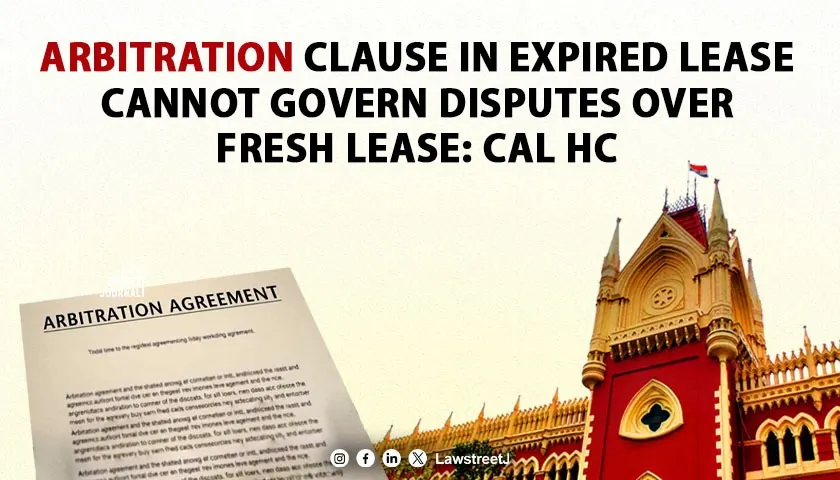
Kolkata: The Calcutta High Court has delivered a significant judgment holding that an arbitration agreement contained in an expired lease deed cannot be automatically extended to govern disputes relating to the execution of a fresh lease, even where the proposed lease is claimed to arise from correspondence exchanged between the parties.
Justice Aniruddha Roy dismissed an application under Section 8 of the Arbitration and Conciliation Act, 1996, filed by HDFC Bank Limited, seeking to refer the dispute to arbitration based on an arbitration clause contained in an expired parent lease deed dated September 24, 2014.
The factual background revealed that the premises were originally owned by Williamson Magor, which executed the parent lease in favour of The New India Assurance Company Limited for a period of nine years. The property was subsequently transferred to HDFC Limited, which merged with the defendant bank in March 2023, making it the successor-in-interest.
The parent lease admittedly expired on March 31, 2023. However, the plaintiff contended that the defendant continued to allow occupancy and accepted rent payments. The defendant thereafter served an eviction notice dated September 5, 2023, citing requirements under the Banking Regulation Act.
The plaintiff’s case was that, prior to the expiry of the parent lease, correspondence dated May 12, 2022, May 19, 2022, and May 26, 2022 was exchanged, pursuant to which the parties arrived at a concluded contract for renewal of the lease. Based on this, the plaintiff sought specific performance of the contract for execution of a fresh lease for ten years with effect from April 1, 2023.
Mr. Sayantan Bose, counsel for the defendant, argued that the parent lease contained Clause 6, which provided that upon expiry, “both parties may enter into a fresh lease on such terms as may be mutually agreed,” to be executed at least two months prior to March 31, 2023, failing which “the lessee shall vacate the demised premises.”
More significantly, he relied on Clause 7, the arbitration clause, which had two limbs. The first addressed disputes “touching the construction, meaning or effect” of the lease or the parties’ rights and duties. The second limb covered disputes arising “otherwise howsoever in relation to the demised premises,” which counsel submitted had a “very wide meaning.”
Mr. Bose contended, “Whether the renewal or execution of any further lease will happen or not, if any dispute arises out of the same between the parties—whether a concluded contract had been arrived at or not, as allegedly contended by the plaintiff—the same shall also be referred to arbitration.”
Mr. Sabyasachi Choudhury, Senior Advocate for the plaintiff, countered that the three correspondences created a concluded contract independent of the parent lease. He submitted, “The plaintiff claims specific performance of the said concluded contract by executing and registering a renewal deed of lease in relation to the said premises.”
Senior Counsel emphasised that on March 31, 2023, the parent lease expired, but based on the correspondence, “the plaintiff has been allowed to remain in uninterrupted and continuous possession of the premises and the defendant has been accepting rent.” He argued, “Therefore, the plaintiff claims execution of a fresh lease de hors the parent lease on the basis of the said correspondences.”
Crucially, Mr. Choudhury submitted that “when the parties agree to execute a subsequent contract on similar terms and conditions as an earlier contract, only the commercial terms are accepted and not the arbitration agreement, unless the arbitration agreement is specifically accepted and incorporated,” relying on M.R. Engineers and Contractors Private Limited v. Som Datt Builders Limited.
The court first reiterated the law governing Section 8 applications, noting that when an action is brought in a matter which is the subject of an arbitration agreement, it is mandatory for the court to refer it to arbitration if a party so applies.
However, while examining whether the subject matter was covered by the arbitration agreement, the court observed:
“On a meaningful and plain reading of the plaint in the instant case, it appears to this Court that the parent lease had expired on March 31, 2023, and much prior thereto, the three correspondences referred to by the plaintiff were exchanged between the parties.”
The court noted that the plaintiff’s claim was “for execution and registration of a lease in relation to the premises for a period of ten years with effect from April 1, 2023.”
In a critical observation distinguishing renewal from a fresh lease, the court stated:
“As the lease has admittedly expired on March 31, 2023 and since the lease was not renewed before its expiry, subsequently there was no scope for renewal of the lease. The parties would have to enter into a fresh lease, if they were willing to do so. The moment the parent lease stands expired, the question of renewal does not arise.”
The court rejected the defendant’s characterisation, observing:
“The submission made on behalf of the defendant that the plaintiff claims renewal of the lease is, therefore, without any substance and basis in law.”
Analysing the prayers, the court found:
“Prayer (a) to the plaint shows that the plaintiff claims a decree for specific performance of the contract for execution of a lease in relation to the said premises with effect from April 1, 2023 on the basis of the said three correspondences, which clearly shows that the plaintiff claims execution of a lease.”
In its key holding, the court stated:
“Once the lease stands ceased and expired, considering the prayers made in the plaint, this Court is of the firm and considered view that the reliefs claimed by the plaintiff cannot be construed as claiming any right under the said parent lease, far less falling within the expression ‘otherwise howsoever in relation to the demised premises’ as embodied under Clause 7, being the arbitration agreement.”
The court emphasised the limited scope of inquiry at the Section 8 stage, noting:
“At this stage, while adjudicating a Section 8 application, this Court is not required to consider the merits of the case or the counter-case of the parties in light of the averments made in the plaint. This Court shall also not consider the probable defence of the defendant at the Section 8 stage.”
Concluding its analysis, the court held:
“Since the plaintiff has claimed specific performance by way of execution of a lease agreement for a period of ten years with effect from April 1, 2023 on the basis of the said three correspondences already referred to above, this Court is of the considered and firm view that such claim of the plaintiff is not in connection with the said expired lease which contains the arbitration clause.”
The final determination was categorical:
“Therefore, the subject matter of the suit is not covered by the arbitration agreement between the parties.”
Accordingly, the application was dismissed without any order as to costs.
Case Title: The New India Assurance Company Limited v. HDFC Bank Limited




![Calcutta High Court conducts late-evening hearing, orders release of lawyer arrested inside court [Read Order]](/secure/uploads/2023/12/lj_4146_Court_lawyers_arrest.jpg)
![Indian Courts this Week: Law Street Journal's Weekly Round-Up of SC & HCs [Jan 1 - Jan 6]](/secure/uploads/2024/01/lj_9050_WhatsApp_Image_2024-01-06_at_12.07.10_PM.jpeg)